
Last Updated: October 26, 2026
Quick Summary
Commercial fleet towing services provide heavy-duty towing, on-site roadside repairs, vehicle recovery, and flatbed transport to keep your fleet operational and minimize costly downtime. These services reduce the full cost of breakdowns, lost revenue, idle labor, recovery fees, and customer impact, making a comprehensive plan more cost-effective than paying per incident.
- A single two-hour breakdown can cost $575 to $1,325 when accounting for lost revenue, idle labor, and recovery expenses.
- On-site repairs like tire changes and battery service typically resolve in 15 to 45 minutes for $150, while towing to a facility costs $400 to $600 and takes multiple hours.
- 24/7 emergency support with live dispatch and defined response-time targets, such as 30 minutes in urban areas or 60 minutes in rural areas, prevents delays that compound downtime costs.
- Heavy-duty towing requires certified operators and properly rated flatbeds: 19 ft. for medium trucks and 21 ft. for full-size tractors and box trucks.
- Service-level agreements should specify response times by zone, completion-rate commitments, and monthly reporting so you can verify performance instead of relying on sales claims.
Table of Contents
- What Commercial Fleet Towing Services Include
- How Commercial Fleet Roadside Assistance Reduces Operational Disruption
- Fleet Breakdown Assistance and 24/7 Emergency Support
- Heavy-Duty Truck Towing for Medium and Large Fleets
- Managing Downtime: On-Site Repairs vs. Towing to a Facility
- Towing for Abandoned Commercial Vehicles and Private Property
- Securing Fleet Towing Coverage for Your Operation
- Frequently Asked Questions
What Commercial Fleet Towing Services Include
Commercial fleet towing goes far beyond pickup and drop-off. When a truck breaks down or needs accident recovery, your provider determines whether the operation stays on schedule or spirals into costly downtime.
Not all towing providers handle all situations equally.
The difference between adequate and comprehensive coverage shows up in the details: can the provider handle your specific vehicle types, do they have specialty recovery experience, and will they document the incident for insurance and compliance?
How Commercial Fleet Roadside Assistance Reduces Operational Disruption
The real cost of a fleet breakdown isn’t just the towing bill. It’s the missed delivery, the idle driver, the rescheduled customer, the lost revenue, and the reputation damage, and that math is what justifies a fleet plan.
Build a simple downtime cost model
You don’t need a consultant to estimate what an hour off the road costs. Build the number from four inputs you already track:
- Lost or delayed revenue per vehicle-hour. Take the average revenue a route generates per day and divide by the hours that vehicle is scheduled to run. A route producing $1,800 in revenue over a 10-hour day is worth about $180 per vehicle-hour.
- Idle labor. A driver waiting on the shoulder is still on the clock. At a fully loaded cost of $32 per hour, a two-hour breakdown is $64 in labor before anyone touches the truck.
- Recovery and secondary costs. Towing, mobile repair, a rental or substitute vehicle, and rescheduling fees. A short on-site fix might run $150 to $300; a tow plus a day in the shop can easily land in the $400 to $900 range depending on distance and facility.
Put together, a single two-hour incident on a $180-per-hour route looks like roughly $360 in lost revenue, $64 in idle labor, and $150 to $900 in recovery and repair, a $575 to $1,325 event that repeats every time a vehicle goes down.
Compare that to what the plan costs
A per-vehicle roadside or towing membership is typically a flat annual or monthly fee per unit, with heavy-duty towing billed by the mile or hook beyond a covered allowance. The comparison isn’t plan price versus tow price, it’s plan cost versus the fully loaded incident cost above. If a membership costs a few hundred dollars a year per vehicle and prevents even one multi-hour breakdown from cascading, the math usually favors coverage.
Where roadside assistance actually cuts the cost
The savings come from three mechanisms:
- Faster response shrinks the revenue and labor loss. A provider that commits to a defined response window in your operating territory cuts the vehicle-hour and idle-labor portion of the incident. Every hour saved is revenue and payroll recovered.
- On-site repair avoids the tow and the shop day. Many breakdowns resolve with a tire change, fuel delivery, battery service, or a minor fix. When the provider can complete that at the roadside, you skip the tow charge and the facility time entirely.
- Documentation prevents repeat costs. Time, location, cause, resolution, and any safety hazards should be captured on every incident. That record supports insurance claims and compliance files, and it surfaces patterns, such as one unit that keeps breaking down, so maintenance spend goes where it actually reduces future incidents.
Don’t evaluate a fleet towing plan on the towing invoice alone. Model the fully loaded cost of a breakdown (lost revenue + idle labor + recovery + customer impact), multiply by your realistic incident frequency, and compare that annual figure to the plan cost. That comparison, not the headline rate, is the business case.
The benefit compounds across a fleet. At one breakdown per month, that’s 12 potential disruptions a year. With reliable roadside assistance, most resolve without towing, and the few requiring transport happen with minimal delay.
Fleet Breakdown Assistance and 24/7 Emergency Support
A breakdown doesn’t wait for business hours. Tire blowouts happen at midnight and mechanical failures on holiday weekends. Your breakdown assistance must match your fleet’s operating reality.
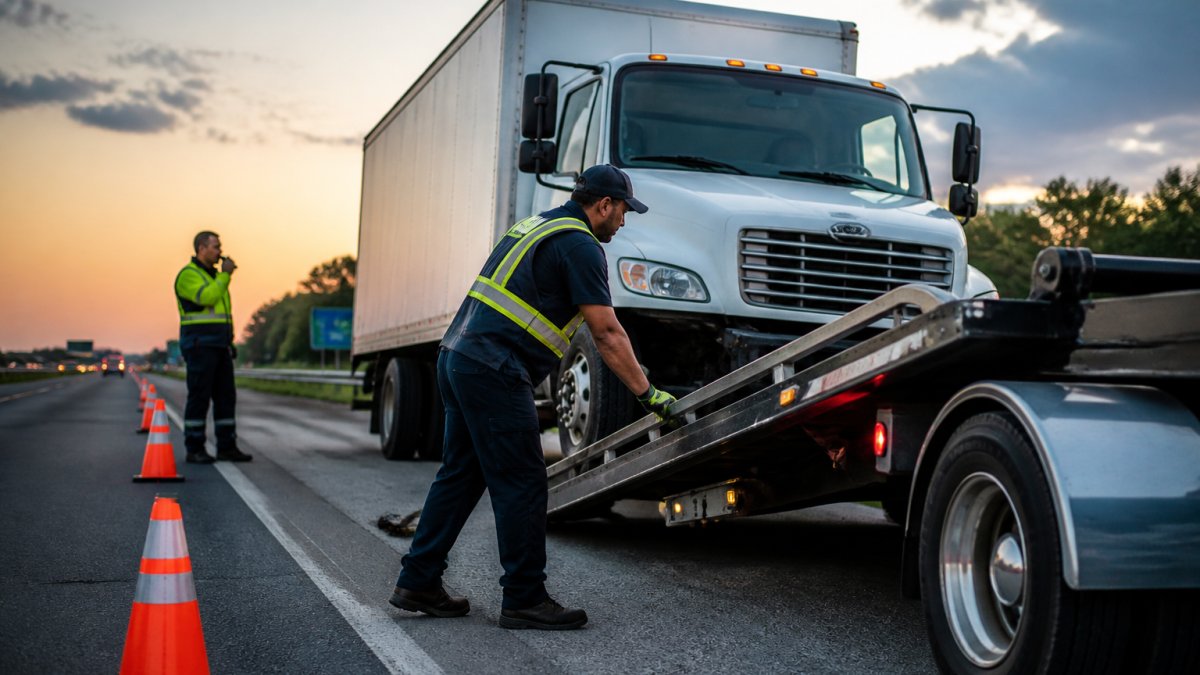
24/7 emergency support means a real person answers when your driver calls, not a voicemail system. Learn more about emergency roadside assistance availability and response for trucks. Dispatch immediately captures the situation, vehicle location, assistance needed, and driver safety, then sends the nearest qualified operator.
Driver safety comes first. A disabled vehicle on a busy highway is a hazard, so the provider should guide your driver on positioning the vehicle safely, activating hazard lights, and staying clear of traffic before the tow truck arrives.
Response time expectations should be explicit. A commitment to arrive within 30 minutes in urban areas or 60 minutes in rural areas sets clear expectations.
Heavy-Duty Truck Towing for Medium and Large Fleets
Not all towing equipment handles heavy-duty vehicles equally. A standard light-duty tow truck cannot safely transport a loaded tractor-trailer or box truck; the weight, drivetrain complexity, and cargo demand specialized expertise.
Heavy-duty truck towing requires flatbed equipment rated for the vehicle’s gross vehicle weight rating (GVWR). A 19 ft. flatbed handles medium trucks and lighter commercial vehicles.
Operator certification matters significantly.
Medium and large fleets need a provider with capacity for multiple simultaneous calls.
Managing Downtime: On-Site Repairs vs. Towing to a Facility
When a vehicle breaks down, the first decision is whether to repair it on-site or tow it to a facility. Step-by-step guidance on handling truck breakdowns helps you understand your options.
On-site repairs resolve common issues without towing.
Towing becomes necessary when the breakdown exceeds roadside repair scope: engine failure, transmission damage, major electrical problems, or suspension issues.
The cost structure differs. On-site repairs typically involve a service call fee and parts cost; towing involves distance-based charges and facility fees.
Watch out: Some towing providers inflate on-site repair capabilities to avoid towing.
On-site repairs and towing each suit different breakdown scenarios and carry distinct cost and time implications.
| Scenario | Resolution Method | Typical Duration | Typical Cost |
|---|---|---|---|
| Tire change, fuel delivery, battery service | On-site repair | 15 to 45 minutes | $150 |
| Engine failure, transmission damage, electrical problems | Tow to facility | Multiple hours | $400 to $600 |
| Minor mechanical fixes | On-site repair | 15 to 45 minutes | $150 |
| Suspension issues | Tow to facility | Multiple hours | $400 to $600 |
Towing for Abandoned Commercial Vehicles and Private Property
Private property towing has specific legal requirements. A vehicle cannot be towed simply because it’s parked where the owner doesn’t want it.
The technical challenge differs from roadside towing. An abandoned vehicle may be locked, have a dead battery, or have mechanical issues preventing it from being driven off the property.
You can explore towing abandoned commercial vehicles and the legal steps involved to understand the specific requirements in your jurisdiction and how to work with a service provider to ensure compliance.
Documentation is critical in private property towing.
Securing Fleet Towing Coverage for Your Operation
Choosing the right commercial fleet towing service requires evaluating more than price. The service must match your fleet’s vehicle types, geographic coverage, response-time expectations, and operating schedule. What separates a real fleet agreement from a consumer roadside plan is the service-level agreement (SLA) behind it and the reporting that proves the provider meets it.
Define your requirements before you shop
Start with a baseline your operation already knows:
- Vehicle classes and weights. List every unit by type and gross vehicle weight rating (GVWR) so the provider can confirm equipment and operator certification match.
- Primary and secondary territories. Map where your vehicles actually run, including routine routes and occasional lanes.
- Incident frequency. Pull 12 months of breakdown records to estimate incidents per month and per vehicle.
Put response commitments in writing
“24/7 support” means different things to different providers. An SLA should state, in writing:
- Response-time targets by zone. For example, a defined arrival window in dense urban territory and a longer window in rural areas, with the clock starting at dispatch confirmation.
- Completion-rate commitments. What percentage of dispatched calls the provider expects to complete without a second vendor or a transfer.
- Escalation path. Who your dispatcher calls when a unit is overdue, and what the provider’s internal escalation triggers are.
Ask for average and worst-case response data, not best-case anecdotes. A provider that tracks and reports its own performance is easier to hold accountable.
Read the fine print before you sign
The headline rate rarely tells the whole story. Compare plans on these contract details:
- Vehicle and weight limits. Confirm the plan covers your heaviest units, not just light-duty vehicles.
- Distance and mileage allowances. Understand how far a covered tow goes before per-mile charges begin, and what those charges are.
- Labor and after-hours limits. Check whether on-site labor is capped by time or by task, and how after-hours or holiday calls are priced.
A low per-vehicle rate with tight mileage allowances, capped labor, and narrow geography can cost more per incident than a higher headline rate with broader coverage. Compare plans on total expected annual cost at your incident frequency, not on the monthly per-unit price.
Verify credentials and capacity
Before signing, ask for proof of operator certification, insurance, and industry credentials, and confirm the provider has equipment and backup operators for multiple simultaneous calls. A buyer’s guide to heavy-duty towing services helps you evaluate and select the best option for your fleet.
For specialized needs, such as high-value vehicles, specialty recovery, or specific equipment requirements, confirm the provider has direct experience rather than a general claim of handling everything. You can review a comprehensive guide to selecting towing services for fleet managers to understand the full evaluation process and what to look for in a service agreement.
Frequently Asked Questions
What are the main benefits of commercial fleet towing services?
Commercial fleet towing services provide 24/7 emergency response, reduce vehicle downtime, protect high-value assets during transport, and offer on-site roadside repairs when possible. For fleet operators, these services mean faster recovery from breakdowns, fewer missed deliveries, and access to certified operators experienced with heavy-duty vehicles. The combination of rapid response and professional handling minimizes operational disruption and protects your fleet’s condition.
How does fleet breakdown assistance help prevent missed deliveries?
When a commercial vehicle breaks down, every hour of downtime costs money in lost productivity and delayed shipments. Fleet breakdown assistance prioritizes fast response times and on-site minor repairs, getting vehicles back on the road quickly. For issues requiring towing, professional service ensures the vehicle is transported safely to a repair facility without additional damage. This rapid intervention reduces the window of operational loss and helps maintain delivery schedules.
Can commercial fleet towing services handle heavy-duty trucks and specialty vehicles?
Yes, professional commercial fleet towing services are equipped for heavy-duty vehicles including box trucks, tractor-trailers, buses, and specialty commercial equipment. Certified operators understand the specific requirements of heavy-duty towing, such as proper weight distribution and drivetrain handling, which prevents damage during transport. Verify that your service provider has state-of-the-art equipment like 19-foot and 21-foot flatbeds and fully certified operators before committing to coverage.
What should I look for when choosing a commercial fleet towing provider?
Prioritize providers with 24/7 availability, fully certified and licensed operators, and experience with your fleet’s vehicle types. Verify they offer both roadside assistance and towing, have rapid response times, and maintain state-of-the-art equipment suitable for heavy-duty vehicles. Ask about their service coverage area, on-site repair capabilities, and whether they offer fleet-specific pricing or service agreements that match your operational needs.
How does towing for abandoned commercial vehicles work?
Professional towing services handle abandoned or illegally parked commercial vehicles on private property, removing them quickly to restore lot access and maintain security. Fleet managers and property operators contact the service provider with vehicle details and authorization, and certified operators remove the vehicle to a designated facility. This service prevents liability issues, clears parking areas for operational use, and ensures proper documentation of the removal for compliance and incident records.
