
Table of Contents
- What Makes a Heavy-Duty Towing Service Stand Out
- 24/7 Heavy-Duty Towing: Availability and Response Times
- Heavy-Duty Towing Rates and Cost Factors
- Semi-Truck Towing and Large-Vehicle Recovery
- Commercial Truck Recovery for Fleet Operations
- How to Verify Certifications and Safety Credentials
- Choosing the Right Provider for Your Needs
- Frequently Asked Questions
Last Updated: October 4, 2026
What Makes a Heavy-Duty Towing Service Stand Out
When your heavy-duty truck breaks down on the highway or your fleet vehicle needs recovery, the difference between a competent towing service and an exceptional one comes down to three things: equipment capability, operator expertise, and response reliability.
Heavy-duty towing services aren’t all equal. The best understand that moving a semi-truck, bus, or loaded trailer requires specialized equipment, certified operators, and a clear recovery strategy.
At Fox Recovery, we’ve built our reputation on understanding exactly what it takes to move heavy equipment safely. Our state-of-the-art 19-foot and 21-foot flatbeds are designed specifically for medium and heavy-duty vehicles. Our operators hold full certifications and licenses. And we’re available 24 hours a day, 365 days a year, because breakdowns don’t follow business hours.
The best heavy-duty towing services combine certified operators, specialized equipment rated for the vehicle weight, and genuine 24/7 availability. Cheaper operators often cut corners on certifications or equipment, and that’s where your vehicle gets damaged.
24/7 Heavy-Duty Towing: Availability and Response Times
Real 24/7 availability means dispatch is staffed around the clock with operators on rotation, not just voicemail services.
Understanding Response-Time Expectations
Response time expectations vary by geography and conditions. In urban areas with multiple towing providers and heavy traffic, a 30-minute response is realistic. In suburban areas, expect 30-45 minutes. In rural regions or during severe weather, 45-90 minutes is standard. The key question to ask any towing provider: What’s your actual average response time, and what’s your guarantee if you miss it? Many companies won’t give you a straight answer; that’s a red flag.
Response time depends on truck availability, distance, traffic, weather, and situation complexity. Providers with multiple trucks and dispatch points respond faster.
Ask for average response time broken down by geography and time of day. Vague answers are a red flag.
The Dispatch Process: What Information to Provide
When you call a towing service, the dispatcher will ask for specific information. Providing it clearly and completely speeds up response:
- Your exact location, Give the highway number and mile marker, or the street address and nearest cross street. “I’m on I-90 near mile marker 142” is better than “I’m somewhere on I-90.” If you’re on a rural road, use GPS coordinates if available, or describe landmarks (“two miles east of the gas station on Route 7”).
- Vehicle type and size, “2024 Peterbilt semi-truck with a 53-foot trailer” tells the dispatcher which trucks to deploy. “A big truck” does not.
- Vehicle condition, Is the engine running? Can it be driven, or is it completely disabled? Is it blocking traffic or safely off the road? Is there a hazard (leaking fuel, fire risk)?
- Your safety status, Are you in the vehicle or out? Are you in a safe location? Is traffic a hazard? This determines whether the dispatcher advises you to stay in the vehicle or move to a safer spot.
- Any special requirements, Do you need the truck towed to a specific repair facility? Do you need it transported with special care (high-value cargo, hazardous materials)?
Providers with professional dispatch systems will repeat back your information to confirm accuracy before dispatching a truck. This prevents the truck arriving at the wrong location or being unprepared for what it finds.
Safety While Waiting for the Tow Truck
If disabled on a highway, turn on hazard lights, exit to a safe location at least 100 feet from traffic, and stay in the vehicle only if exiting is unsafe. Never attempt roadside repairs on heavy vehicles.
Infrastructure That Supports Real 24/7 Service
The best services maintain multiple trucks, rotating operator schedules, backup equipment, and real-time dispatch visibility to ensure 24/7 coverage.
Ask how many heavy-duty trucks are available at 3 a.m. on a Tuesday. Specific answers indicate real infrastructure; vague ones do not.
Avoid towing services that don’t clearly state their response time commitment or that hedge with “we’ll try to get there soon.” They don’t have the infrastructure to back up a promise. You need specifics: average response time by geography, what happens if they miss it, and how many trucks are actually available during off-hours. If they won’t provide these details, they probably can’t deliver on them.
Heavy-Duty Towing Rates and Cost Factors
Heavy-duty recovery pricing is custom-quoted due to numerous variables including distance, vehicle weight, and recovery complexity.
Primary Cost Drivers
Vehicle weight, configuration, and trailer condition affect cost. Overweight loads, jackknifed trailers, or odd configurations require additional equipment and increase the bill.
Recovery complexity escalates costs significantly. Extraction, winching, or stabilization can add $300-$1,500 or more depending on severity.
Quote Comparison Framework
When requesting quotes, ask providers to itemize their pricing in this structure:
- Base dispatch fee, The cost to send a truck, regardless of distance. This typically ranges from $150 to $300 for heavy-duty services.
- Per-mile or zone-based charge, Whether they charge by the mile or use geographic zones. Ask for the exact rate and whether it applies to the return trip.
- Equipment surcharges, Any additional fees for flatbed vs. wrecker, specialty rigging, or heavy-load handling.
- Recovery or extraction fees, Separate charges if the tow involves pulling, winching, or stabilization beyond a standard tow.
- Standby time, If the truck arrives and must wait (for example, while a driver is located or paperwork is completed), some providers charge hourly rates, typically $50-$150 per hour.
- After-hours or weekend premiums, The percentage markup for calls outside standard business hours.
A transparent provider itemizes before you commit. If they refuse, hidden charges may appear on the final invoice.
Real-World Pricing Examples
Negotiating and Securing Better Rates
Fleet managers should negotiate preferred pricing before emergencies occur. Providers often offer discounts for fleet accounts, volume discounts, or flat-rate packages that guarantee maximum per-tow costs.
Get quotes from at least two providers. Compare price, response time, equipment, and credentials, not just the dollar amount.
Request itemized quotes that separate the base towing fee from surcharges, recovery fees, and after-hours premiums. This prevents surprise charges when the bill arrives. A reputable service will provide this breakdown upfront without hesitation. If a quote seems unusually low, ask what’s included and what’s not, you may be comparing apples to oranges.
Semi-Truck Towing and Large-Vehicle Recovery
Semi-truck towing requires heavy-duty equipment rated for 80,000+ pounds and operators trained in weight distribution and brake systems. Improper rigging, dragging instead of flatbedding, or mishandling air brakes causes catastrophic damage.
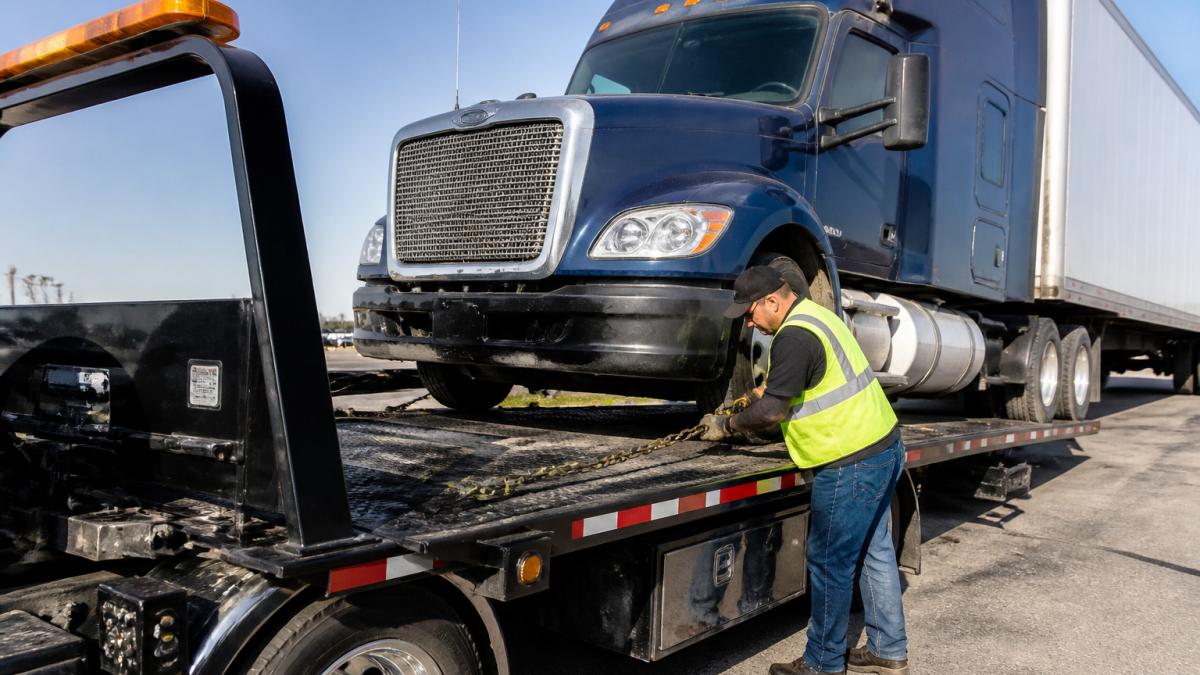
The right approach uses a flatbed specifically rated for the truck’s weight. The operator inspects the vehicle, identifies the best recovery points, and uses proper rigging techniques. The truck is secured at multiple points, not just the front axle. The entire recovery is executed with precision to prevent any damage beyond what the accident or breakdown already caused.
Fox Recovery operates flatbeds rated for medium and heavy-duty trucks, including fully loaded semis. Our operators understand the mechanical systems in commercial vehicles. We don’t drag; we flatbed. We don’t improvise rigging; we follow industry standards. That’s the difference between recovery and additional damage.
Large-vehicle recovery also includes buses, tractor-trailers, and specialty commercial equipment. Each requires the same level of expertise: proper equipment, certified operators, and a methodical approach to safety.
Commercial Truck Recovery for Fleet Operations
Fleet managers face a different towing challenge than individual vehicle owners. When one truck goes down, you lose revenue. When two trucks are down simultaneously, you’re scrambling. When a third breaks down while the first two are being recovered, you’re managing a crisis.
The best heavy-duty towing services understand fleet operations. They prioritize calls from fleet customers. They coordinate multiple recoveries. They communicate status updates so you can manage your dispatch and customer commitments. They work with your maintenance team to get trucks back on the road as quickly as possible.
Commercial truck recovery includes breakdowns, accidents, and mechanical failures. It also includes situations that individual vehicle owners rarely face: a truck stuck in mud after a delivery, a trailer jackknifed on a curve, a vehicle that needs towing to a specific repair facility rather than the nearest one.
Fleet managers should establish a relationship with their towing provider before an emergency happens. Know their response times. Confirm they can handle simultaneous calls. Discuss preferred repair facilities and whether the towing service will coordinate directly with your maintenance team. Some services offer fleet accounts with priority dispatch, that’s worth paying for if you manage multiple vehicles.
A commercial towing service built for fleet operations coordinates multiple vehicles, communicates proactively, and understands the business impact of downtime. That’s worth more than the lowest price.
How to Verify Certifications and Safety Credentials
Not every operator holding a tow truck has legitimate credentials. Some states require licensing; others don’t. Some operators carry insurance; others operate on a handshake. When you’re putting a high-value vehicle or critical fleet asset on a flatbed, you need proof of legitimacy.
Ask for specific credentials. Tow operators should hold a commercial driver’s license (CDL) if they’re towing heavy vehicles. They should carry liability insurance and cargo insurance. Many hold certifications from industry organizations like the Towing and Recovery Association (TRA) or similar bodies that set safety standards.
Request proof before you commit. A legitimate operator will provide insurance certificates without hesitation. They’ll explain their certifications. They’ll answer questions about their training and experience. If a towing service gets defensive about credentials or says “we’re all licensed,” that’s a warning sign.
Fox Recovery’s operators hold full certifications and licenses. We carry the necessary insurance. We maintain our equipment to industry standards. These aren’t selling points, they’re baseline requirements. Any heavy-duty towing service that doesn’t meet these standards shouldn’t be on your list.
High-value vehicles, luxury cars, collector vehicles, showroom inventory, require extra verification. Ask whether the towing service has experience with high-value transport. Do they perform multi-point inspections before and after transport? These details matter when you’re moving a $200,000 vehicle.
Choosing the Right Provider for Your Needs
The decision comes down to matching your specific situation to a provider’s actual capabilities. A service that excels at highway breakdowns might struggle with private property recovery. A provider great with passenger vehicles might not understand commercial trucks.
Start by defining your actual need. Are you looking for occasional emergency towing, or do you need a reliable partner for a fleet? Do you need specialty recovery capabilities, or primarily standard breakdowns? Are you in an urban area where response time is critical, or a rural region where you need someone who can handle long-distance recovery?
Then ask the provider directly: Can you handle my specific situation? Can you do it 24/7? What’s your response time? Can you provide references from customers with similar needs? What are your certifications? What’s included in your pricing?
The provider that answers these questions clearly and specifically is the one worth considering. The one that hedges, avoids specifics, or promises everything probably can’t deliver on any of it.
Frequently Asked Questions
How much does heavy-duty towing typically cost?
Heavy-duty towing rates depend on vehicle weight, distance, recovery complexity, and time of day. Contact Fox Recovery for a specific quote based on your vehicle and situation, pricing varies significantly by job type.
What should I look for in a heavy-duty towing service?
Look for full state certification and licensing, 24/7 availability, modern equipment (flatbeds rated for your vehicle weight), experience with your vehicle type, and verifiable response times. Ask about their track record with high-value vehicles, fleet support, and whether they handle both roadside and private property recovery. Check for customer references from businesses similar to yours.
Can a heavy-duty towing company recover a loaded semi-truck?
Yes, specialized heavy-duty towing companies handle loaded semi-trucks, but it requires specific equipment, expertise, and sometimes multiple units. The recovery process depends on the truck’s condition, weight distribution, and accident location. Always verify the provider has experience with loaded commercial vehicles and proper recovery equipment before requesting service.
How long does it take for a heavy-duty tow truck to arrive?
Response times vary by location and current demand. Many 24/7 heavy-duty towing services aim for 30-60 minute response times in their service areas, though emergency situations on highways may be faster. During peak times or in remote locations, arrival may take longer. When you call, ask for an estimated arrival time based on your specific location and situation.
When a heavy-duty truck breaks down or your fleet faces a recovery emergency, you need a towing service that combines certified expertise, reliable equipment, and genuine 24/7 availability. Fox Recovery delivers all three. Our state-of-the-art flatbed equipment, fully licensed operators, and round-the-clock dispatch mean your vehicle gets handled with the precision it deserves. Call us at (847) 587-6076 when you need heavy-duty towing you can trust.