
Table of Contents
- Why Towing Services Matter for Fleet Managers
- Commercial Fleet Towing: Coverage, Response Time, and Reliability
- Heavy-Duty Towing for Fleets: Specialized Equipment and Expertise
- Fleet Breakdown Management: Reducing Downtime and Operational Disruption
- Towing for Abandoned Commercial Vehicles: Compliance and Recovery
- How to Evaluate and Select a Towing Provider for Your Fleet
- Integrating Towing Services into Fleet Management Workflows
- Frequently Asked Questions
Last Updated: October 10, 2026
Why Towing Services Matter for Fleet Managers
Fleet downtime is expensive. When a commercial vehicle breaks down, you’re not just paying for the tow, you’re losing productivity, missing deliveries, and potentially disappointing customers. The real cost compounds fast.
That’s where reliable towing services for fleet managers become critical infrastructure for fleet operations. At Fox Recovery, we work with fleet managers who understand that the right towing partner isn’t a luxury, it’s a necessity for operational continuity. A breakdown on I-90 at 2 a.m. shouldn’t turn into a six-hour disaster because your tow operator can’t handle heavy-duty vehicles or doesn’t know how to prevent drivetrain damage.
Fleet managers face a specific problem that standard roadside assistance doesn’t fully solve. You need 24/7 coverage that understands commercial vehicles. You need operators who won’t damage your equipment during recovery. And you need transparency about costs before they surprise you.
The stakes are different for fleets than for individual vehicle owners. A single breakdown can ripple through your entire operation, affecting multiple routes, stranding drivers, and damaging your reputation with clients. This guide covers what actually matters when selecting towing services for fleet managers, and how to structure that relationship so it protects your bottom line.
Commercial Fleet Towing: Coverage, Response Time, and Reliability
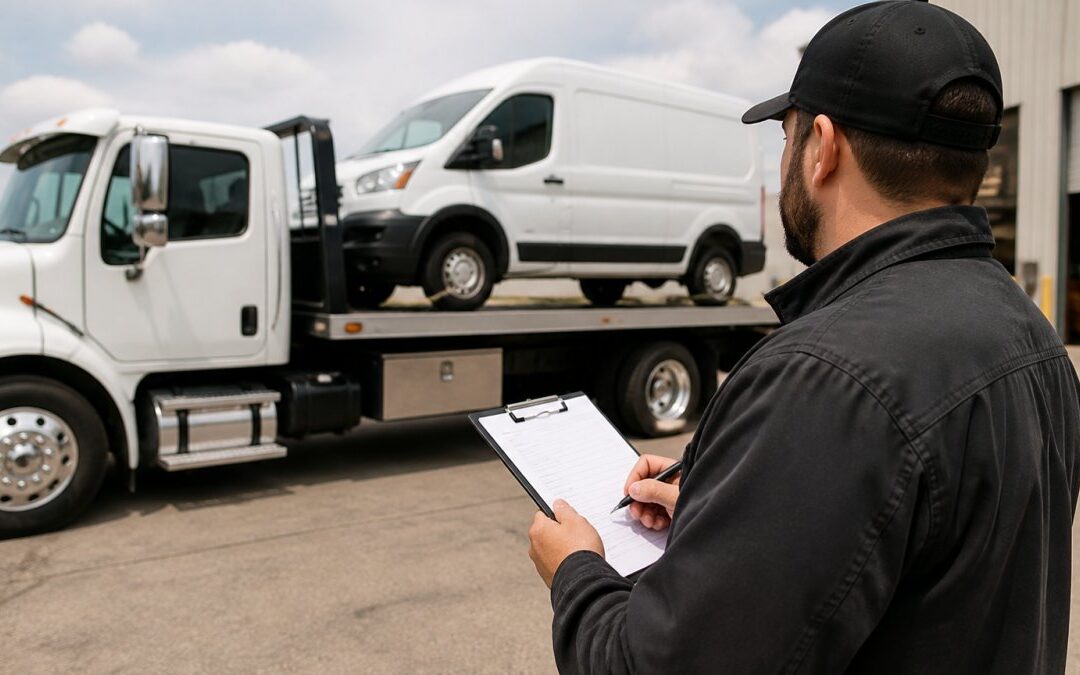
Commercial fleet towing isn’t the same as roadside assistance for personal vehicles. Your needs are larger, more complex, and more time-sensitive.
24/7 Availability and Emergency Response
Your fleet operates around the clock. That means your towing provider must too. The difference between a provider who answers at 3 a.m. and one who takes messages is the difference between a one-hour delay and a six-hour disaster.
True 24/7 coverage means a real person answers the phone immediately, dispatches a truck to your location, and provides an estimated arrival time, not a callback in the morning. When you’re running commercial operations, downtime costs money by the minute. A provider who can’t commit to consistent response times isn’t worth the contract.
Fox Recovery operates 365 days a year with immediate dispatch, which means your drivers aren’t left waiting on the roadside wondering if someone’s actually on the way.
Real-Time Dispatch and Vehicle Tracking
Dispatch quality separates professional fleet towing from amateur operations. A good dispatch system does three things: it locates your vehicle instantly, assigns the nearest available truck, and keeps you updated on arrival time.
GPS tracking isn’t just for the tow company’s benefit, it’s for yours. You need visibility into where your vehicle is, what’s happening to it, and when it will be recovered. This matters for insurance claims, customer communication, and operational planning.
The alternative, a provider who takes a call, says “we’ll send someone,” and leaves you guessing, creates operational chaos. You can’t inform customers, you can’t update your dispatch, and you can’t make contingency decisions without knowing your vehicle’s status.
Heavy-Duty Towing for Fleets: Specialized Equipment and Expertise
Not all tow trucks are built the same. Medium and heavy-duty commercial vehicles require specific equipment and operator knowledge that many providers simply don’t have.
Flatbed Transport and Damage Prevention
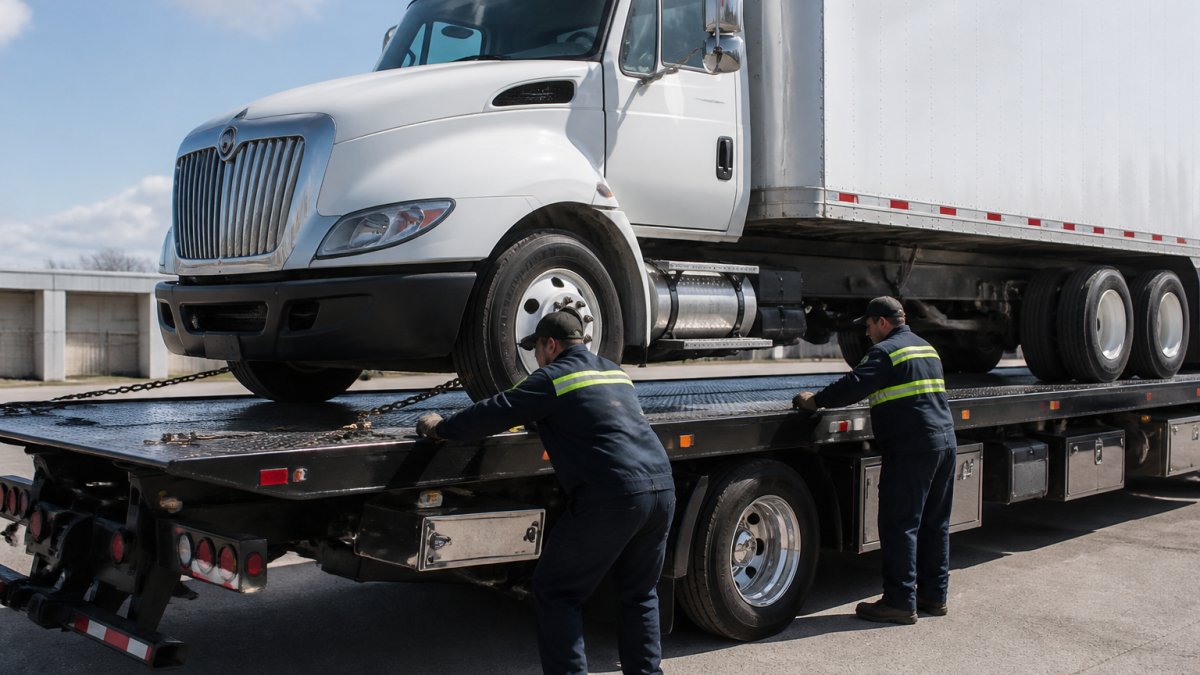
Flatbed towing is the standard for commercial fleet recovery. Unlike wheel-lift towing, flatbed trucks distribute weight evenly and eliminate drivetrain damage risk. This matters enormously for your bottom line, a damaged transmission or differential can cost tens of thousands to repair.
The difference between a careless operator and a professional one shows up in how the vehicle is loaded, secured, and transported. Proper flatbed towing requires multiple tie-down points, correct angle of approach, and knowledge of how different vehicle types need to be handled. A bus requires different securing than a box truck. A tractor-trailer with a damaged axle needs different equipment than a standard commercial vehicle.
Fox Recovery uses state-of-the-art 19-foot and 21-foot flatbeds with certified operators who understand the specifics of commercial vehicle recovery. This isn’t about having the biggest truck, it’s about having the right equipment and the expertise to use it safely.
Medium and Heavy-Duty Vehicle Recovery
Your fleet likely includes vehicles ranging from box trucks to tractor-trailers. Not every towing company has the capacity or expertise to handle the full spectrum.
A provider who specializes in light-duty towing will struggle with heavy-duty recovery. They may not have the right equipment, the trained operators, or the insurance coverage for larger vehicles. This creates a dangerous situation where you’re forced to call multiple providers depending on which vehicle breaks down, or worse, you use an underqualified provider and risk damage to expensive equipment.
Fleet-focused towing providers understand medium and heavy-duty recovery as a core competency. They maintain equipment specifically rated for these vehicles, train operators on proper recovery procedures, and carry appropriate liability coverage. This matters for buses, tractor-trailers, and any commercial vehicle in your fleet that represents significant capital investment.
Fleet Breakdown Management: Reducing Downtime and Operational Disruption
A breakdown isn’t just a mechanical problem, it’s an operational crisis. The way your towing provider responds determines how much damage the incident does to your business.
Incident Response Procedures and Driver Safety
When a driver calls in a breakdown, the first priority is safety. Your driver shouldn’t be standing on the roadside in traffic longer than necessary. A professional towing provider has procedures for this: confirm the driver’s location, ensure they’re in a safe position, provide an estimated arrival time, and keep them updated.
The second priority is preventing secondary incidents. A disabled vehicle on a highway creates a hazard for other traffic. Professional towing companies understand this and move quickly to clear the roadway, protecting your driver and reducing liability exposure for your company.
Driver safety also means the towing operator treats your employee with respect and professionalism. Your drivers represent your company. An operator who’s dismissive, rude, or unhelpful damages the relationship and creates frustration that compounds the stress of a breakdown situation.
Preventive Maintenance and Reliability Planning
The best towing provider is one you don’t need. Preventive maintenance reduces breakdown frequency and extends vehicle life.
Towing for Abandoned Commercial Vehicles: Compliance and Recovery
Private property towing and abandoned vehicle recovery are different from roadside assistance, but they’re part of fleet management for many operations.
Property managers and fleet operators often need to remove abandoned or illegally parked vehicles from lots. This requires compliance with local regulations around notice, documentation, and storage.
Abandoned vehicle recovery also requires proper documentation. You need to verify that the vehicle was legally removed, that notice was properly given, and that storage is being handled in compliance with regulations.
How to Evaluate and Select a Towing Provider for Your Fleet
Choosing a towing provider is a significant decision. You’re entrusting your vehicles and your operational continuity to this relationship. Use a structured evaluation process.
Certification, Licensing, and Safety Standards
Start with credentials. Your towing provider should be fully licensed and certified for the vehicle types in your fleet. This isn’t a suggestion, it’s a requirement for legal liability coverage.
Verify certifications directly. Ask for proof of licensing, insurance coverage, and any industry certifications. A provider who hesitates to share this information isn’t trustworthy. Fully certified and licensed operators are the baseline, anything less is a liability.
Also check safety standards. Ask about driver training programs, vehicle maintenance schedules, and safety protocols. A provider who takes safety seriously will have clear answers to these questions.
Service-Level Agreements and Performance Metrics
A service-level agreement (SLA) puts commitments in writing. It specifies response times, coverage areas, available equipment, and what happens when the provider fails to meet commitments.
Key metrics to include in an SLA:
- Maximum response time for different vehicle types
- Coverage area and any geographic limitations
- Equipment availability (flatbed capacity, heavy-duty capability)
- Communication protocols (how you’ll be updated on incident status)
- Performance penalties if commitments aren’t met
An SLA forces both parties to be specific about expectations. It eliminates vague promises and creates accountability. A provider who won’t commit to specific response times isn’t confident in their ability to deliver.
Pricing Transparency and Contract Structure
Ask for pricing before you need it. A reputable provider gives you a clear breakdown of costs for different services. This should include tow distance pricing, equipment charges, and any additional fees.
Avoid providers who quote low prices and then surprise you with charges. Ask specifically about what’s included in their base rate and what costs extra. For fleet contracts, negotiate volume discounts if you’re committing to a long-term relationship.
| Evaluation Criteria | What to Look For | Why It Matters |
|---|---|---|
| Certification & Licensing | Verified licenses for vehicle types in your fleet | Protects you legally and ensures operator competence |
| Response Time Commitment | Written SLA with specific maximum response times | Reduces operational disruption and downtime costs |
| Equipment Capability | Flatbed capacity rated for your heaviest vehicles | Prevents damage and ensures safe recovery |
| 24/7 Availability | Real dispatch, not voicemail, at all hours | Critical for around-the-clock fleet operations |
| Pricing Structure | Clear, itemized costs with no surprise charges | Enables accurate budgeting and cost control |
| Integration Capability |
Integrating Towing Services into Fleet Management Workflows
The best towing providers integrate with your existing systems rather than operating in isolation.
Telematics and GPS Tracking Integration
Modern fleet management systems track vehicle location, diagnostics, and driver behavior in real time.
Dispatch Software and Real-Time Communication
Selecting the right towing provider for your fleet isn’t about finding the cheapest option, it’s about finding a partner who reduces operational disruption and protects your equipment. Fox Recovery provides 24/7 towing and recovery services with fully certified operators, state-of-the-art flatbed equipment, and expertise in handling medium and heavy-duty commercial vehicles. Our commitment to prompt service and safe vehicle transport means your fleet gets the support it needs, whenever it’s needed. Call (847) 587-6076 to discuss your fleet’s towing and recovery needs.
Frequently Asked Questions
How quickly should a towing company respond when a fleet vehicle breaks down?
Response time is critical for fleet operations. Most professional towing services for fleet managers aim for 30-60 minute response times in urban and suburban areas. Look for providers offering 24/7 dispatch with GPS-enabled vehicles and real-time tracking. Ask potential providers about their average response times in your service area and what happens during peak incident periods. Faster response reduces vehicle downtime and keeps your fleet operational.
What should you look for in a commercial fleet towing provider?
Evaluate commercial fleet towing providers on several factors: full state licensing and certification of all operators, experience with your specific vehicle types (trucks, buses, tractor-trailers), state-of-the-art equipment like flatbeds that prevent drivetrain damage, 24/7 availability, transparent pricing structures, and a service-level agreement defining response times and coverage. Request references from other fleet operators and verify insurance coverage limits match your fleet’s value.
How can fleet managers reduce vehicle downtime after a breakdown?
Minimize downtime by partnering with a responsive towing provider that offers quick dispatch and real-time status updates. Establish clear incident protocols so drivers know exactly what to do and who to call. Maintain preventive maintenance schedules to reduce breakdowns. Have a backup towing provider for peak times. Document all incidents to identify patterns and address reliability issues before they cause more downtime.
What is the difference between heavy-duty towing for fleets and standard towing?
Heavy-duty towing for fleets handles medium and heavy-duty trucks, buses, and tractor-trailers that standard tow trucks cannot safely recover. It requires specialized equipment like heavy-duty flatbeds (typically 19-21 feet), trained operators certified in commercial vehicle recovery, and understanding of drivetrain protection and load securement. Standard towing handles light-duty passenger vehicles. Fleet managers need providers with heavy-duty capability to prevent equipment damage, liability issues, and extended downtime when commercial vehicles break down.