
Last Updated: November 8, 2026
Quick Summary
If your truck breaks down in live traffic, grip the wheel with both hands, ease off the accelerator, turn on your hazard lights right away, and steer toward the right shoulder once traffic allows. Stop as far from the traffic lane as you can, set the parking brake, and keep your seatbelt on until you have checked the traffic around you.
- Do not brake hard, because sudden movements at highway speed can cause a skid or jackknife.
- If the shoulder is blocked or missing, keep hazards on, call 911, and stay buckled in.
- Exit through the passenger-side door and move behind a guardrail, never into a live lane.
- Call 911 first if the truck blocks a live lane or is in a tunnel or on a bridge.
- Give dispatchers your location, lane position, truck type, load status, and callback number.
Table of Contents
- Pull Over Safely When Your Truck Breaks Down
- Truck Breakdown Safety Tips for Busy Traffic
- Who to Call When a Truck Breaks Down on the Highway
- What Information to Give Roadside Assistance
- Truck Roadside Assistance Response Time: What to Expect
- Loaded Truck and Cargo Safety at the Roadside
- Breakdowns in Tunnels, Bridges, Work Zones, and Bad Weather
- Call Fox Recovery for Heavy-Duty Highway Breakdowns
- Frequently Asked Questions
Pull Over Safely When Your Truck Breaks Down
A blown tire or a dead engine on a busy highway gives you seconds to act.
Here is the sequence that matters most:
- Grip the wheel with both hands and keep the truck pointed straight.
- Ease off the accelerator and let the truck slow on its own.
- Turn on your hazard lights right away so drivers behind you see the problem.
- Steer toward the right shoulder once traffic allows.
- Stop as far from the traffic lane as you can, ideally past a guardrail.
Do not brake hard. Sudden movements at highway speed can send a heavy truck into a skid or a jackknife. Gentle steering and slow braking keep you in control.
Once stopped, set the parking brake and keep your seatbelt on until you have checked the traffic around you.
What to Do When the Truck Cannot Reach the Shoulder
Sometimes the shoulder is too narrow, blocked, or missing entirely. A loaded tractor-trailer may not fit, or a bridge may have no room at all.
Keep your hazard lights on and call 911. Tell the dispatcher your truck is stopped in a live lane and give your exact location.
Watch out: never step out into a live lane to wave traffic around your rig. That is how people get hit.
Here is the sequence that matters most when your truck fails in live traffic.
| Step | What to do |
|---|---|
| 1 | Grip the wheel with both hands, keep truck pointed straight |
| 2 | Ease off the accelerator and let the truck slow |
| 3 | Turn on hazard lights right away |
| 4 | Steer toward the right shoulder once traffic allows |
| 5 | Stop as far from the traffic lane as you can |
| After stopping | Set parking brake, keep seatbelt on until traffic checked |
Truck Breakdown Safety Tips for Busy Traffic
The biggest mistake drivers make after a breakdown is standing in the wrong place. Most breakdown deaths involve a person outside the vehicle, not the vehicle itself.
Stay Inside or Exit: Deciding in the First Minute
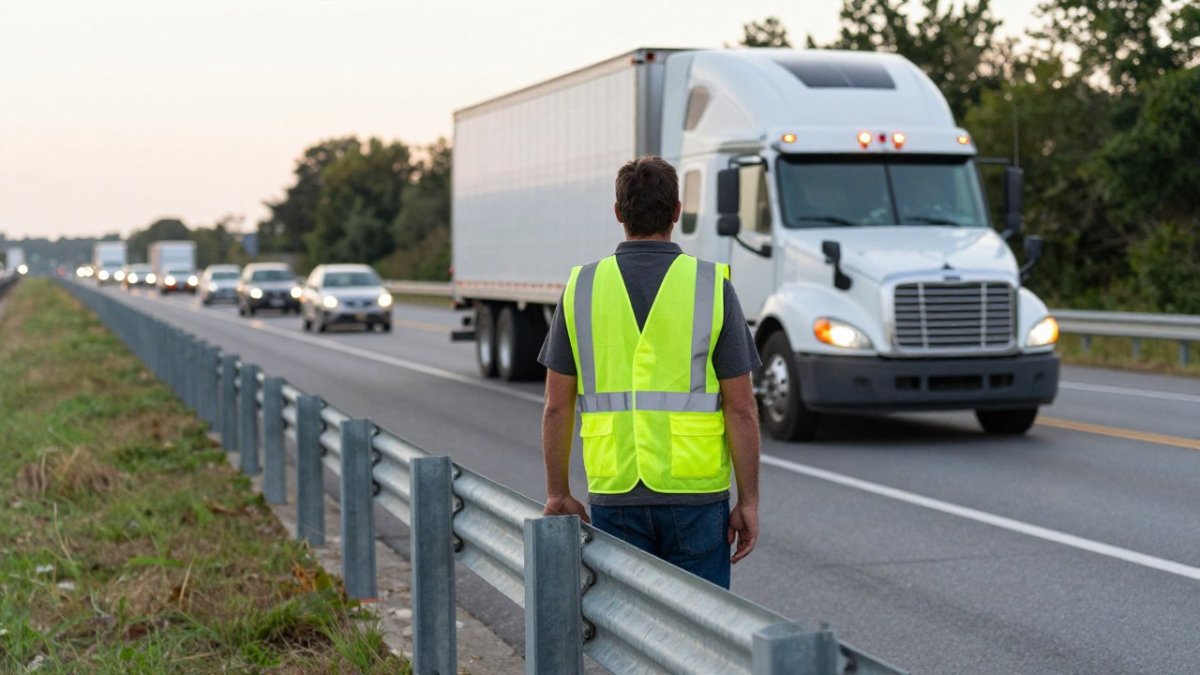
Stay inside with your seatbelt on if traffic is heavy and your truck is in a live lane. Your cab is the safest place until help arrives.
If you do get out, follow these rules:
- Exit through the passenger-side door, away from traffic.
- Move to a spot behind a guardrail or well off the roadway, for a long rig, walk toward the rear of the trailer rather than the front, so you are not standing in the shadow of the cab where approaching drivers lose sight of you.
- Never stand between your truck and oncoming traffic.
- Keep a safe distance from the vehicle, especially at night. A common pattern is to put at least the width of a shoulder plus a few car lengths between you and the travel lane.
Watch out: on a narrow shoulder, the trailer overhangs farther into the lane than the cab does, so the “safe” spot beside the cab may still be in the strike zone behind the trailer.
Warning Devices: What a Truck Is Expected to Carry and How to Place Them
Reflective triangles are not optional equipment for most commercial trucks. Commercial vehicle rules on warning devices vary by jurisdiction and vehicle type. Check the requirements that apply to your vehicle and your route with the official transportation authority for your state.
Placement is where drivers get hurt. The goal is to give approaching traffic enough warning to change lanes before they reach your truck, without you spending more time in the roadway than necessary.
- Deploy from the traffic side only after checking traffic, and place the first triangle at the traffic-facing corner of the vehicle so it is visible immediately.
- Work backward along the shoulder, not across the lane. Spacing depends on posted speed and sight distance, so follow the placement guidance in your vehicle’s official safety materials.
- On a one-way road or divided highway, place devices so they face approaching traffic from the direction drivers will see them first.
- Retrieve them only when it is safe, and never turn your back on moving traffic.
If you cannot place devices without entering a live lane, do not place them.
Who to Call When a Truck Breaks Down on the Highway
Call 911 first if anyone is hurt, if your truck is blocking a live lane, if you are in a tunnel or on a bridge, or if the load is hazardous or shifting.
For a full walkthrough of your options, read our guide on emergency roadside assistance for trucks. It covers who to call and which service fits your situation.
The Emergency-Call Checklist
Have this information ready before you dial. Dispatchers and 911 operators ask for the same core details, and having them written down or pulled up on your phone cuts minutes off the response.
- Location: the highway number and direction of travel, the nearest mile marker or exit, and the nearest overpass or sign. “I-90 eastbound, just past mile marker 132” beats “somewhere near the exit.”
- Lane position: shoulder, right lane, center lane, or blocking a ramp. This tells responders whether they need to shut down a lane before they arrive.
- Truck type and load status: a medium-duty box truck, a bus, or a loaded tractor-trailer, and whether the load is heavy, oversized, or hazardous.
- What went wrong: a blowout, a dead engine, a brake problem, or a warning light, in plain words.
- Injuries: whether anyone is hurt and how many people are in the vehicle.
- Hazards: fuel or fluid leaks, smoke, a leaning trailer, or cargo that has shifted.
- Callback number: a phone that will stay on and reachable.
911 Versus a Tow Dispatcher: Who Handles What
911 coordinates traffic control and emergency medical response.
Watch out: hanging up after giving your location can cost you the callback if the dispatcher needs to confirm a detail, so stay on the line until they release you and keep the phone where you can hear it over traffic.
If you are unsure which to call, call 911 when the truck is in a live lane or anyone is hurt, and call the tow dispatcher once you are safely on the shoulder.
What Information to Give Roadside Assistance
Give the dispatcher five things and the call goes fast: where you are, which way you are heading, what your truck is, what broke, and how to reach you.
A precise vehicle location saves time. “I-90 eastbound, just past mile marker 132” beats “somewhere near the exit.” If you can, name the nearest exit, overpass, or sign.
Then describe the truck: a medium-duty box truck, a bus, or a loaded tractor-trailer. Tell them about any injuries and whether the truck is carrying cargo that needs special care.
Truck Roadside Assistance Response Time: What to Expect
Response time depends on where you are, the weather, and how busy the towing service is. A truck on a busy highway near a metro area usually sees a crew sooner than one on a rural stretch at night.
Several things affect how long you wait:
- Distance to the nearest heavy-duty tow truck
- Traffic and weather conditions
- Whether the truck needs a flatbed or a wheel-lift
- Whether emergency services are already on scene
Our article on emergency roadside response time breaks down what is realistic so you can plan how long you may be stranded. While you wait, stay in a safe spot and keep your hazard lights on.
Loaded Truck and Cargo Safety at the Roadside
A loaded truck changes the whole picture. Weight shifts, cargo can settle, and a poorly secured load can move during recovery. Your safety and your cargo both depend on a careful approach.
Before help arrives:
- Do not try to unload or shift cargo yourself on the shoulder.
- Keep clear of the trailer if you smell fuel or see a lean.
- Tell the operator the load weight and how it is secured.
Our guide on avoiding towing damage to trucks explains how proper rigging protects the drivetrain and the load. A vehicle recovery crew that knows heavy trucks will secure the load before they lift.
Breakdowns in Tunnels, Bridges, Work Zones, and Bad Weather
Some locations leave no room for error. A breakdown in a tunnel, on a bridge, in a work zone, or in a storm needs faster action and a cooler head.
- Tunnels: Turn on hazards, stop if you can, and call 911. Do not walk through the tunnel.
- Bridges: There is often no shoulder. Stay buckled in and call for help.
- Work zones: Follow the cones and flaggers. Space is tight, so move slowly.
- Bad weather: Reduce speed early and increase your following distance. Visibility drops fast in rain or snow.
In every one of these spots, the same rule applies: protect people first, then the truck.
Call Fox Recovery for Heavy-Duty Highway Breakdowns
A breakdown on a busy highway is stressful, but you do not have to manage it alone. Fox Recovery provides 24/7 towing and recovery for medium and heavy-duty trucks, buses, and tractor-trailers.
When you call, you get:
- Available 24 hours a day, 365 days a year
- 19 ft. and 21 ft. flatbeds for a range of vehicles
- Fully certified and licensed tow operators
- Expertise with high-value vehicles and heavy-duty recovery
If you are ready to call, check our 24/7 heavy recovery service availability before you dial, and keep our step-by-step breakdown guide handy for next time.
Do not wait on the shoulder longer than you have to. Call Fox Recovery at (847) 587-6076 and get a certified crew headed your way.
Frequently Asked Questions
Should I stay in my truck if it breaks down on the highway?
On a busy highway, staying buckled inside with your seatbelt on is usually the safer choice, especially if you are in a traffic lane or on a narrow shoulder. Your truck offers far more protection than standing outside. Exit only when you can do so on the side away from traffic, and move well behind a guardrail before calling for help. If a collision from behind seems likely, exit immediately and get clear of the vehicle.
Who should I call when my truck breaks down on the highway?
Call 911 first if you are blocking a lane, in a tunnel, or in any position where other drivers cannot see you in time. Otherwise, contact a heavy-duty towing and recovery company that handles medium and heavy trucks, plus your fleet manager or dispatcher if you drive for a company. Have your location, direction of travel, and mile marker ready so the dispatcher can route the right equipment.
What information should I give roadside assistance after a truck breakdown?
Give your exact location using the mile marker, exit number, or nearest cross street, plus your direction of travel. Describe the truck by size and type, note whether it is loaded and with what, and explain the symptoms so the dispatcher sends the right truck. Mention any hazards such as a spilled load, a lane blockage, or poor visibility, and confirm a callback number and your emergency contact.
How long does truck roadside assistance take to arrive?
Response time depends on your location, traffic, weather, and equipment availability. A heavy-duty wrecker may take longer than a standard tow because fewer units are on the road and they move slowly. When you call, ask for an estimated arrival window and a dispatch reference number, then stay in a safe position and keep your hazard lights on until help reaches you.
