
Table of Contents
- How Towing Can Damage a Truck
- Truck Towing Safety Checklist: What to Inspect Before Towing
- Heavy-Duty Truck Towing Capacity: Know Your Limits
- Protecting the Transmission and Drivetrain During Towing
- Flatbed Towing for Trucks: The Safest Method
- What to Do If a Truck Is Damaged During Towing
- Safe Recovery of Stuck or Disabled Trucks
- Frequently Asked Questions
Last Updated: October 21, 2026
How Towing Can Damage a Truck
Towing damage happens fast. A single incorrect tow can cause thousands of dollars in drivetrain, transmission, and suspension repairs, and avoiding towing damage to trucks requires more than hooking up a cable and pulling.
Your drivetrain is vulnerable during towing. With drive wheels on the ground, the transmission turns without engine power, breaking down fluid faster. The driveshaft can snap and the differential can fail.
Four-wheel drive and all-wheel drive trucks face greater risks.
The goal of avoiding towing damage to trucks is simple: keep your drive wheels off the ground whenever possible. Use flatbed towing when you can. When you can’t, use a dolly under the drive wheels.
Truck Towing Safety Checklist: What to Inspect Before Towing
Before any tow, perform a complete vehicle inspection. This checklist takes 15 minutes and prevents most damage.
Pre-Tow Inspection Steps:
- Check your parking brake, make sure it holds firmly
- Inspect all four tires for pressure and damage
- Test your brakes with the engine off, they should be firm
- Look under the truck for fluid leaks (oil, transmission fluid, coolant)
- Check your headlights, brake lights, and turn signals
- Verify your battery has enough charge to power the truck during towing
- Take photos of your truck’s current condition from all angles
- Document any existing damage with close-up photos
- Write down your truck’s mileage before towing
- Check your owner’s manual for the recommended towing method
Why This Matters:
Photos protect you. If damage occurs during towing, you need proof of your truck’s prior condition. Photograph the front bumper, rear bumper, both sides, and undercarriage, with a date and time stamp.
Fluid leaks signal problems. A transmission fluid leak will worsen during the tow, and an engine oil leak can cause the engine to seize. Report these issues to the tow operator before they hook up your truck.
Your parking brake is your safety net. During towing, your truck is pulled and stopped repeatedly, and a weak brake can let it roll or shift on the tow truck.
Take video as well as photos. Walk around your truck while recording, showing the condition of every panel, the tires, and the undercarriage. Video timestamps are harder to dispute than still photos if a damage claim becomes necessary.
Heavy-Duty Truck Towing Capacity: Know Your Limits
Your owner’s manual specifies your truck’s towing capacity, the maximum weight it can safely tow. Exceeding this limit causes transmission failure, suspension damage, and brake failure.
Find your truck’s towing capacity in three places:
- Your owner’s manual (most reliable source)
- The driver’s side door jamb label (shows GVWR and towing capacity)
- Your truck’s build sheet (if you have the original paperwork)
Heavy-duty trucks typically have towing capacities between 10,000 and 35,000 pounds, depending on engine size and configuration. Medium-duty trucks range from 5,000 to 15,000 pounds.
Towing capacity is NOT the same as payload capacity. Towing capacity is what you can pull behind your truck; payload capacity is what you can carry in the bed.
When towing, your truck must stay within BOTH limits. If you’re towing a 10,000-pound load and carrying 2,000 pounds of cargo in your bed, you’ve exceeded your total capacity.
Exceeding your towing capacity voids your manufacturer’s warranty on the transmission and drivetrain. If your transmission fails after towing over capacity, the manufacturer will not cover repairs. You’ll pay the full cost out of pocket.
Protecting the Transmission and Drivetrain During Towing
Your transmission is an expensive component to repair on a truck. Preventing transmission damage during towing is worth the extra effort.
How Towing Damages Transmissions:
Automatic transmissions are more vulnerable than manuals.
Protecting Your Drivetrain:
The safest method is flatbed towing. With all four wheels off the ground, your transmission doesn’t turn, your driveshaft doesn’t spin, and your differential stays stationary.
If flatbed towing isn’t available, use a wheel lift on the front wheels and a dolly under the rear wheels.
Never allow a tow operator to tow your truck with the drive wheels on the ground unless your owner’s manual specifically allows it.
Two-Wheel Drive vs. Four-Wheel Drive Towing
Two-wheel drive trucks are simpler to tow safely: they have one set of drive wheels (usually the rear), and keeping those off the ground protects your transmission.
Four-wheel drive trucks are more complex. With two sets of drive wheels, power can flow to either or both depending on the transfer case setting.
Towing a four-wheel drive truck with a wheel lift on the front leaves the rear wheels on the ground, so the rear differential turns and the driveshaft spins. This can damage your transfer case and rear differential.
The safest method for four-wheel drive trucks is flatbed towing. All four wheels are off the ground. Nothing spins. Nothing wears.
All-Wheel Drive Considerations
All-wheel drive trucks are the most vulnerable to towing damage. These systems constantly distribute power between front and rear axles and aren’t designed for wheels spinning at different speeds.
Towing an all-wheel drive truck with any wheels on the ground makes the system fight itself: the front and rear wheels spin at different speeds, and the coupling tries to force them to match, damaging the coupling, differential, and transfer case.
Never tow an all-wheel drive truck with any wheels on the ground. Flatbed towing is the only safe method. If flatbed towing isn’t available, your truck should be transported on a rollback truck where all wheels are completely off the ground.
All-wheel drive and four-wheel drive trucks require special towing methods. Flatbed towing is the safest option for both. If flatbed isn’t available, ask your tow operator if they have a rollback truck that lifts all wheels off the ground.
Flatbed Towing for Trucks: The Safest Method
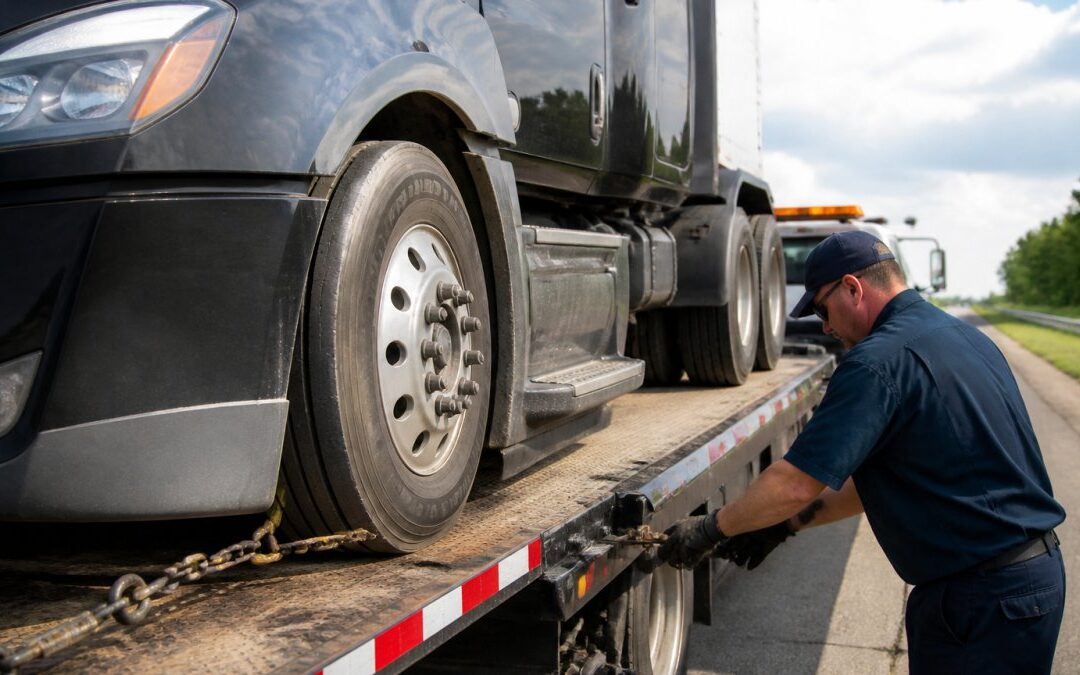
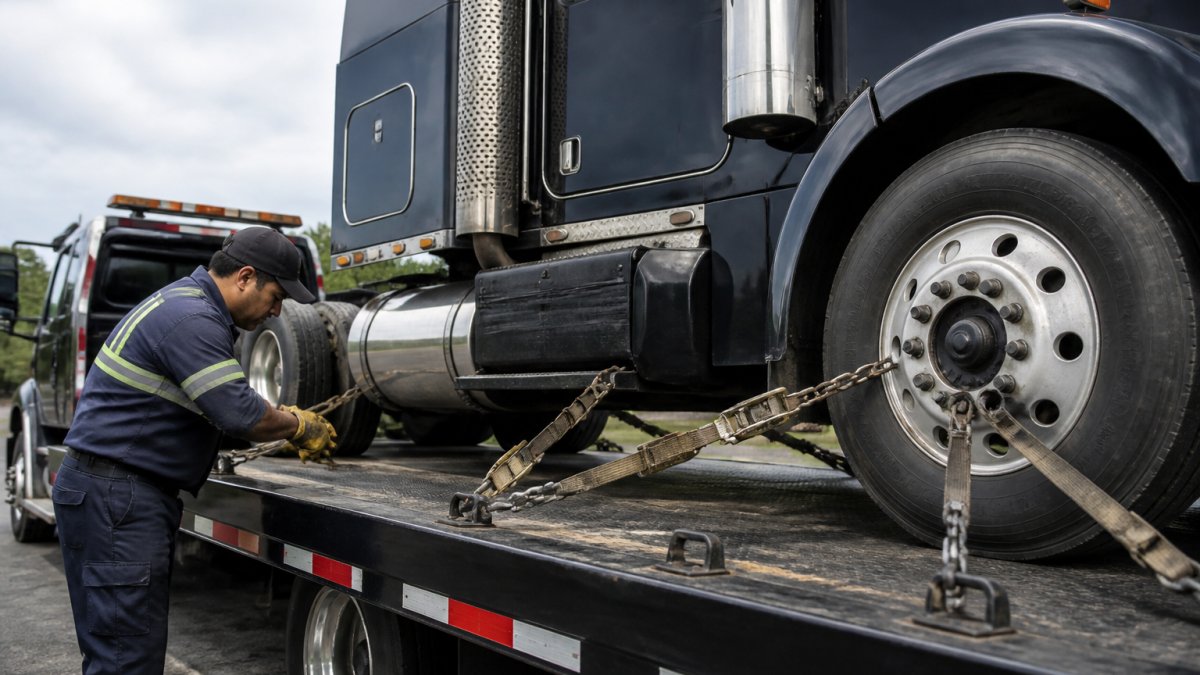
Flatbed towing is the gold standard for avoiding towing damage to trucks. Your truck sits on a flat platform.
Flatbed tow trucks have a flat platform that extends from the rear.
Flatbed towing costs more than wheel lift or dolly towing, but that extra cost is worth it when you’re protecting a valuable truck.
Fox Recovery operates state-of-the-art 19-foot and 21-foot flatbeds specifically designed for heavy-duty trucks.
Why Flatbed Towing Works:
Your truck doesn’t move during towing. The flatbed holds it stationary, so the transmission doesn’t turn, the driveshaft doesn’t spin, and the differential stays at rest.
Flatbed towing protects your suspension by distributing weight evenly across the platform, with no stress on the frame or suspension components.
Wheel Lift and Dolly Alternatives
Wheel lift towing uses a hydraulic arm to lift one or two wheels off the ground.
Both methods are cheaper than flatbed towing. Both methods also create risks for avoiding towing damage to trucks.
Wheel Lift Towing Risks:
Wheel lift towing lifts the front two wheels off the ground.
Wheel lift towing also stresses your front suspension. Your truck’s full weight hangs on the front bumper and frame.
Wheel lift towing works best for front-wheel drive vehicles. For trucks, it’s risky.
Dolly Towing Risks:
Dolly towing places a wheeled platform under your drive wheels. This lifts your drive wheels off the ground.
For front-wheel drive trucks, dolly towing doesn’t work. Your front wheels are your drive wheels.
Dolly towing also requires proper securing.
What to Do If a Truck Is Damaged During Towing
Damage discovered after towing requires immediate action. Document everything. Report the damage to the tow operator and your insurance company. File a claim. Gather evidence. Protect your rights.
Immediate Steps:
- Stop the tow immediately if damage is discovered during transport
- Take photos and video of all damage while the truck is still on the tow truck
- Get the tow operator’s name, company name, and contact information
- Get the names and contact information of any witnesses
- Ask the tow operator to stop at a repair facility so you can have the damage inspected
- Do not sign any paperwork accepting the truck’s condition until you’ve inspected it completely
Damage can be subtle. Check for:
- Cracks in your frame or welds
- Bent suspension components
- Damaged bumpers or body panels
- Fluid leaks from your transmission, engine, or differential
- Unusual noises when the engine starts
- Warning lights on your dashboard
Documenting Damage and Filing a Claim
Documentation is everything when filing a damage claim. Photos and video prove what happened. Written statements from witnesses support your case. Repair estimates show the cost of fixing the damage.
Documentation Steps:
- Take photos of all damage from multiple angles
- Include close-ups of specific damage areas
- Take photos showing the tow truck and towing method
- Record video of your inspection, narrating what you see
- Get a written statement from the tow operator describing what happened
- Get contact information from any witnesses
- Request a copy of the tow ticket and any paperwork signed during the tow
- Get a repair estimate from a qualified mechanic or dealership
Filing Your Claim:
Contact the towing company‘s insurance company. Provide all documentation. Request a claims adjuster to inspect the damage. Get a written estimate for repairs. Submit the estimate with your claim.
If the towing company disputes the claim, provide your photos, video, and witness statements. Show the repair estimate. Explain how the damage occurred during the tow.
Do not accept a settlement offer until you have a complete repair estimate. Transmission damage might not show up for weeks or months. Get a pre-purchase inspection from a mechanic before accepting any settlement. Hidden damage could cost thousands to repair later.
Safe Recovery of Stuck or Disabled Trucks
Recovering a stuck or disabled truck requires specialized equipment and expertise.
Recovery Equipment:
Rotator trucks have a boom and winch that can pull from any angle.
Rollback trucks have a flatbed that tilts and slides.
Wheel lifts with winches can pull a truck out of a ditch by the frame.
Recovery Precautions:
Never use a single winch point. Always use multiple attachment points on your truck’s frame.
Never exceed your truck’s recovery rating. Your owner’s manual specifies the maximum pulling force your frame can withstand.
Never pull at extreme angles. Recovery should be as straight as possible.
Never attempt self-recovery with consumer equipment.
At Fox Recovery, we operate state-of-the-art flatbed equipment specifically designed for heavy-duty trucks.
| Recovery Method | Drive Wheels | Best For | Risks |
|---|---|---|---|
| Flatbed | All off ground | All trucks | Higher cost |
| Wheel Lift | 2 on ground | Front-wheel drive only | Transmission drag (RWD) |
| Dolly | 2 off ground | Rear-wheel drive only | Rear suspension stress (FWD) |
Additional Resources:
According to National Highway Traffic Safety Administration guidance on towing safety, proper vehicle inspection before towing prevents most damage claims.
The American Trucking Associations safety standards recommend flatbed towing as the preferred method for protecting vehicle drivetrains during transport.
Research from Consumer Reports on vehicle towing damage shows that improper towing method selection is the leading cause of post-tow transmission failures.
Frequently Asked Questions
What should you check before towing a heavy-duty truck?
Before any tow, inspect the truck’s brakes, steering, lights, and tire condition. Check that all doors and windows are secure and that the parking brake is released. Review the owner’s manual for manufacturer towing recommendations, including weight limits and drivetrain requirements. Verify that the tow operator has confirmed the truck’s configuration (two-wheel drive, four-wheel drive, or all-wheel drive) to determine the safest towing method. Take photos of the truck’s condition before towing begins.
How do you protect a truck’s drivetrain during towing?
The safest way to protect a truck’s drivetrain is to keep all drive wheels off the ground. For rear-wheel-drive trucks, use a flatbed or wheel lift on the front wheels. For four-wheel-drive and all-wheel-drive trucks, flatbed towing is the only safe option because these vehicles cannot have any drive wheels on the ground without risk of transmission damage. Always follow the manufacturer’s guidance in the owner’s manual and ensure the tow operator understands your truck’s specific drivetrain configuration.
What happens if you tow over capacity?
Towing beyond a truck’s rated capacity can cause severe damage to the transmission, driveshaft, suspension, and brakes. The vehicle may experience overheating, fluid leaks, and loss of braking ability during transport. Always verify the truck’s towing capacity in the owner’s manual and ensure the tow company confirms they can safely handle the weight before beginning the tow.
How can you document truck damage before and after a tow?
Take clear, timestamped photos of the truck from multiple angles before the tow begins, including close-ups of any existing damage, dents, or wear. Document the odometer reading, fuel level, and overall condition. After the tow is complete, photograph the truck again in the same locations and angles. If damage is discovered, photograph it immediately and write down the date, time, and specific damage description. Keep all photos, the tow receipt, and any written agreement with the towing company for your damage claim.