
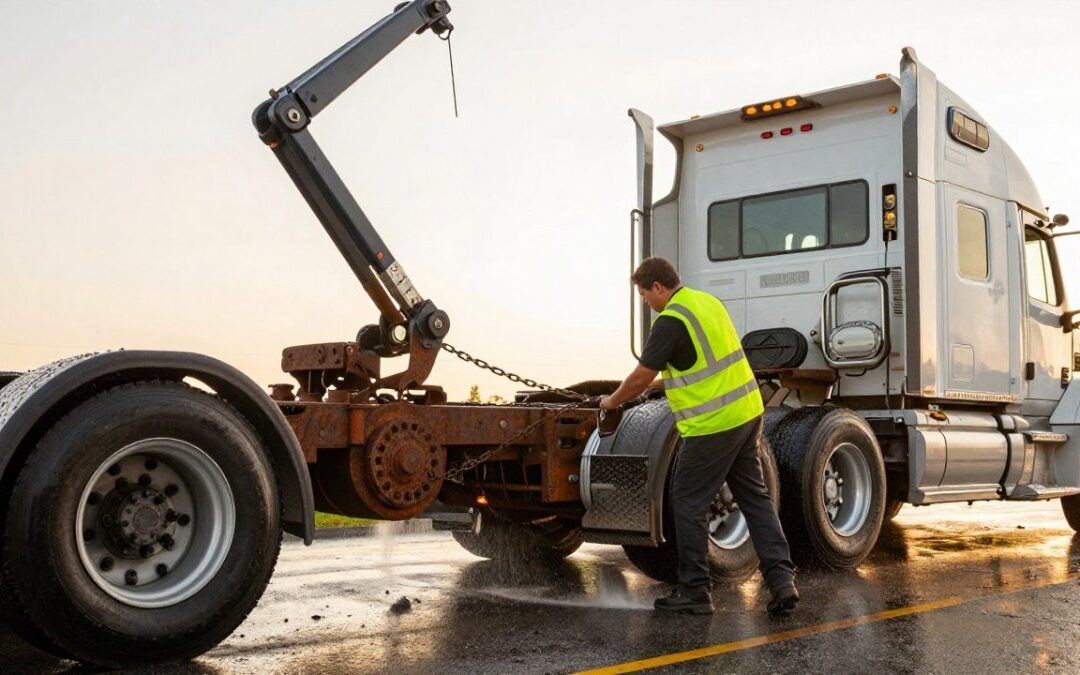
Quick Summary
Most heavy duty towing accidents are avoidable and come from small gaps like unchecked equipment, overloaded or poorly secured cargo, speeding and following too closely. Preventing them requires pre-trip inspections, load control, safe driving and careful scene setup.
- Walk around the truck and inspect tires, lights, hydraulic lines and the winch cable before every tow.
- Confirm the vehicle is within its rated towing capacity and attach loads only at manufacturer-approved points.
- Keep a wide following gap, often several seconds, and brake gently and early.
- Calculate line tension from the pull angle and rolling resistance, and choose components whose working load limit exceeds it.
- Set up work zones from the traffic side outward and leave a buffer between the traffic lane and the work area.
Table of Contents
- Why Heavy Duty Towing Accidents Happen and How Most Are Avoidable
- Pre-Trip Inspections and Preventive Maintenance for Heavy-Duty Tow Equipment
- Load Securement, Weight Distribution, and Safe Towing Capacity
- Speed, Following Distance, and Defensive Driving on Heavy-Duty Tows
- Heavy Truck Recovery Safety Procedures: Scene Assessment and Rigging
- Roadside Towing Safety: Work Zones, Visibility, and Weather Controls
- Scheduling a Safety Review With Your Heavy-Duty Towing Provider
- Frequently Asked Questions
Why Heavy Duty Towing Accidents Happen and How Most Are Avoidable
Last Updated: November 19, 2026
Heavy duty towing accidents rarely come from one big mistake.
Preventing heavy duty towing accidents starts with knowing where the risk comes from: inspection, load control, safe driving and scene setup.
A heavy-duty tow moves a large truck, bus or trailer too heavy for a standard tow rig.
Common causes include:
- Overloaded or poorly secured cargo
- Worn brakes, tires or couplings
- Speeding on curves or downhill grades
A common mistake is treating a heavy tow like a normal job. The truck is bigger, so it needs more planning.
Pre-Trip Inspections and Preventive Maintenance for Heavy-Duty Tow Equipment
Before any tow, inspect the hitch, safety chains, wheel lift or sling, lights and brakes. To figure out which tools you need on hand, see What Heavy Vehicle Recovery Equipment Do You Actually Need?.
- Walk around the truck and check tires for cuts, bulges and proper inflation.
- Test all lights, turn signals and warning beacons.
- Inspect hydraulic lines and fittings for leaks.
- Confirm the winch cable or chain is free of kinks and broken strands.
- Record any defects and fix them before the job starts.
Watch out: a worn chain or strap can fail under load even when it looks fine from a distance. Replace any rigging that shows damage, and never use a part past its rated limit.
Keep a maintenance log. Regular checks catch problems early and give you a record if questions come up later. To go deeper on protecting the drivetrain, read Prevent Drivetrain Damage During Towing.
Load Securement, Weight Distribution, and Safe Towing Capacity
Every tow has a weight limit. For guidance on avoiding towing damage to your truck, see Avoiding Towing Damage to Trucks.
Weight distribution matters as much as total weight. An uneven load can cause sway, poor steering and trouble braking.
- Confirm the vehicle is within its rated towing capacity
- Attach the load at manufacturer-approved points only
- Use straps and chains rated above the expected load
If you are towing a large vehicle of a different type from your rig, consider whether your equipment suits it.
Speed, Following Distance, and Defensive Driving on Heavy-Duty Tows
Heavy vehicles need much longer to stop than cars. Keep your speed down, especially on curves, downhill stretches and wet pavement.
Defensive driving means expecting the unexpected: scan far ahead, check mirrors often, plan lane changes early, signal well before you move, and avoid sudden braking where you can.
- Brake gently and early
- Take curves slowly with a steady throttle
- Keep a wide following gap, often several seconds
Fatigue and shift length are often overlooked. Tired drivers react more slowly and misjudge distances.
Heavy Truck Recovery Safety Procedures: Scene Assessment and Rigging
Recovery work, pulling a truck out of a ditch, off a soft shoulder, or away from a crash scene, carries more risk than a routine tow because the forces are unpredictable and the vehicle may already be unstable. For a step-by-step guide to recovering a ditched truck, follow the process in order. Recovery failures usually trace back to two things: a scene that was never properly assessed, and rigging selected by guesswork rather than calculation.
Step 1: Stop, park, and protect before you assess
Before you walk up to the casualty vehicle, position your recovery unit so it protects the scene and gives you a safe escape path. Set the parking brake, chock the wheels on a grade, turn on amber warning lights, put on a high-visibility vest, and place warning devices behind the scene before anyone steps into the roadway. Do not begin assessment until traffic is being warned.
Step 2: Run a repeatable scene risk assessment
A repeatable checklist helps make sure nothing gets skipped under time pressure. Cover five categories:
- Traffic: speed and volume of passing vehicles, sight distance, lane closures needed, and whether law enforcement or a traffic control contractor should be requested.
- Terrain: slope, surface (pavement, gravel, grass, mud, sand), soft shoulders, ditches, embankments, and whether the recovery unit itself can stay stable under pull.
- Weather: rain, ice, snow, fog, wind, and visibility at the time of the pull, not the forecast.
Mark the exclusion zone physically, cones, tape, or vehicles, and keep everyone out of it, including the driver of the casualty vehicle. A common pattern is a well-meaning bystander standing near the bumper to “help,” which puts them directly in the line of tension.
Step 3: Calculate the real load before you rig
Rigging is where recovery work most often goes wrong. The load on a recovery line is not the same as the vehicle’s weight. Two effects raise it:
- Angle factor: when a line pulls at an angle rather than straight on, the tension in the line increases. A pull at 30 degrees off the vehicle’s axis can put substantially more tension on the line than the vehicle’s weight alone, and the effect grows as the angle widens. Rig for the tension the line will actually see, not the weight on the door placard.
- Rolling and resistance: a vehicle stuck in mud, sand, or against a curb resists movement, and that resistance adds to the pull. A vehicle that is mired can require far more line tension to break free than it does to roll once moving.
Working load limit (WLL) is the rated capacity of a strap, chain, shackle, or winch line after the safety factor is applied, not the breaking strength printed on the tag. Select every component so its WLL exceeds the calculated tension, and remember the weakest link sets the limit: a 20,000 lb rated chain connected to a 10,000 lb rated hook is a 10,000 lb system.
Step 4: Choose anchor points and rig correctly
Attach only to manufacturer-designated recovery points, frame rails, or purpose-built tow points. Bumpers, axles, tie rods, and sheet metal are not recovery points and will fail or damage the vehicle.
Keep the pull as straight as the scene allows. Side pulls put bending loads on the frame and increase the chance of a rollover.
Watch out: never stand between the recovery vehicle and the load, and never straddle a line under tension.
Step 5: Pull slowly and re-check as you go
Take up slack slowly, stop and inspect the rigging once tension is on, then continue the pull at a steady, low speed. Stop immediately if anything shifts, if the anchor point moves, or if the vehicle begins to lean. Once clear, re-inspect the rigging and vehicle before moving it, and document the recovery, what was used, the scene conditions, and any defects found, so the next job benefits.
Roadside Towing Safety: Work Zones, Visibility, and Weather Controls
Roadside work puts operators within a few feet of moving traffic, one of the largest single risks in towing. The controls below turn general advice into a repeatable setup, plus weather and terrain adjustments and a way to measure whether the controls are working.
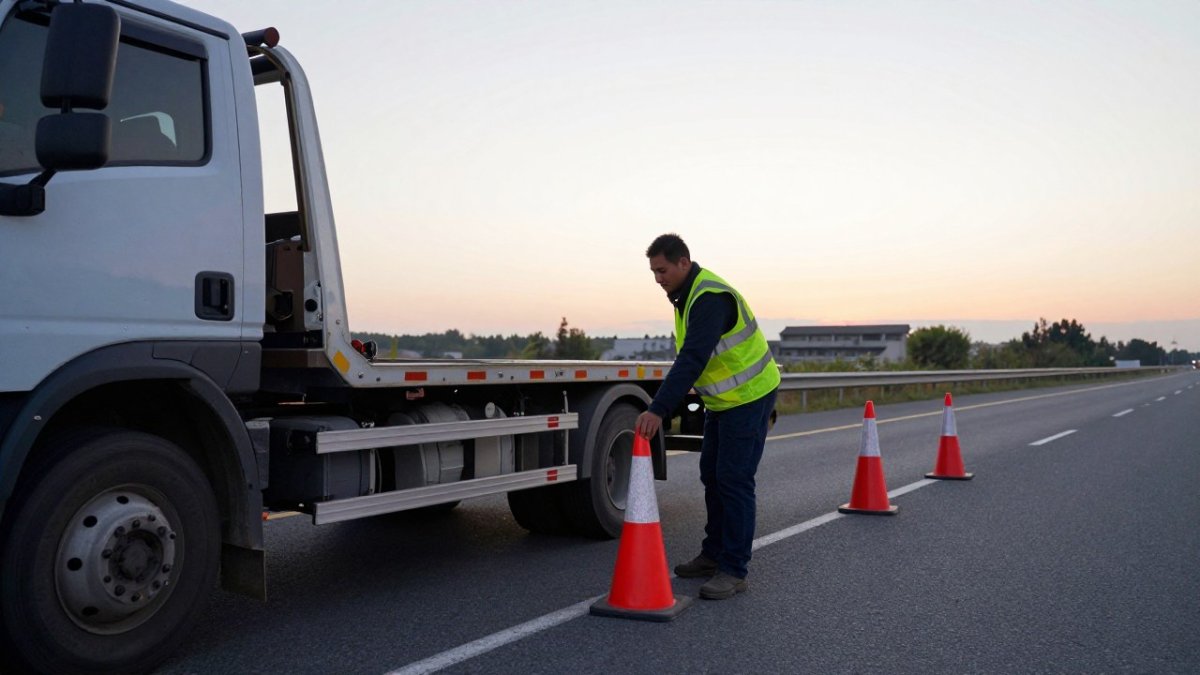
Set up a work zone in a repeatable order
Set up from the traffic side outward, so you are never standing in the lane longer than necessary:
- Park to protect. Position the tow truck between the work area and traffic where the scene allows, with amber lights facing oncoming vehicles. Set the parking brake and chock the wheels on any grade.
- Warn early. Place the first warning device well upstream of the work area so drivers have time to react, then place additional devices at closer intervals leading up to the scene. On higher-speed roads, extend the taper and add a buffer space between the traffic lane and the work area.
- Create a buffer. Leave an empty gap between the traffic lane and the work area, do not let the taper end at the vehicle. The buffer is where an errant vehicle goes before it reaches a person.
- Mark the exclusion zone. Use cones, tape, or a second vehicle to keep bystanders, the casualty vehicle’s driver, and responders out of the line of tension and out of the traffic lane.
- Wear high-visibility apparel that meets the applicable public-road work-zone standard, and keep it on for the entire job, not just while setting up.
Watch out: a common failure is setting up the taper behind the tow truck but leaving the operator’s side of the vehicle exposed to traffic.
Adjust for weather, road, and terrain
Conditions change the job, and the controls should change with them:
- Rain and wet pavement: stopping distances grow and visibility drops. Slow down, extend following distance, and add more warning devices upstream. Check that flares and cones will stay in place in wind and water.
- Ice and snow: traction on the shoulder and on ramps is unpredictable. Chock wheels, avoid parking on grades where the truck could slide, and consider whether the job should wait.
- Fog and low visibility: increase the warning distance substantially and use the truck’s lighting to make the scene visible from farther back. If visibility is too poor for traffic to react, pause the work.
Measure whether the controls are working
Safety controls only prove themselves if you track them. A practical program records:
- Near misses, close calls with traffic, rigging failures caught before they broke, and setup errors, so patterns surface before an injury does.
- Preventable incidents, collisions and damage that a reasonable operator could have avoided, reviewed for the root cause, not just the outcome.
- Inspection defects, what was found, how often, and whether the same defect keeps recurring.
Review the plan with your provider
If you manage a fleet or rely on a towing provider for regular work, ask how they set up work zones, how they adjust for weather and terrain, and how they track near misses and defects.
The article’s key work-zone setup and weather adjustments can be scanned at a glance:
| Condition | Adjustment | Why |
|---|---|---|
| Rain and wet pavement | Slow down, extend following distance, add upstream warning devices | Stopping distances grow and visibility drops |
| Ice and snow | Chock wheels, avoid grades, consider delaying the job | Traction on shoulders and ramps is unpredictable |
| Fog and low visibility | Increase warning distance, use truck lighting, pause if needed | Traffic cannot react in time |
| Wind | Avoid working under raised booms or lifted vehicles in strong gusts | High-profile vehicles and empty trailers are most affected |
| Grades and soft shoulders | Assess slope and surface, use wheel chocks and blocking | Recovery unit can lose stability under pull |
Scheduling a Safety Review With Your Heavy-Duty Towing Provider
If you manage a fleet or rely on a towing provider for regular work, ask about their safety practices. A good provider can explain their inspection routine, rigging standards, driver training and roadside setup. Before you book, you can compare the best heavy-duty towing services to see what to look for.
Questions worth asking:
- How are trucks and rigging inspected before each job?
- What is the process for reporting defects?
- Are operators trained for heavy-duty and recovery work?
For questions about heavy-duty towing service, call (847) 587-6076. Fox Recovery offers service 24 hours a day, 365 days a year.
Frequently Asked Questions
How can heavy-duty towing accidents be prevented?
Most heavy-duty towing accidents trace back to a few repeatable causes: equipment that was not inspected, loads that were not secured or balanced, speed and following distances that were too aggressive for the vehicle, and roadside setups that did not protect the crew from passing traffic. Prevention means building a consistent routine around each of those points. Complete a documented pre-trip inspection, verify the vehicle’s weight and securement points before moving, keep speeds conservative for the load, and set up warning devices before any hookup. Fleet managers should also track defects and near misses so recurring problems get fixed before they cause a crash.
What safety checks should operators complete before a heavy-duty tow?
Before any heavy-duty tow, operators should confirm the tow truck’s brakes, tires, lights, couplings, winch cable or chain, and hydraulic components are in working order. Check that the recovery equipment is rated above the expected load, that the towed vehicle’s weight is known or estimated, and that chains, straps, and hooks show no wear or damage. Confirm the towed vehicle’s brakes and steering are functional if it is being towed in a conventional manner, and verify that all lights and warning devices work. Record findings in a checklist and remove defective equipment from service until it is repaired.
How should a tow operator secure a heavy vehicle for transport?
Secure the vehicle at manufacturer-approved tie-down or towing points, never at suspension or non-structural parts. Use load binders and straps rated above the vehicle’s weight, and apply enough tension to prevent shifting under braking and cornering. Check the weight distribution on the carrier so the load does not overload the front or rear axles, and recheck the securement after the first few miles and at every stop. Keep the load low and centered when possible to reduce rollover risk.
What is the 80% rule of towing, and does it apply to heavy-duty towing?
The 80% rule is a common rule of thumb that suggests keeping a towing load at or below about 80% of the tow vehicle’s rated capacity to leave a safety margin for braking, grades, wind, and road conditions. It is a practical guideline rather than a federal requirement, and it applies to heavy-duty towing as well. Operators should always work from the manufacturer’s ratings for the specific vehicle, equipment, and hitch, and reduce loads further in adverse weather, on steep grades, or on uneven terrain.
