
Table of Contents
- Assess the Scene and Vehicle Condition Before Recovery Begins
- Truck Recovery Safety Procedures: Essential Steps Before Extraction
- Heavy-Duty Recovery Equipment: Choosing the Right Tools
- Semi-Truck Ditch Recovery: Heavy-Duty Extraction Techniques
- Heavy-Duty Winch-Out Procedures: Controlled Extraction Steps
- When to Call a Professional Recovery Service
- Post-Recovery Inspection and Vehicle Assessment
- Frequently Asked Questions
Last Updated: October 8, 2026
Assess the Scene and Vehicle Condition Before Recovery Begins
Before any recovery operation, understand what you’re working with. This initial assessment often determines whether the extraction is safe or dangerous; skipping it risks vehicle damage, injury, or worse.
Evaluate the terrain: is the truck in a shallow ditch or deep ravine, and what’s the slope angle? Are trees, rocks, or other obstacles blocking the path? A truck stuck in mud behaves differently than one wedged against a hillside, and slope angle determines which direction you can pull without flipping it.
Evaluate terrain, slope angle, and obstructions
Terrain determines your traction. Soft ground like mud or sand requires different equipment and techniques than rocky or frozen terrain, so check whether the ground around the ditched truck can support recovery equipment, anchor points, and pulling vehicles.
Slope angle is critical: a truck on a 30-degree slope pulls differently than one on a 60-degree slope, and steeper angles raise the risk of rolling during extraction.
Look for obstructions that block the extraction path:
- Fallen trees or branches
- Large rocks or debris
- Fencing or utility lines
- Water or standing mud
- Vehicles or equipment in the way
Clear what you can safely remove. If power lines are nearby, do not attempt recovery yourself, call a professional service like Fox Recovery that has experience working around hazards.
Check for hazards and establish traffic control
Hazards extend beyond the ditch. Check for fuel leaks, electrical damage, or signs the vehicle is unstable; a truck partially submerged or tilted at a dangerous angle may shift during recovery.
Traffic safety matters on highways and private property alike. If the truck is near a roadway, establish a buffer zone with warning triangles, flares, or cones, and keep yourself and your equipment out of traffic flow. A moving vehicle hitting your setup is a worst-case scenario proper traffic control prevents.
Never stand directly in line with a recovery rope or strap under tension. If the equipment fails or slips, it can whip back with deadly force. Always position yourself to the side and behind the recovery vehicle.
Truck Recovery Safety Procedures: Essential Steps Before Extraction
Safety procedures are the difference between walking away and facing serious injury. Before touching any equipment, establish what you’re protecting against.
Secure the vehicle and prevent rolling
A ditched truck can shift unexpectedly. Before pulling, engage the parking brake firmly and, on a slope, turn the wheels toward the uphill side to use gravity as a brake.
Chock the wheels if possible with wooden blocks or metal wedges. In water or soft mud, chocking may not be practical, so focus on rigging the recovery line to prevent rotation.
Put the transmission in Park (automatic) or a low gear (manual) as an extra layer of security, and disable the engine so it can’t start accidentally during recovery.
Verify recovery points and rated equipment compatibility
Every truck has designated recovery points, reinforced attachment points rated for pulling forces. Using the wrong point can tear through the frame and turn a straightforward extraction into catastrophic failure.
Locate the recovery points in your truck’s manual, usually front tow hooks, rear tow hooks, or frame-mounted D-rings, and confirm the point matches the rated capacity of your equipment.
Equipment ratings matter: a strap rated for 20,000 pounds cannot safely pull a 30,000-pound truck.
A recovery point rated for 15,000 pounds and a strap rated for 20,000 pounds are only as strong as the weakest link. Both must exceed the expected pulling force by a safety margin of at least 2:1.
Heavy-Duty Recovery Equipment: Choosing the Right Tools
The right equipment makes recovery faster and safer; the wrong equipment makes it impossible or dangerous. Knowing what each tool does separates professionals from amateurs.
Winches, snatch blocks, and mechanical advantage
A winch is the core tool for controlled extraction, spooling a recovery line under power to pull the stuck vehicle steadily.
Winch capacity is measured in pounds of pulling force.
A snatch block is a pulley that redirects the pull or increases mechanical advantage.
The trade-off is speed. Doubled mechanical advantage means the line spools twice as slowly. What takes 2 minutes without a snatch block takes 4 minutes with one. For a ditched truck, the extra time is worth the safety margin.
Recovery straps, kinetic straps, and rated shackles
Recovery straps are flat webbing rated for specific pulling forces, typically 20,000 to 30,000 pounds. They handle the shock loads of pulling a stuck vehicle and, unlike rope, don’t stretch much, making them suited to direct, controlled pulling.
Kinetic straps are recovery straps with built-in elasticity that stretch during the pull, absorbing shock and reducing sudden failure. For vehicle-to-vehicle recovery, they’re often safer than rigid straps because they cushion the force.
Shackles are metal connectors rated for specific loads, connecting your strap to the vehicle’s recovery point.
Understanding working load limits and equipment ratings
Working load limit (WLL) is the maximum safe pulling force for a piece of equipment, not its breaking strength. A strap with 40,000 pounds of breaking strength might have a 20,000-pound WLL, meaning you never pull with more than 20,000 pounds of force.
Every piece of recovery equipment has a marked WLL.
Add a safety margin: if you estimate 15,000 pounds of pull, use equipment rated for at least 30,000 pounds. This 2:1 margin accounts for unexpected resistance, angle of pull, and equipment wear.
Tag your recovery equipment with its WLL so operators can see it instantly. A permanent marker on the strap or a laminated label on the shackle prevents mistakes in high-stress situations.
Semi-Truck Ditch Recovery: Heavy-Duty Extraction Techniques
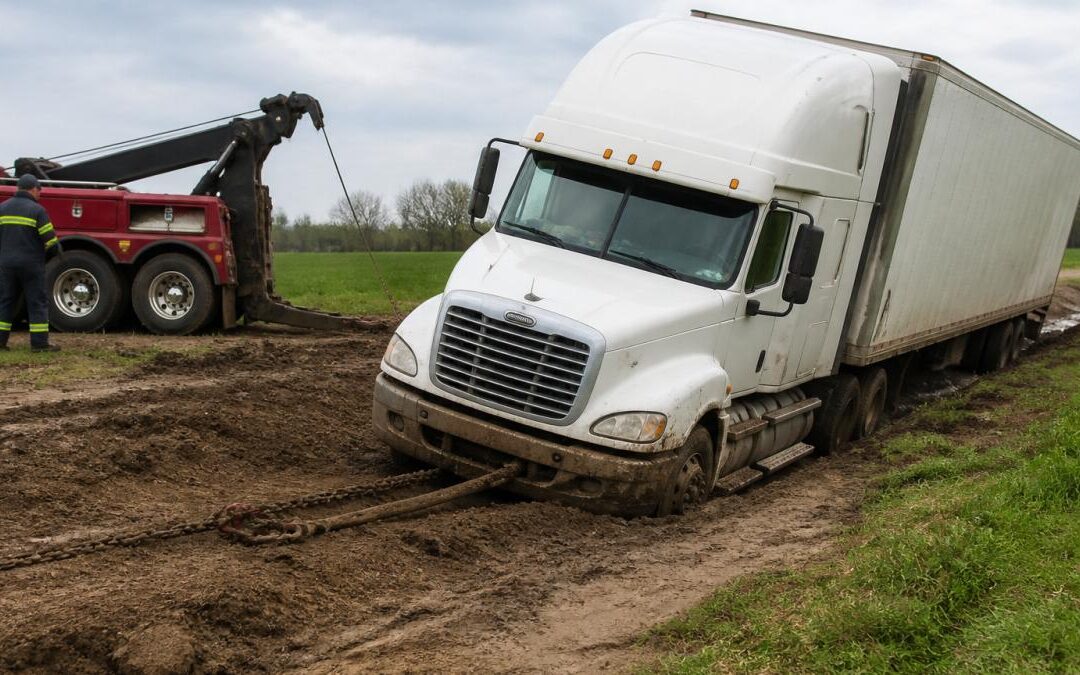
Semi-trucks and heavy-duty trucks present unique challenges. Their weight and size demand careful planning and specialized recovery for ditched trucks techniques.
Determining pull direction and anchor points
Pull direction determines whether the truck comes out smoothly or gets damaged. The ideal is straight out of the ditch, perpendicular to the slope; pulling at an angle risks rolling the vehicle or tearing the frame.
Anchor points must be immovable: a tree at least 12 inches in diameter, a recovery vehicle heavier than the stuck truck on stable ground, or a ground anchor driven or buried to hold pulling force.
Clearing obstructions and preparing the extraction path
Before pulling, clear the path of rocks, branches, and debris that might catch on the truck.
Dig mud from around the tires and undercarriage, clearing at least 12 inches on all sides if possible. For deeply buried wheels, use a shovel or excavator to expose them, reducing resistance as the truck moves.
For trucks stuck in sand or snow, airing down the tires increases the contact patch and improves traction once recovery begins. Lower tire pressure from 80 PSI to 30 PSI (or as low as your truck’s manual allows).
Heavy-Duty Winch-Out Procedures: Controlled Extraction Steps
A controlled winch extraction is methodical and deliberate. Rushing creates danger; the process takes time but works.
Setting up the winch and spooling the recovery line
Position the recovery vehicle on stable ground facing the direction of pull, engage the parking brake, and shift to Park or neutral so it cannot move during the pull.
Attach the recovery line to the winch drum, wrapping cable or synthetic rope in tight, even layers so it spools smoothly without twisting or bunching.
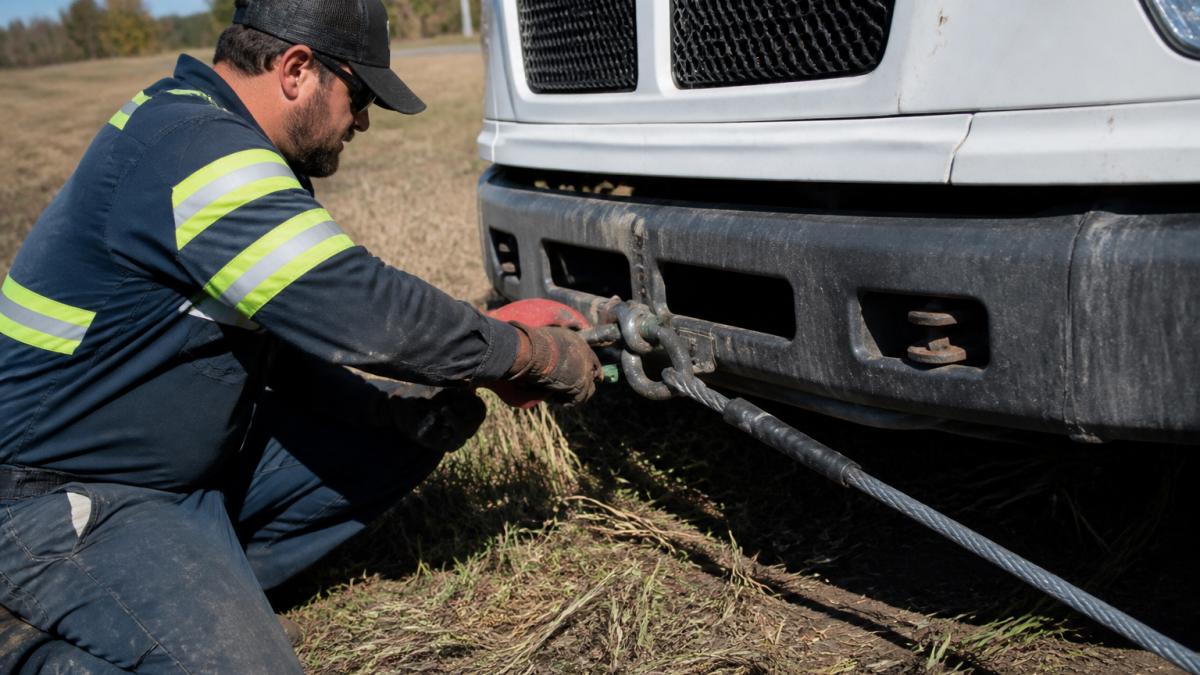
Attach the line to the recovery point with a rated shackle, double-checking that the pin is fully seated and secured. A loose connection fails instantly under load.
Executing the controlled pull and monitoring progress
Start the winch slowly so the vehicle shifts gradually and you can observe for problems.
Monitor the stuck vehicle continuously. Watch for:
- The vehicle tilting or rolling
- Smoke or steam from the recovery point
- The line stretching or moving erratically
- The stuck vehicle moving forward steadily
If the vehicle doesn’t move within 30 seconds, stop and reassess: resistance may be higher than expected or the pull angle wrong.
If the vehicle is heavily stuck, pull in short bursts: wind for 10-15 seconds, stop, let the ground settle, then resume. This rhythmic approach breaks suction in mud and reduces shock loads.
As the vehicle moves, keep the line under tension; slack creates shock loads when tension returns, and shock loads snap equipment.
When to Call a Professional Recovery Service
Some situations demand professional help. Knowing when to stop and call specialists prevents injury and expensive damage.
Recognize situations beyond DIY recovery:
- The vehicle is in water deeper than the tires
- The truck is on a slope steeper than 45 degrees
- Power lines or other utilities are near the recovery area
- The vehicle is damaged or unstable
- You lack the proper equipment or experience
- Multiple recovery attempts have failed
Professional operators have heavy equipment, insurance, and experience with complex extractions. Fox Recovery provides specialized recovery for ditched trucks where standard towing won’t work; our fully certified and licensed operators assess the scene, plan the extraction, and execute it safely.
When you call for professional recovery, provide clear information:
- The vehicle’s location and GPS coordinates
- The type and weight of the vehicle
- How the vehicle became stuck (ditched, rolled, bogged)
- Any hazards (power lines, fuel leaks, unstable ground)
- Whether the vehicle is occupied or empty
- The terrain and weather conditions
This helps the recovery team arrive prepared with the right equipment, protecting your vehicle and your safety.
Post-Recovery Inspection and Vehicle Assessment
Once the truck is extracted, inspect it thoroughly before driving; the process stresses the frame, suspension, and drivetrain.
Check the frame for cracks or bending and look underneath for damage to the transmission, transfer case, or differential.
Start the engine and listen for unusual noises; the transmission should shift smoothly.
A post-recovery inspection catches damage early, before it causes a breakdown or safety issue; even a successful extraction can damage hidden components.
Ditched truck recovery demands respect for the vehicle, the terrain, and the forces involved. Our 24/7 availability and fully certified operators handle complex extractions safely.
Frequently Asked Questions
What should a driver do immediately when a truck slides into a ditch?
First, ensure everyone is safe and turn on hazard lights. Exit the vehicle only if it is safe to do so and move to high ground away from traffic. Do not attempt to drive out, as this can cause the truck to roll or dig deeper. Call a professional recovery service and provide your exact location, vehicle weight, and how the truck is positioned in the ditch. Avoid walking near the vehicle or the ditch edge, and keep bystanders away from the recovery area.
What equipment is used for heavy-duty truck recovery?
Professional recovery uses winches with rated working load limits matched to the truck’s weight, recovery straps or kinetic straps rated for the load, snatch blocks to change pull direction and increase mechanical advantage, shackles and connectors certified for the working load, and traction boards or air-down techniques to improve grip. All equipment must be rated and compatible; mixing incompatible gear can cause failure and injury. A recovery operator inspects the truck’s recovery points and the terrain to select the safest method.
How do recovery operators prevent a truck from rolling during recovery?
Operators assess the ditch slope and the truck’s center of gravity before beginning extraction. They use snatch blocks and controlled winch tension to pull at the correct angle, minimizing sideways forces that could cause a rollover. Spotters watch for signs of instability, and the operator stops immediately if the truck tilts dangerously. In steep ditches, a second anchor point or stabilization rig may be used to hold the truck upright. Professional recovery teams are trained to recognize rollover risk and adjust their technique to keep the vehicle stable throughout the pull.
When should I call a professional recovery service instead of attempting DIY recovery?
Call a professional immediately if the truck is steep-sided or deep in the ditch, if it is loaded or a semi-truck, if the terrain is unstable or flooded, or if the vehicle has rolled. DIY recovery with undersized equipment or untrained operators causes injury and vehicle damage. Professional services have certified operators, rated equipment, and insurance. If you are unsure whether the situation is safe, call a recovery specialist to assess the scene. Attempting recovery without proper training and equipment can be fatal.