
Last Updated: November 4, 2026
Quick Summary
Yes, heavy duty mobile repair is usually worth it when the truck can be fixed safely on the spot, because the higher hourly rate is typically smaller than the towing bill plus a full day of lost work. The trade-off between avoided towing and downtime, not the hourly rate alone, decides the answer.
- Mobile repair carries a higher hourly rate plus a flat call-out fee, but no towing cost.
- The break-even point is the repair duration at which the mobile premium equals the tow plus downtime you avoid.
- Choose mobile repair for blown hoses, failed sensors, dead batteries, brake adjustments, or wiring faults.
- Transmission, drivetrain, frame, and collision damage almost always require a tow to a shop.
- Check manufacturer warranty terms before approving work outside an authorized facility.
Table of Contents
- The Real Math Behind Heavy Duty Mobile Repair
- Mobile Truck Repair vs. Shop Repair Cost: The Full Breakdown
- When to Choose Mobile Truck Repair Instead of Towing
- Heavy-Duty Mobile Mechanic Services: What Actually Comes to You
- Heavy-Duty Truck Repair or Replace: Making the Call
- Where Mobile Repair Falls Short: Safety, Diagnostics, and Warranty
- Weighing the Verdict: Who Comes Out Ahead
- Getting Your Truck Back on the Road with Fox Recovery
- Frequently Asked Questions
The Real Math Behind Heavy Duty Mobile Repair
Is heavy duty mobile repair worth it? For most breakdowns where the truck can be fixed safely on the spot, yes: the higher hourly rate is usually smaller than the towing bill plus a full day of lost work. That trade-off, not the hourly rate alone, decides the answer.
**** The service exists to shorten downtime, and downtime is the cost most owners forget to count.
A common mistake is comparing only the mechanic’s hourly rate against a shop’s rate. That misses towing, missed loads, and hours spent waiting for a bay. Below, we walk through the real numbers, when mobile repair wins, and when a shop is the honest answer.
Mobile Truck Repair vs. Shop Repair Cost: The Full Breakdown
The mobile truck repair vs. shop repair cost comparison depends on several factors, including labor rate, any call-out charge, towing, and downtime. Mobile service is often priced differently from shop work, so pricing depends on the job, your location, and the provider’s quote.
That premium only matters if it exceeds what you avoid. Compare the two paths side by side:
| Cost Line | Mobile Repair | Shop Repair |
|---|---|---|
| Labor rate | Higher hourly rate | Lower hourly rate |
| Call-out fee | Yes, flat charge | None |
| Towing | None, truck stays put | Towing cost both ways |
| Downtime | Shorter, repair starts on arrival | Longer, wait for tow and bay |
| Best for | Fixable faults, safe roadside access | Complex diagnostics, major repairs |
Run the comparison honestly. Add the mobile hourly premium to the call-out fee, then set that total against the tow bill plus a day of lost productivity. For help weighing tow quotes, read how to compare heavy-duty towing rates. When avoided costs are larger, mobile repair is cheaper even though the rate looks higher.
Build Your Own Break-Even Estimate
Most comparisons stop at the rate table. The useful version lets you plug in your own numbers. The goal is your break-even point for this specific breakdown, not a national average.
| Assumption | What to Enter | Why It Matters |
|---|---|---|
| Mobile labor rate | Your quoted hourly rate | The visible premium you are weighing |
| Shop labor rate | Your shop’s hourly rate | The baseline the premium is measured against |
| Mobile call-out fee | Flat charge quoted before work starts | Sunk cost once the unit rolls |
| Estimated mobile repair hours | From the provider’s estimate | Multiplies the hourly premium |
| Tow distance and hook fee | Miles to the shop plus base hook | The cost mobile repair avoids |
| Shop wait time | Hours until a bay opens | Adds to downtime even after the tow |
| Downtime value per hour | Revenue or load value lost per hour down | Usually the largest single line |
Add a few hours of avoided downtime and the gap widens. The break-even point is the repair duration at which the mobile premium equals the tow plus downtime you avoid; below it, mobile repair is cheaper, and above it, the shop wins on total cost.
A Worked Example You Can Adapt
Suppose a tractor-trailer loses a coolant hose on a rural shoulder. The mobile provider quotes a call-out fee plus a higher hourly rate for a short repair.
Watch out: entering a shop labor rate you were quoted months ago, or a downtime value that ignores the load’s delivery penalty, will make the mobile premium look larger than it is and push you toward the wrong call.
For owner-operators, one truck down means zero income, so the break-even point arrives faster than for a fleet with spare capacity. Fleet managers should value downtime at the marginal cost of the idle vehicle and the coordination time spent arranging the tow, not at a fleet-wide average.
When to Choose Mobile Truck Repair Instead of Towing
Choose mobile truck repair instead of towing when the fault is repairable on site and the truck sits somewhere a mechanic can work safely.
Towing makes more sense when the repair needs a lift, a diagnostic bay, or parts the mechanic cannot carry. Major engine and transmission work, frame damage, and collision repair belong in a shop.
The rule we give drivers: if the mechanic can reach the failed part, carry the replacement, and finish safely on the shoulder, mobile repair wins on both time and total cost. For a step-by-step walkthrough of a breakdown, see how to handle truck breakdowns.
Heavy-Duty Mobile Mechanic Services: What Actually Comes to You
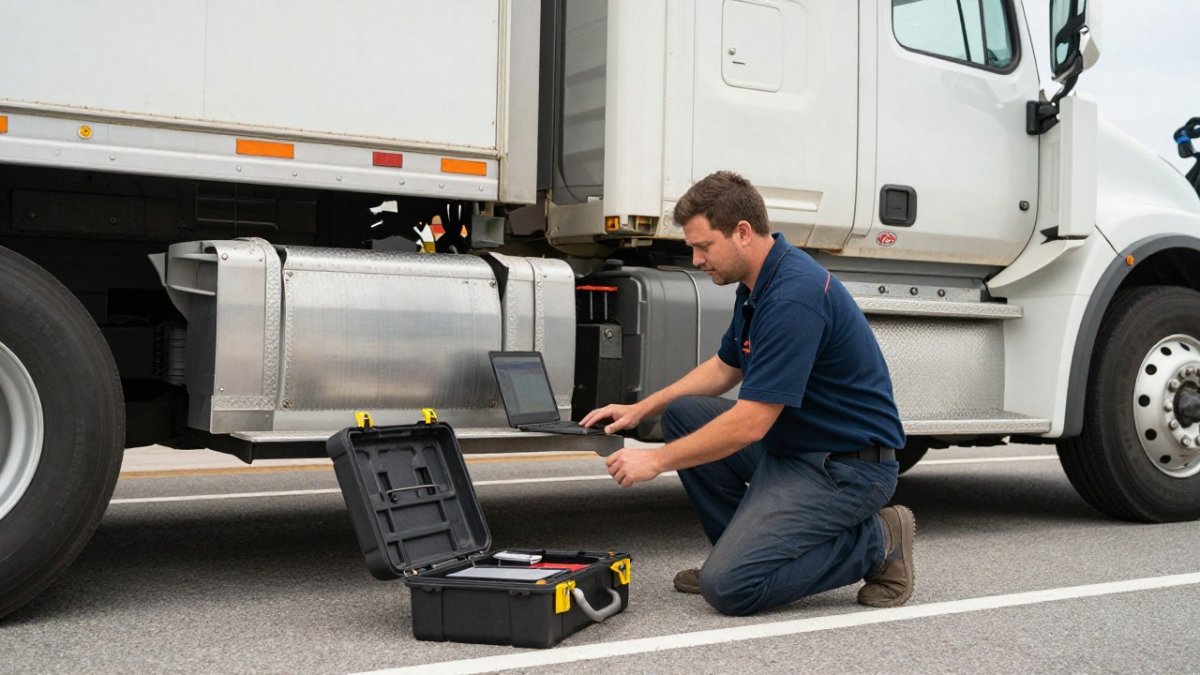
For what emergency roadside assistance covers when a mobile unit rolls out, read our guide on emergency roadside assistance for trucks.
Heavy-Duty Truck Repair or Replace: Making the Call
A single roadside fix rarely triggers this question. It surfaces when the same truck keeps breaking down, or when the diagnosis points to a major component.
Use this simple test. If the repair cost is a small share of what the truck earns in a year and the drivetrain is otherwise sound, repair it. If the repair approaches the truck’s market value, or the failure points to repeat drivetrain damage, replacement deserves a hard look. Learn how to prevent truck drivetrain damage before you decide.
Where Mobile Repair Falls Short: Safety, Diagnostics, and Warranty
Mobile repair falls short in three places: unsafe roadside conditions, repairs that need a full diagnostic bay, and warranty work that requires an authorized facility. A mechanic working on a narrow shoulder in heavy traffic or bad weather puts everyone at risk. The honest answer depends on the specific failure, not on a blanket rule.
Match the Failure to the Right Path
Treating every breakdown alike is the most common mistake. Use this repair-specific matrix to decide whether mobile service, towing, or a shop is the right call.
| Failure | Mobile Repair | Tow to Shop | Why |
|---|---|---|---|
| Tire or wheel-end issue | Often, if the location is safe and the spare or replacement is on the truck | When the shoulder is exposed or the wheel end is damaged | Tire work is fast but traffic exposure is the risk |
| Battery or charging fault | Usually | Rarely | Diagnosable and replaceable on site with the right stock |
| Air leak or hose failure | Usually, for accessible lines and fittings | When the leak is inside a sealed assembly | Hose and fitting stock decides the outcome |
| Electrical or sensor fault | Often, with a scan tool | When codes point to a module needing a controlled diagnostic bay | On-site diagnosis depends on the provider’s equipment |
| Engine fault | Sometimes, for external components | Usually, for internal or emissions-related faults | Internal work needs a bay and parts the truck cannot carry |
| Transmission or drivetrain | Rarely | Almost always | Lift, tooling, and parts exceed a service truck |
| Frame or collision damage | No | Always | Structural work requires a controlled shop environment |
Roadside Safety and Traffic Exposure
The location decides as much as the fault. A mechanic can only work safely where there is room to set up, light the scene, and keep the technician out of the travel lane. Narrow shoulders, blind curves, active work zones, and heavy-traffic corridors raise the risk enough that recovery to a shop is safer even for a repair mobile service could otherwise handle. Our best heavy-duty towing services buyer’s guide helps you pick a provider.
Watch out: approving a roadside repair on a shoulder with no safe setup area trades a small labor premium for a serious injury risk, and no cost comparison justifies that trade.
Diagnostics, Parts, and Repair Quality
A mobile unit is only as good as its diagnostic gear and parts stock. Ask whether the provider can pull and interpret fault codes on site, and whether the service truck carries the parts your truck is likely to need. A provider without the right scan tool or replacement part turns a one-hour fix into a wasted call-out plus the tow you needed all along. Repair quality also depends on follow-up: a roadside fix that addresses the symptom but not the root cause will bring the truck back to the shoulder. Ask what warranty the provider offers on the repair itself and whether a follow-up visit is included.
Warranty Coverage and Authorization
If your truck is under a manufacturer warranty, check the coverage terms before approving repairs, since some coverage may require work at an authorized facility. Check the terms before you approve work outside a dealer, and keep the mobile provider’s invoice and parts documentation so the repair record is complete. For faults that are clearly warranty items, the shop path may be cheaper in total even with the tow, because the repair itself is covered.
Weighing the Verdict: Who Comes Out Ahead
Mobile repair can suit fixable faults on accessible ground, while a shop may be the better choice for complex, warranty, or heavy-component work. Fleet managers who track downtime per breakdown see the difference fastest.
Where mobile repair loses is when it is used for the wrong job. A provider who cannot diagnose on site, or a fault that needs a bay, turns a cheap fix into a wasted call-out plus a tow. Match the service to the fault and the math favors you almost every time.
Getting Your Truck Back on the Road with Fox Recovery
When a commercial vehicle goes down, the fastest path back to work is a call to a team that can move it safely. Fox Recovery provides 24-hour, 365-day service with fully certified and licensed operators and 19 ft. and 21 ft. flatbeds for medium and heavy-duty trucks, buses, and tractor-trailers. We provide safe delivery of high-value vehicles under a multiple-point inspection, and we support fleet managers who need dependable recovery.
Call (847) 587-6076 and get your truck back on the road.
Frequently Asked Questions
Is heavy duty mobile repair worth it compared to towing to a shop?
It depends on the repair and the distance. Towing a heavy-duty truck commonly runs a hookup fee plus a per-mile charge, and every hour off the road adds downtime cost. If the truck needs a lift, a bay, or major engine work, towing is the better call.
Does mobile truck repair cost more than shop repair?
The hourly rate usually is higher, since you are paying for the mechanic’s travel and the convenience of on-site work. The comparison only makes sense when you add the costs mobile service avoids: the tow, the drop-off and pickup trips, and the days the truck sits waiting for a bay. A repair that takes two hours on site can still come out cheaper overall than a tow plus a shop visit, especially for a fleet where every down day has a price.
What repairs can a heavy-duty mobile mechanic perform?
Common on-site jobs include battery and charging system faults, starter replacement, alternator work, belt and hose replacement, air system leaks, brake adjustments, tire and wheel service, electrical diagnostics, and many trailer repairs. Work that needs a lift, a press, a welding bay, or engine teardown generally has to go to a shop. Ask the dispatcher to confirm your specific fault is something the mobile unit can handle before it rolls.
When should you choose mobile truck repair instead of towing?
Choose towing when the vehicle is blocking traffic or in a hazardous spot, when the damage is structural or collision-related, or when the job clearly needs shop equipment. A quick phone description of the symptoms usually settles which route makes sense.
How do I know a mobile repair provider can handle a heavy-duty truck without damaging it?
Ask for proof of certification and licensing before dispatch, A provider that handles medium and heavy-duty vehicles, buses, and tractor-trailers should be able to describe its equipment and experience without hesitation. Getting that confirmation up front protects the drivetrain and avoids the bad experiences that come from operators unfamiliar with heavy equipment.
