
Last Updated: November 1, 2026
Quick Summary
Flatbed vs wheel-lift towing comes down to whether all four wheels leave the ground. A flatbed carries the entire vehicle with nothing rolling, while a wheel-lift raises two wheels and leaves the other two spinning the drivetrain. Modern AWD, EV, and low-clearance vehicles generally call for a flatbed.
- Wheel-lift towing can be slightly more cost-effective than flatbed, according to AAA’s comparison.
- Many manufacturers specify flatbed transport for AWD and 4WD vehicles because no safe axle can be lifted.
- Under roughly 5 inches of ground clearance, request a flatbed with a long, shallow approach ramp.
- A dead 12-volt battery can leave an EV stuck in Park with the parking pawl engaged.
- Long-distance towing favors flatbed stability, while short local moves suit wheel-lift maneuverability.
Table of Contents
- Flatbed vs Wheel-Lift Towing: The Core Differences
- Side-by-Side Comparison: Cost, Damage Risk, and Maneuverability
- Flatbed Towing for Electric Vehicles
- Wheel-Lift Towing for All-Wheel-Drive Cars: What the Owner’s Manual Says
- Flatbed Towing for Low-Clearance Vehicles
- How to Tow a Modern Car Safely: A Decision Framework
- Requesting the Right Tow for Your Vehicle
- Frequently Asked Questions
Flatbed vs Wheel-Lift Towing: The Core Differences
Flatbed vs wheel-lift towing comes down to one question: do all four wheels leave the ground, or do two stay rolling? A flatbed loads your entire vehicle onto a powered deck. A wheel-lift raises only two wheels using a metal yoke, leaving the other two on the road. Flatbeds are the method modern drivetrains generally call for, and owner’s manuals often specify them. Below, we break down how each method works, where the damage risk sits, and how to pick correctly for your vehicle.
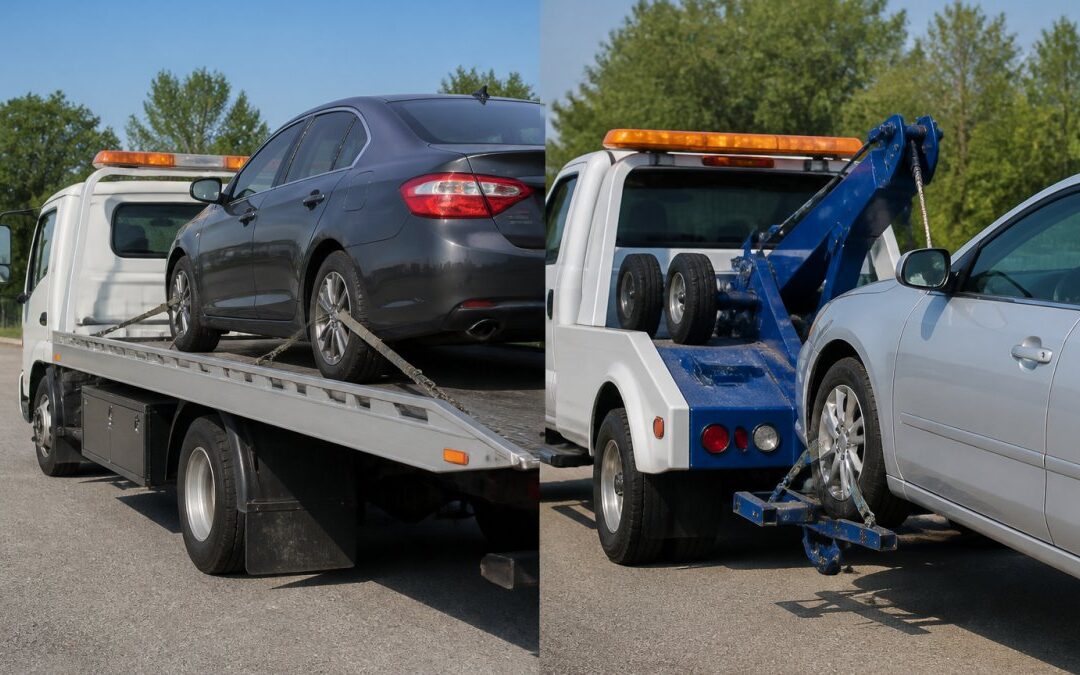
Flatbed towing is a transport method where the entire vehicle is winched onto a flat deck and secured with all four wheels off the ground. Nothing on the drivetrain turns during transport.
Wheel-lift towing is a method where a metal yoke lifts the front or rear wheels while the remaining wheels stay on the road and roll. The vehicle is only partially supported.
That single mechanical difference drives almost every other trade-off in this comparison.
How Flatbed Towing Works
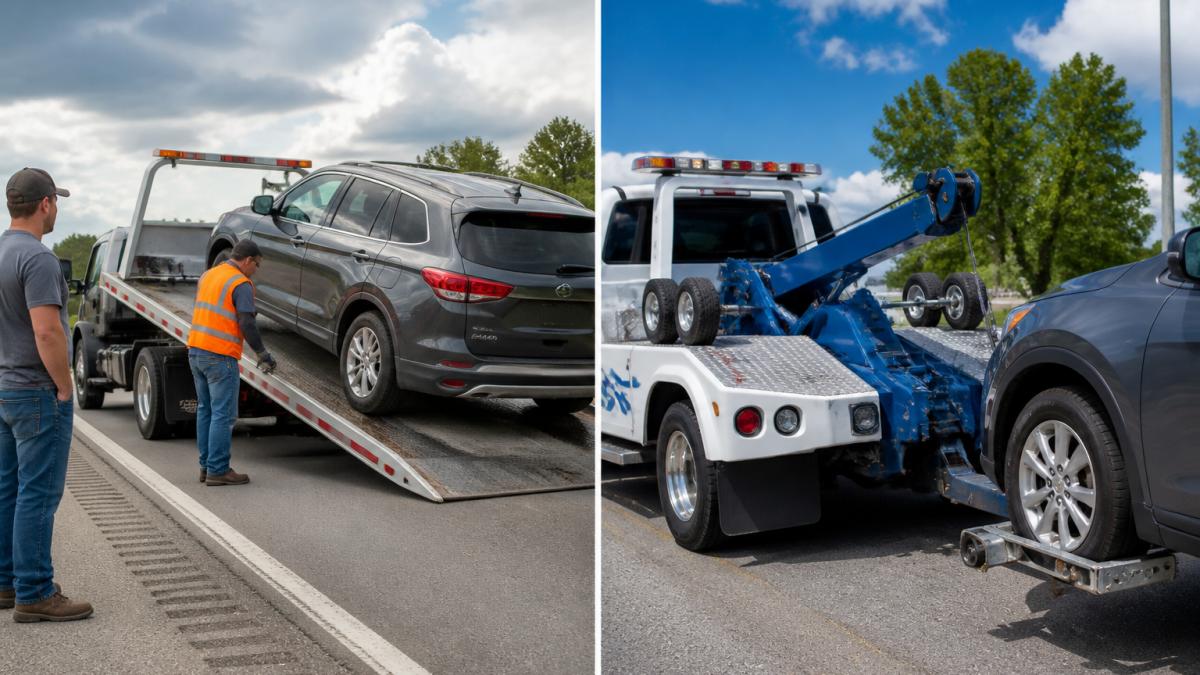
The operator tilts or slides the deck to the ground, winches the vehicle up the loading angle, levels the bed, and straps all four tires down. Loading angle matters here: a gentle approach ramp protects low front bumpers and splitters that would scrape on a steeper incline. Because the vehicle never rolls during transport, wheel bearings, axles, and transmission internals stay still. Flatbeds are larger and slower to position in tight spaces, and that is the honest cost of the protection.
How Wheel-Lift Towing Works
A wheel-lift truck backs up, lowers the yoke, and cradles two tires before hydraulically raising them. The other two wheels remain on the road. It hooks up fast and fits into tight spaces a flatbed cannot reach, which is why it dominates quick parking-lot work and short local moves. The catch is road contact: the rolling wheels spin the drivetrain, and the yoke contacts the tires and lower body directly.
Side-by-Side Comparison: Cost, Damage Risk, and Maneuverability
Wheel-lift is often the cheaper option, but cost is not the whole story. According to AAA’s comparison of flatbed and wheel-lift towing, wheel-lift towing can be slightly more cost-effective than flatbed, while flatbeds suit larger vehicles like SUVs and trucks.
| Factor | Flatbed Towing | Wheel-Lift Towing |
|---|---|---|
| Wheels on ground | None, all four off | Two remain rolling |
| Drivetrain stress | None | Rolling wheels spin the drivetrain |
| Damage risk | Low | Higher for AWD and low cars |
| Maneuverability | Limited in tight spaces | Strong in tight spaces |
| Typical cost | Higher | Often lower |
| Best for | AWD, EVs, low-clearance, luxury | Simple rear-drive, short moves |
Pros of flatbed: all four wheels off the ground, no drivetrain rotation, gentle loading angle, ideal for high-value vehicles.
Cons of flatbed: larger footprint, slower hookup in cramped lots, generally higher cost.
Pros of wheel-lift: fast hookup, excellent maneuverability, often cheaper, good for short-distance towing.
Cons of wheel-lift: road contact spins the drivetrain, greater tire and body damage risk, poor fit for AWD and low vehicles.
Flatbed Towing for Electric Vehicles
Flatbed towing is generally the recommended method for electric vehicles, and the reason is mechanical. An EV’s drive wheels are connected to an electric motor through a single-speed reduction gear, and there is no torque converter or clutch to isolate the motor from the wheels. When the wheels roll, the motor turns.
A few practical points that matter on modern EVs:
- “Neutral” is not the same as “free to roll.” Many EVs use a shift-by-wire selector, and Neutral may be electronically engaged only while the vehicle has 12-volt power. If the 12-volt battery is dead or the vehicle is in a crash state, Neutral may be unavailable, and the parking pawl or electric park brake may stay engaged.
- The electric parking brake (EPB) is a loading problem, not just a driving one. A flatbed operator needs the wheels to roll onto the deck. If the EPB cannot be released because of a fault, the vehicle may need to be skated, lifted with a wheel dolly, or winched with the brakes mechanically released per the manufacturer’s procedure.
- High-voltage safety is the operator’s concern too. First responders and tow operators are trained to treat orange-cabled components and the high-voltage battery pack as energized until proven otherwise, and to avoid cutting or crushing certain zones during recovery. Ask whether the operator has EV recovery training.
- Regenerative braking changes the risk profile. On a wheel-lift, even a short roll can put the motor in a generating state and, on some models, trigger fault codes or a service warning that has to be cleared at a dealer.
Do not assume a “tow mode” or “transport mode” in the infotainment menu makes wheel-lift towing safe. Those modes are typically designed for flatbed winching and may time out, require the key fob present, or disengage when the vehicle is tilted. Confirm the procedure in the owner’s manual and follow it exactly.
Hybrids deserve their own note. A hybrid has both an engine and one or more electric motor-generators, and if the drive wheels turn, the motor-generators turn. Owners should follow the manufacturer’s towing instructions for their specific hybrid.
For a modern EV, the honest summary is: flatbed unless the manufacturer’s manual explicitly permits another method, and even then only with the exact procedure the manual describes. For a high-value vehicle, the same logic that applies to luxury transport applies here.
Wheel-Lift Towing for All-Wheel-Drive Cars: What the Owner’s Manual Says
For all-wheel-drive cars, check the owner’s manual before anyone hooks up. For a deeper look at protecting the drivetrain, see Prevent Drivetrain Damage During Towing: A Complete Guide. Many manufacturers specify flatbed transport for AWD and four-wheel drive vehicles, because a wheel-lift leaves two wheels rolling, which can turn the drivetrain. Front-wheel-drive and rear-wheel-drive cars can often be wheel-lifted if the correct axle is raised, but AWD and 4WD leave no safe axle to lift.
Flatbed Towing for Low-Clearance Vehicles
Low-clearance vehicles are where loading angle decides everything. Sports cars, modified suspensions, and luxury sedans sit close enough to the ground that a steep ramp will catch the front lip or exhaust. If you are weighing flatbed transport for a special vehicle, read Is Professional Flatbed Towing Worth It for Vintage Cars?. A flatbed with a long, shallow approach ramp solves this; a wheel-lift yoke adds contact points under the body that a low car cannot spare. For high-value vehicles, see Flatbed Transport for Luxury Vehicles: A Complete Guide.
How to Tow a Modern Car Safely: A Decision Framework
Use this framework before you call anyone. For the full safe guide on avoiding towing damage, see Avoiding Towing Damage to Trucks: A Safe Guide.
Step 1, Identify the drivetrain and the energy source. AWD, 4WD, EV, or hybrid: plan on a flatbed. FWD or RWD: wheel-lift may work if the correct axle is raised.
Step 2, Check the owner’s manual, not the internet. Towing requirements vary by make, model, drivetrain, and model year.
Step 3, Measure ground clearance at the lowest point. Under roughly 5 inches at the front lip, splitter, or exhaust: request a flatbed with a long, shallow approach ramp, and tell the dispatcher the clearance number. A wheel-lift yoke adds contact points under the body that a low car cannot spare.
Step 4, Assess whether the vehicle can roll and steer. This is where most generic checklists stop, and where modern vehicles get complicated:
- Non-rolling wheels. A seized wheel, a locked electric parking brake, or a damaged hub means the vehicle cannot be winched normally. The operator may need skates, dollies, or a mechanical brake release per the manufacturer’s procedure.
- Steering damage or a locked steering column. If the front wheels will not straighten, a wheel-lift cannot safely cradle them, and a flatbed winch may pull the vehicle sideways. A flatbed with a straight-line pull and wheel straps is the safer choice.
- Parking pawl and shift-by-wire. If the vehicle will not shift out of Park because of a 12-volt fault, the operator needs to know before arrival so they bring the right equipment.
- Collision damage. Airbag deployment, a damaged high-voltage pack, or a crushed rocker panel changes the securement plan. Tell the dispatcher what is damaged.
Step 5, Check the distance and the route. Long-distance towing favors flatbed stability and keeps the drivetrain still for hours. Short local moves are where wheel-lift’s maneuverability earns its keep.
Step 6, Confirm the operator and the coverage. Ask three questions: Does the truck have a flatbed available? How will you secure the vehicle, and with what straps or wheel chocks? Are you trained and insured for this vehicle type? Then check your insurance and roadside-assistance coverage before you assume the tow is covered, many policies reimburse towing up to a limit, and some exclude certain vehicle types or require pre-authorization.
A trained operator will ask you the same questions you should be asking them: drivetrain, clearance, whether the wheels roll, and whether the steering works. If the dispatcher does not ask, volunteer it.
Watch out: the most common mistake is letting a wheel-lift raise the wrong axle on a FWD car, which drags the driven wheels and can damage the transmission. The second most common is assuming a “tow mode” makes a modern vehicle safe on a wheel-lift when the manual says otherwise.
Requesting the Right Tow for Your Vehicle
When you call, name the vehicle, the drivetrain, and the situation. “AWD crossover, cannot roll, front end damaged” tells the dispatcher more than “my car is stuck,” and it lets them send the right equipment the first time. Ask whether a flatbed is available and how the operator plans to load a low or damaged vehicle. At Fox Recovery, our fully certified and licensed operators are available 24 hours a day, 365 days a year, and vehicles are inspected at multiple points before and after loading.
Frequently Asked Questions
Is flatbed towing safer for modern cars?
For most modern vehicles, flatbed towing is the safer choice. The car sits entirely on the bed with all four wheels off the ground, so the drivetrain, transmission, and tires are not turning during transport. That matters for all-wheel-drive, four-wheel-drive, and electric vehicles, where spinning wheels can cause damage. Wheel-lift towing still works for many front-wheel-drive and rear-wheel-drive cars, but check your owner’s manual first.
Can a wheel-lift tow truck damage an all-wheel-drive vehicle?
It can. Lifting one axle leaves the other wheels on the road, and on an all-wheel-drive car those rolling wheels can spin the drivetrain and transmission without proper lubrication. Many manufacturers explicitly recommend flatbed transport for AWD and 4WD models. If a wheel-lift is the only truck available, ask whether a tow dolly can be used to keep all four wheels off the ground.
Should electric vehicles be towed on a flatbed?
Yes, flatbed towing is the standard recommendation for EVs. Electric motors connect directly to the wheels, so rolling the car in gear can generate current and heat that damages the motor or battery system. Flatbed towing for electric vehicles keeps all four wheels stationary. Always check the owner’s manual for the manufacturer’s specific towing instructions before the truck arrives.
When is wheel-lift towing appropriate for a modern vehicle?
Wheel-lift towing suits front-wheel-drive or rear-wheel-drive cars that roll and steer freely, especially for short-distance towing or tight spaces where a full flatbed cannot maneuver. It is often slightly more affordable. Avoid it for AWD, 4WD, EVs, low-clearance cars, or vehicles with locked wheels or collision damage, where a flatbed is the safer choice.
Modern drivetrains do not forgive a rushed hookup, and a wheel-lift on the wrong vehicle can turn a breakdown into a repair bill. Fox Recovery runs state-of-the-art 19 ft. and 21 ft. flatbeds with fully certified and licensed operators, available 24 hours a day, 365 days a year, with multiple-point inspection before and after every load. Get started with Fox Recovery and move your vehicle the way its manufacturer intended. Call (847) 587-6076.
