
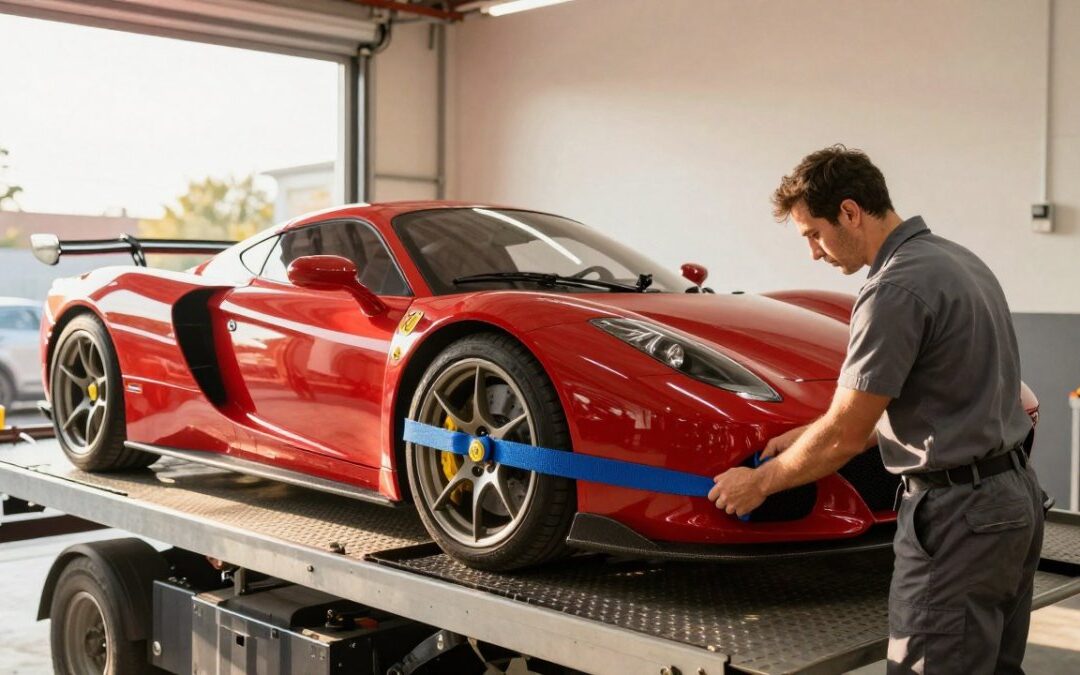
Last Updated: November 22, 2026
Quick Summary
To prepare for exotic car transport, wash the car, photograph every panel, and note existing scratches, chips, and wheel rash in writing. Remove personal items, check fluids, battery, tires, and fuel, record the odometer, hand over one key, and confirm the carrier’s credentials and insurance before booking.
- Leave about a quarter tank of fuel and keep the spare key with you.
- Ask for a flatbed with a tilt deck and extendable ramps for low-clearance cars.
- Confirm the carrier’s cargo insurance limit meets or exceeds your car’s agreed value.
- Write any new damage on the bill of lading before you sign at delivery.
- Tell the carrier upfront if the car is inoperable so they bring a winch and skates.
Table of Contents
- The Exotic Car Shipping Checklist: What to Do Before the Truck Arrives
- How to Ship a Low-Clearance Car Without Scraping the Bumper
- The Car Shipping Inspection Checklist: Documenting Every Detail
- Vetting Your Carrier: Credentials, Equipment, and Experience
- Exotic Car Transport Insurance: Verifying Coverage and Filing Claims
- Under the Hood and Inside the Cabin: Final Vehicle Prep
- Special Handling: Inoperable Vehicles and Loading Safeguards
- Booking Your Exotic Car Transport with Fox Recovery
- Frequently Asked Questions
The Exotic Car Shipping Checklist: What to Do Before the Truck Arrives
Learning how to prepare an exotic car for transport safely starts with one rule: the carrier can only protect what you hand over in good order. At Fox Recovery, we know that the cars that arrive in the best condition are usually the ones whose owners did the homework first.
Exotic car transport is the process of moving a high-value vehicle between locations using specialized equipment, documented condition reports, and insured carriers. Skip one step and you’re relying on luck.
Here’s the short version of the checklist:
- Wash the car and photograph every panel
- Note scratches, chips, and wheel rash in writing
- Remove all personal items and loose objects
- Check fluids, battery, tires, and fuel level
- Record the odometer reading
- Hand over one key, keep the spare
- Confirm the carrier’s credentials and insurance
The Federal Motor Carrier Safety Administration regulates interstate movers and requires operating authority, so ask for it before booking.
Here is the short version of the pre-shipment checklist the article lays out.
| Step | What to do |
|---|---|
| Clean and document | Wash the car and photograph every panel |
| Note existing damage | Record scratches, chips, and wheel rash in writing |
| Clear the interior | Remove all personal items and loose objects |
| Check the mechanicals | Check fluids, battery, tires, and fuel level |
| Record mileage | Note the odometer reading |
| Handle keys | Hand over one key, keep the spare |
| Vet the carrier | Confirm credentials and insurance before booking |
How to Ship a Low-Clearance Car Without Scraping the Bumper
Low ground clearance is where most damage happens. A supercar with a splitter sitting a few inches off the pavement cannot climb a standard ramp angle, and forcing it cracks carbon fiber.
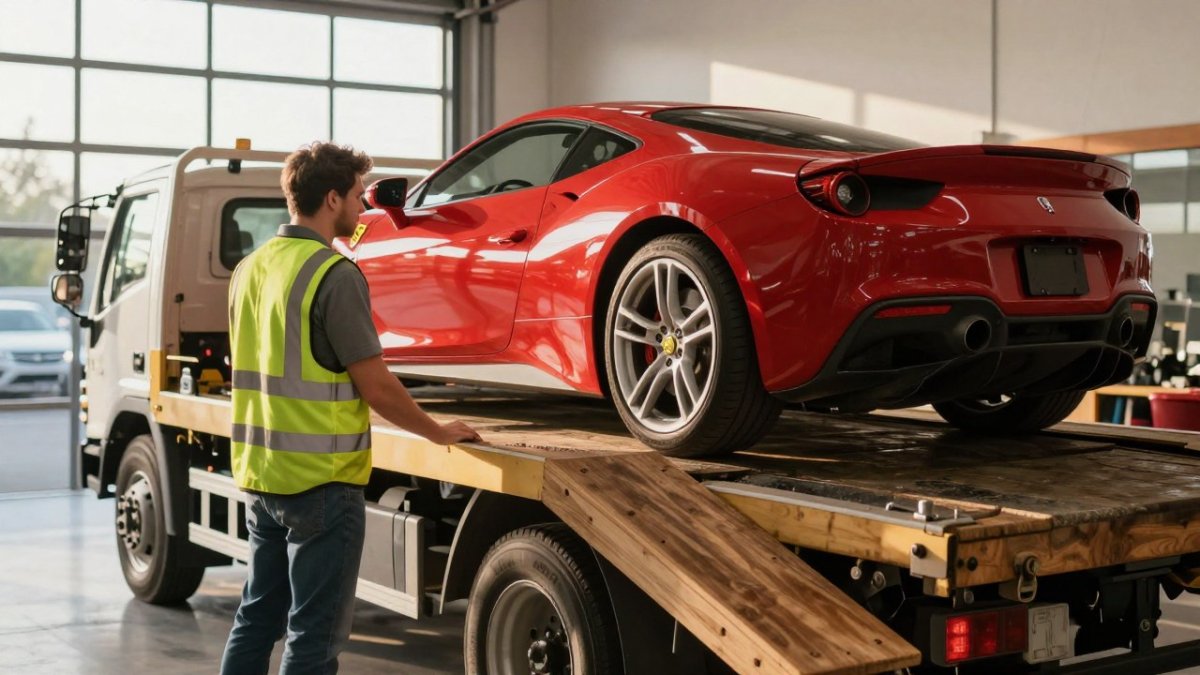
The fix is equipment, not muscle. A flatbed with a tilt deck and extendable ramps can lower the approach angle so the nose clears.
If clearance is tight, read our guide to flatbed transport for luxury vehicles before you book.
The Car Shipping Inspection Checklist: Documenting Every Detail
A proper condition report is your proof if something goes wrong. It records the car’s state at pickup with photos and notes, signed by both parties.
Photographing Pre-Existing Damage
Walk the car in good light and shoot these:
- Four corners, straight on
- Each wheel and tire sidewall
- Rocker panels and front splitter
- Windshield and roof
- Odometer with the key in frame
Snap close-ups of every chip and scuff. Date-stamped photos beat memory every time.
The Delivery Inspection
Repeat the same walk at delivery, before you sign. Compare against your pickup photos. Note anything new in writing on the bill of lading. If damage appears, our guide on what to do if a luxury car is damaged during transport walks through the claim steps.
Vetting Your Carrier: Credentials, Equipment, and Experience
Carrier selection is the single decision that determines whether your exotic arrives in the same condition it left. A practical carrier check takes only a few minutes before you pay a deposit.
1. Confirm active operating authority
What you want to see:
- Authority status: Active, not pending or revoked.
- Operating status: Authorized for property, not just passenger.
- Out-of-service history: A recent out-of-service order is a walk-away signal.
- Crash and inspection ratios: Compare the carrier’s vehicle out-of-service rate against the national average shown on the same page. A rate well above the average means the fleet is failing roadside inspections.
Watch out: a broker and a carrier are not the same thing. Many listings are brokers who will resell your shipment to an unknown motor carrier. Ask directly: “Are you the carrier that will physically haul the car, or are you brokering it?” If brokered, get the motor carrier’s USDOT number in writing before pickup.
2. Match the equipment to the vehicle
Credentials get a carrier legal; equipment gets your car loaded without damage. Ask for the specific trailer that will arrive, not a generic description:
- Enclosed trailer for show cars, paint-sensitive finishes, and anything with a soft top or exposed carbon.
- Flatbed with a tilt deck and extendable ramps for low-clearance supercars that cannot climb a fixed-angle ramp.
- Wheel straps or soft tie-downs over the tires. Chains or J-hooks on the frame, control arms, or subframe are a hard no on an exotic.
- Winch and skates if the car is inoperable or has a dead battery.
Ask the dispatcher to confirm the trailer length and whether a liftgate is available at both ends. A carrier who cannot name the equipment before booking is guessing.
3. Verify experience with your model class
Experience matters more when it covers vehicles like yours. Ask how many low-clearance or exotic vehicles a carrier has moved and whether the driver has loaded a car with similar ground clearance before. A carrier who hauls mostly sedans and SUVs may still be competent, but the loading conversation needs to be more explicit.
4. Get the pickup and delivery commitments in writing
The bill of lading should name the pickup window, the delivery window, the agreed condition report process, and the carrier’s cargo insurance limit. Verbal promises do not survive a dispute. If the carrier resists putting these terms in writing, treat that as your answer.
For the loading-equipment conversation specifically, see our guide to flatbed transport for luxury vehicles.
Exotic Car Transport Insurance: Verifying Coverage and Filing Claims
Most guides say “confirm the carrier’s insurance” and move on. That advice fails at the moment you need it, because cargo coverage has limits, exclusions, and deadlines that are not visible on a one-line certificate. Here is the verification method that actually protects a high-value car.
The two layers that matter
Carrier cargo insurance covers your vehicle while it is in the carrier’s custody. Your own collector or agreed-value policy may respond after the carrier’s coverage, depending on how the two are written. The order in which they pay, primary versus secondary, changes who you call first after damage.
How to verify the carrier’s cargo coverage
Request a certificate of insurance and read it against these checkpoints:
- Coverage limit per vehicle. Confirm the limit meets or exceeds your car’s agreed value. A carrier with a $100,000 per-vehicle limit is underinsured for a $300,000 supercar.
- Primary or secondary. Ask the carrier’s insurer directly whether the cargo policy is primary to the shipper’s own policy. Get the answer in writing.
- Exclusions. Common exclusions include pre-existing damage, mechanical or electrical failure, and items left in the vehicle. Read the exclusion list, not just the limit.
- Deductible. A per-claim deductible applies to many cargo policies. Know the number before you sign.
- Named insured and certificate holder. Confirm the certificate names the actual motor carrier, not just the broker.
A certificate that shows only a general liability limit is not proof of cargo coverage.
Documenting for a claim before anything goes wrong
Claims are won or lost on the condition report. At pickup, photograph every panel, wheel, and the odometer in good light, and have both parties sign the bill of lading noting any pre-existing damage. At delivery, repeat the same walk before you sign anything, and write any new damage on the bill of lading in the driver’s presence.
Filing a claim: the sequence that works
- Notify the carrier in writing within the window stated in the bill of lading. Many carriers set short notice periods; missing the window can void the claim.
- Attach your condition report photos from pickup and delivery, plus the signed bill of lading.
- File with your own collector policy if the carrier’s coverage is secondary or insufficient, and let the two insurers coordinate.
- Keep a written timeline of every call, email, and photo. A documented sequence is what moves a claim forward.
A carrier who dodges the cargo insurance question is telling you something. Walk away. For the full claim walkthrough, see our guide on what to do if a luxury car is damaged during transport.
Under the Hood and Inside the Cabin: Final Vehicle Prep
Small prep prevents big problems. Do these the day before pickup:
- Wash the car so damage is visible
- Remove toll transponders, garage openers, and cash
- Empty the trunk and glovebox
- Check tire pressure and top off fluids
- Charge the battery or note a weak one
- Leave about a quarter tank of fuel
Leave one key with the driver and keep the spare. Note the odometer reading on the paperwork.
Special Handling: Inoperable Vehicles and Loading Safeguards
A car that won’t start still ships, but it needs a winch and skates. Tell the carrier upfront so they bring the right gear. Loading safeguards include soft straps, wheel chocks, and a second spotter during the pull.
For a full walkthrough of best practices, our guide on luxury vehicle transport covers the wider picture.
Booking Your Exotic Car Transport with Fox Recovery
Ready to hand off the keys? Choosing the right carrier is the last box on the checklist. Our operators are available 24 hours a day, 365 days a year, and use 19 ft. and 21 ft. flatbeds. Call (847) 587-6076 or choose a towing company for high-value imports the right way.
Your car deserves a carrier who treats it like their own. Fox Recovery offers 24/7 availability, fully certified operators, and flatbed equipment built for high-value vehicles. Get started with Fox Recovery and ship your exotic with confidence.
Frequently Asked Questions
How do I document my car’s condition before transport?
Use your phone to take a slow, continuous video walking around the entire car, then take high-resolution photos of all four corners, the wheels, the roof, and the interior. Capture the odometer reading and date stamp the images. This car shipping inspection checklist creates a clear record of pre-existing damage. Have the carrier sign a condition report at pickup and compare it against the same checklist at delivery before you sign anything.
Can a low-clearance exotic car be loaded onto a standard trailer?
A standard open trailer often lacks the angle needed for low-clearance cars. Ask the carrier if they use a flatbed with a dovetail or liftgate, and whether they carry loading ramps and wood blocks to adjust the approach angle. Fox Recovery uses 19 ft. and 21 ft. flatbeds.
Should an exotic car be shipped in an enclosed trailer?
For high-value, classic, or supercar transport, enclosed transport protects against road debris, weather, and UV exposure. Open transport is usually fine for short, local moves, but cross-country shipping of a luxury car favors an enclosed trailer. Ask the carrier about tie-down methods and whether they use soft straps over the tires rather than chains on the frame.
What should I tell the transport company about my exotic car?
Disclose the exact model, ground clearance, modifications, and whether the car is inoperable. Tell them about any aftermarket aero parts, wide tires, or a stiff suspension that affects loading. Share your preferred contact method and confirm the pickup and delivery addresses. Clear communication up front prevents loading surprises and helps the carrier bring the right equipment, like extended ramps or a liftgate.
