

Last Updated: November 14, 2026
Quick Summary
Parking enforcement services are priced through payment-based, flat-fee, or hybrid models, and most quotes break down into a base retainer, a per-citation or per-payment fee, patrol frequency, payment processing, permit administration, signage, and collections. Because patrol labor and the per-citation fee drive most of the total, ask vendors to price each line item separately and model your annual cost against expected citation volume before signing.
- Payment-based models carry little upfront cost but charge a service fee on each successful citation payment.
- Flat-fee packages bill a fixed monthly or annual rate regardless of citation volume.
- A low retainer paired with a high per-payment fee can cost more than a flat fee as volume climbs.
- Signage is often billed separately as a one-time setup cost and can void enforcement if missing.
- Confirm whether towing is bundled and that response times are written into the contract.
Table of Contents
- How Parking Enforcement Pricing Models Actually Work
- What Parking Enforcement Services Cost in Practice
- What a Turnkey Package Usually Includes
- Parking Enforcement Contract Terms to Read Before Signing
- Private Parking Lot Signs: The Compliance Cost Nobody Budgets For
- Where Parking Lot Towing Services Fit in the Package
- How to Compare Providers and Pick the Right Fit
- Request a Lot Assessment Before You Commit
- Frequently Asked Questions
How Parking Enforcement Pricing Models Actually Work
Parking enforcement services pricing and packages rarely arrive as a single number on a quote. Property managers often ask for “the cost” and get three different structures back from three different vendors. That confusion is the first thing to clear up before you sign anything. Most private-lot enforcement providers price through one of three models, and each one shifts risk to a different party.
Payment-Based, Flat-Fee and Hybrid Structures
A payment-based model charges the vendor a service fee on each successful citation payment, with little or no upfront cost. A flat-fee model bills a fixed monthly or annual rate regardless of citation volume. A hybrid blends a modest base fee with a per-citation or per-payment charge.
| Model | Upfront Cost | Monthly Fee | Who Carries the Risk | Best For |
|---|---|---|---|---|
| Payment-based | None to low | None to low | Vendor | Lots with low or unpredictable violation volume |
| Flat-fee | Low | Fixed | Property owner | Steady, high-volume lots |
| Hybrid | Moderate | Base plus per-ticket | Shared | Mixed-use lots with seasonal swings |
Each model carries trade-offs that depend on your lot’s violation activity. Ask each vendor which model they use and why before you compare numbers.
What Parking Enforcement Services Cost in Practice
Parking enforcement services pricing depends on citation volume, patrol frequency, lot size, and how much of the process the vendor handles. Request a current quote for your property to see pricing specific to your lot. What you can do is break the quote into line items, price each one separately, and then rebuild the total so you can see which line is driving the number.
The Line Items Behind Every Quote
Most private-lot enforcement proposals decompose into the same buckets. Ask each vendor to price them individually even when they present a bundled package.
- Base or retainer fee: a fixed monthly charge that covers account setup, software access, and a minimum patrol commitment.
- Per-citation or per-payment fee: the vendor’s cut on each citation issued or each fine collected. This is where payment-based models earn their money, and it is the line most likely to be buried in a bundle.
- Patrol frequency: daily patrols cost more than weekly sweeps because labor is the largest variable cost.
- Payment processing: card and online payment processing fees, chargeback handling, and the cost of maintaining a payment portal. These are usually passed through or folded into the per-payment fee.
- Permit administration: issuing, tracking, and renewing parking permits adds labor and software cost, and it is often priced per permit or as an add-on module.
- Signage and lot marking: warning signs, striping, and lot numbering are frequently billed separately as a one-time setup cost rather than rolled into the monthly fee.
- Notice mailings and collections: first notices, second notices, and escalation to collections each carry a cost. Vendors that handle collections in-house price this differently than vendors that hand accounts to a third party.
How the Line Items Combine
A useful way to compare quotes is to build a simple annual model. Multiply the monthly retainer by twelve, add the per-citation fee times your expected annual citation count, add one-time signage and setup, then add any collections or towing pass-through.
Watch out: a low headline retainer paired with a high per-payment fee can cost more than a flat-fee package once citation volume climbs.
What Moves the Number Most
In most proposals, patrol labor and the per-citation fee are the two largest levers. Lot size and stall count change patrol time per visit; violation volume changes processing and collections work. A vendor that quotes a firm number over the phone without seeing the lot is guessing, and the guess usually lands low to win the bid and rises after the first invoice.
For a full walkthrough of how private-property towing gets set up at a business, our private property towing setup guide covers the steps from sign posting to first tow.
What a Turnkey Package Usually Includes
A turnkey package bundles the full enforcement chain under one contract: patrol, citation issuance, payment processing, notice of violation mailings, collections, and reporting.
Ask for an itemized breakdown even inside a package. A legitimate provider will show you what patrol, citation processing, and collections each contribute.
For a full walkthrough of how private-property towing gets set up at a business, our private property towing setup guide covers the steps from sign posting to first tow.
Parking Enforcement Contract Terms to Read Before Signing
The contract terms decide whether a good price stays good. Two contracts with identical rates can produce very different outcomes once term length and fee splits are on the table.
Term Length, Termination and Fee Splits
- Term length: multi-year terms lock in pricing but lock you in too. Ask what happens if your lot changes hands.
- Termination: look for a clear exit clause and notice period. A contract with no exit is a contract you can’t leave.
- Fee splits: confirm exactly what percentage the vendor keeps on each collected fine versus what flows to you.
- Escalation clauses: check whether rates rise automatically each year and by how much.
- Service-level commitments: patrol frequency, response times, and reporting cadence should be written into the agreement, not promised verbally.
A common mistake is signing a long term to get a lower rate, then discovering the patrol frequency in the fine print is half what you expected. Read the service-level section before the pricing section.
Private Parking Lot Signs: The Compliance Cost Nobody Budgets For
Signage is the line item property managers forget, and it’s the one that can void enforcement. Private-property enforcement rules in many areas require clear, visible warning signs before a vehicle can be cited or towed.
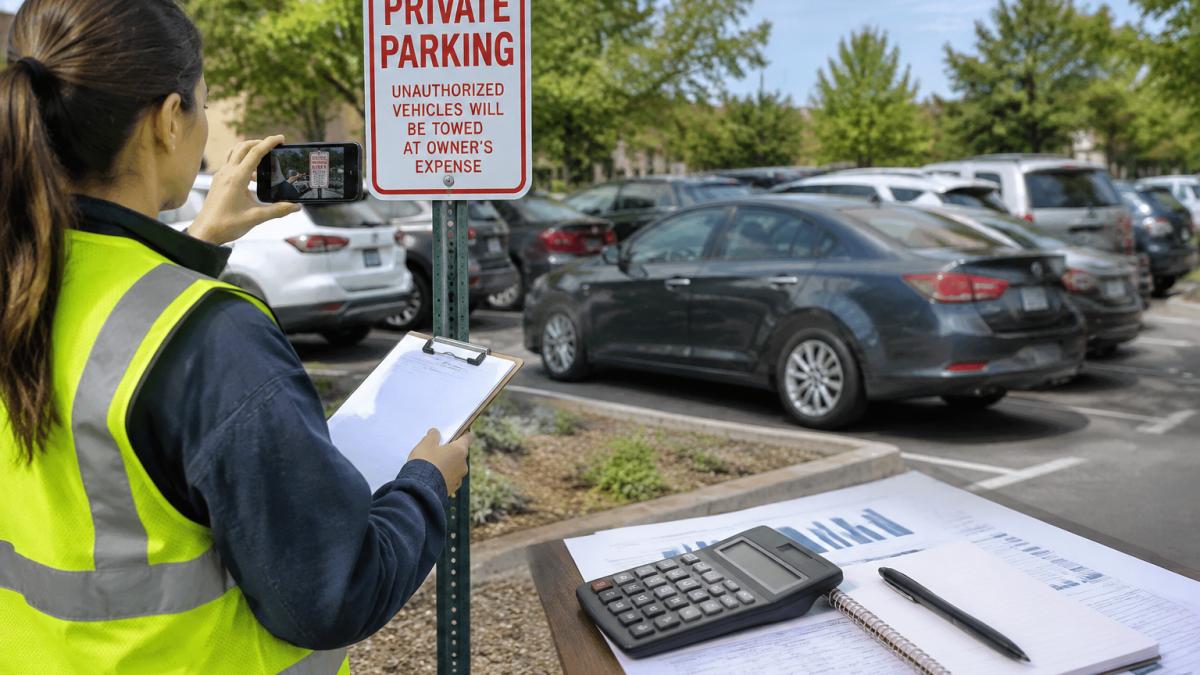
Budget for signs as part of the enforcement package, not as an afterthought. If you’re pricing compliant signage options, our guide to the best parking enforcement signs for private lots breaks down the choices so you can budget accurately.
Where Parking Lot Towing Services Fit in the Package
Parking lot towing can serve as the enforcement backstop: citations handle the paperwork, and towing removes vehicles that ignore them. Confirm whether towing is included in any package you consider.
If towing is bundled, confirm the provider is licensed and that response times are written into the contract. For the legal steps on removing abandoned vehicles from commercial property, see our guide to towing abandoned commercial vehicles.
How to Compare Providers and Pick the Right Fit
Comparing providers comes down to total cost of ownership, not the headline rate. The gap in most buying decisions is that property managers compare retainers and ignore the inclusions, service-level commitments, and recovered revenue that decide whether the contract pays for itself. Build a one-page comparison sheet and score every vendor on the same rows.
The Comparison Sheet
Put each vendor in a column and score these rows side by side:
- Pricing model: payment-based, flat-fee, or hybrid, and the exact split between retainer and per-citation fee.
- Setup and signage cost: one-time fees for signs, striping, and account setup, quoted separately from the monthly rate.
- Patrol frequency and response time: how often the lot is patrolled and how fast the vendor responds to a call, written into the agreement rather than promised verbally.
- Citation technology: handheld or app-based issuance, photo evidence, and whether data syncs to a portal you can access.
- Payment processing and portal: how drivers pay, what processing fees apply, and whether the vendor handles chargebacks.
- Appeals handling: who reviews disputes, how long drivers have to appeal, and whether the vendor or the property owner bears the cost of a successful appeal.
- Reporting cadence: what reports you receive, how often, and whether they show citations issued, paid, disputed, and collected.
Buyer-Specific Fit
Enforcement is not one service, and the right package depends on the property type. Apartments and multifamily lots usually need resident permit administration and a dispute process that handles tenant appeals. Commercial retail lots need fast turnover and towing as a backstop for repeat violators. Campuses and hospitals need permit systems tied to a larger access-control program and reporting that satisfies internal compliance.
The Total-Cost Math
Add the annual retainer, the per-citation fee times expected citations, setup and signage, and any collections or towing pass-through. Then subtract the revenue you recover from paid citations and the administrative hours you save by not handling notices and disputes in-house.
Watch out: a vendor that quotes the lowest rate but cannot show service-level commitments in writing is the one most likely to underdeliver on patrol frequency, and the underdelivery shows up as unpaid citations you cannot collect.
For heavy-duty and commercial recovery needs, our guide to comparing heavy-duty towing rates across providers gives you a method for benchmarking quotes side by side. If you’re selecting a provider from scratch, the heavy-duty towing buyer’s guide walks through the evaluation criteria.
Request a Lot Assessment Before You Commit
The only reliable way to price enforcement is to have the lot assessed. Square footage, stall count, traffic patterns, and existing signage all change the quote.
Accurate pricing usually requires seeing the lot. Fox Recovery provides 24/7 towing and recovery with fully certified and licensed operators, state-of-the-art 19 ft. and 21 ft. flatbeds, and the capability to handle medium and heavy-duty vehicles including buses and tractor trailers.
Frequently Asked Questions
How much do private parking enforcement services cost?
There is no single rate. Providers price by model: some charge no upfront or monthly fee and take a service fee on each successful payment, others bill a flat monthly retainer per lot, and some combine a low base fee with per-citation charges. Your quote depends on lot size, citation volume, patrol frequency and whether towing is included. Ask every provider to break the quote into fixed fees, per-citation fees and payment-processing fees so you can compare like for like.
Do parking enforcement companies charge property owners upfront?
Some do not. Payment-based models advertise no upfront cost and no monthly fee, recovering revenue through a service fee on successful payments instead. Flat-fee models bill monthly from day one regardless of citation volume. Neither is automatically better: a payment-based model costs nothing in a quiet lot but takes a cut of every fine, while a flat fee is predictable but paid whether or not enforcement produces results. Match the model to how much violation activity your lot actually generates.
Can a private parking company tow a vehicle from a lot?
Yes, but only when the lot is properly posted. Private-property towing rules are set at the state and local level and vary by jurisdiction. Confirm the signage requirements that apply to your property with your local authority. Get the exact sign wording and placement requirements from your local authority before enforcement starts, and confirm your towing partner is licensed for private-property work.
What should a property owner compare when choosing a parking enforcement provider?
Compare four things: the fee structure (fixed, per-citation, or payment-based), what the package includes (signage, patrol frequency, citation processing, payment collection, towing), the contract term and exit terms, and response time for towing calls. Ask for the service-level commitments in writing, including how fast a illegally parked vehicle gets removed after a call. A provider that handles both enforcement and towing under one agreement saves you coordinating two vendors when a vehicle needs to go.
What happens if someone does not pay a private parking citation?
The provider’s collection process takes over: late-payment deadlines pass, penalty amounts escalate, and the outstanding balance moves to collections or a citation-processing stage. Some operators pursue the registered vehicle owner through license plate records. How far a private operator can go depends on state and local rules, so confirm the escalation path in the contract before you sign. A clear fine schedule and a working appeal process reduce disputes and improve your collection rate.
