

Table of Contents
- How Heavy-Duty Towing Charges Are Calculated
- Heavy-Duty Towing Winching Charges and Recovery Equipment
- Heavy-Duty Towing Hidden Fees You Should Know
- Building Your Heavy-Duty Towing Quote Checklist
- How to Compare Towing Companies and Verify Certifications
- Regulatory Limits and Pricing Transparency Requirements
- Practical Examples: Real Heavy-Duty Towing Scenarios
- Disputing Charges and Protecting Yourself
- Frequently Asked Questions
Last Updated: October 17, 2026
How Heavy-Duty Towing Charges Are Calculated
Heavy-duty towing cost structures differ fundamentally from standard light-duty services. A heavy-duty recovery isn’t a simple hook-and-pull operation, multiple cost factors compound based on your situation.
The base structure includes a service call fee, then adds charges for distance, vehicle specifications, equipment requirements, and complexity. At Fox Recovery, we provide itemized estimates before dispatch so you know exactly what you’re authorizing.
Base Rate and Hookup Fee
The base rate covers the operator’s time to arrive, assess the situation, and prepare equipment. For heavy-duty vehicles it’s typically higher than light-duty service because the operator needs specialized knowledge and the equipment is more expensive to deploy.
The hookup fee covers safely connecting your vehicle to the tow apparatus. For heavy-duty trucks and trailers, proper connection requires multiple attachment points, weight distribution analysis, and load verification. A tanker requires different rigging than a flatbed trailer.
Per-Mile Rate and Tow Distance
Distance charges apply once your vehicle is hooked and moving. The per-mile rate reflects fuel, equipment wear, operator time, and route logistics. Longer distances mean higher total costs, though the per-mile rate may decrease slightly on longer jobs because fixed costs are spread across more distance.
Tow distance also affects equipment: a ten-mile local recovery might use a standard heavy-duty unit, while a hundred-mile interstate transport requires route planning and specialized highway-rated equipment.
Vehicle Weight, Type, and Complexity
This is where heavy-duty pricing diverges sharply from consumer towing. A 5,000-pound sedan and a 36,000-pound tractor-trailer are not the same job.
Vehicle type matters because different configurations demand different expertise. A dump truck with an elevated bed requires different rigging than a refrigerated trailer, and a bus with air suspension needs different handling than a rigid-frame truck.
Heavy-Duty Towing Winching Charges and Recovery Equipment
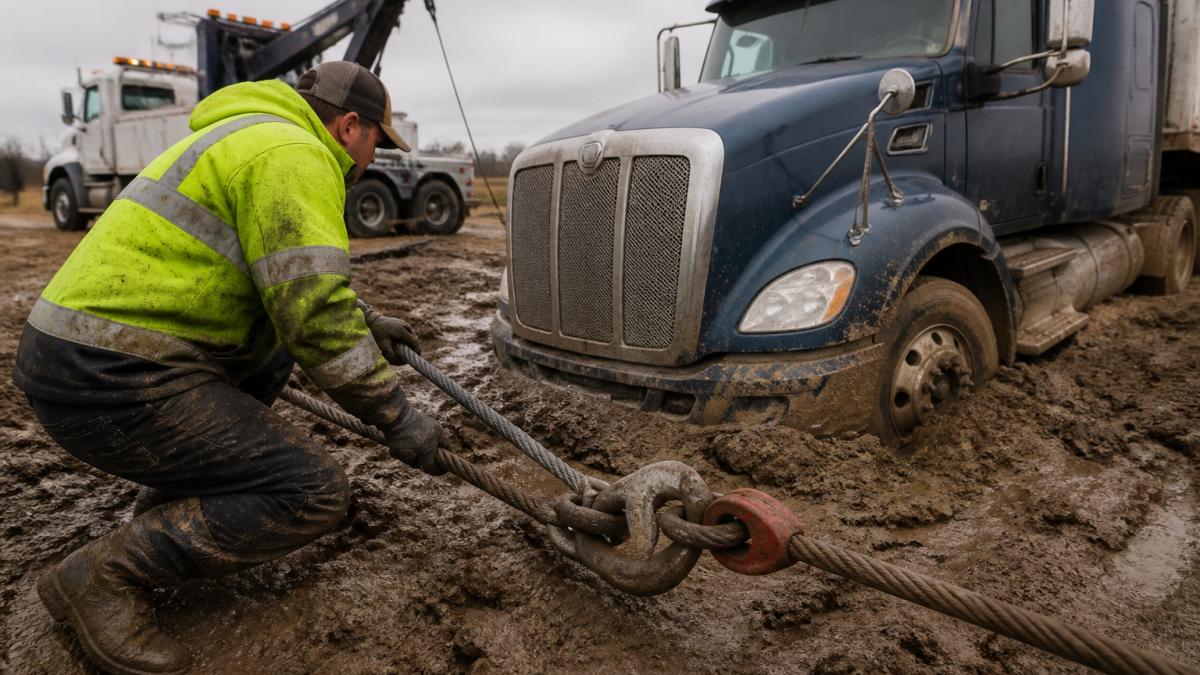
When a vehicle can’t be driven to the tow unit under its own power, or can’t move at all, winching and extraction become necessary. These services carry separate charges because they require specialized equipment, additional labor, and significantly more time.
When Winching and Extraction Are Necessary
Winching is required when a vehicle is stuck: embedded in mud, partially submerged, rolled on its side, or wedged in a ditch. Extraction pulls the vehicle into position to be loaded onto a flatbed or tow apparatus.
Weather events, accident scenes, and mechanical failures on secondary roads frequently leave heavy-duty vehicles needing extraction. If your fleet operates in rural areas or adverse weather regions, budget for occasional winching charges.
Labor and Equipment Costs
Winching equipment includes the winch unit, cables or straps, anchor points, and specialized rigging hardware.
Labor charges reflect the time to assess the recovery, position equipment, secure cables, and execute the pull. A straightforward extraction might take thirty minutes; a complex recovery in difficult terrain could take several hours, charged separately from base and mileage fees.
Heavy-Duty Towing Hidden Fees You Should Know
Surprise charges on the final invoice frustrate customers. Understanding which additional charges exist and when they apply lets you budget accurately.
After-Hours, Weekend, and Holiday Surcharges
A breakdown at 2 a.m. on a Sunday increases the heavy-duty towing cost more than one at 10 a.m. on Tuesday.
These surcharges aren’t hidden if disclosed upfront. When you call, ask explicitly: “What surcharge applies if I need this at midnight?” or “Is there a weekend rate?” A reputable provider will state surcharge rates before you authorize dispatch.
Storage, Impound, and Additional Service Charges
Once your vehicle reaches its destination, additional charges may apply. Storage fees are daily charges for keeping the vehicle at a facility. Impound fees are often set by municipal authorities when a vehicle is held by law enforcement.
Additional service charges cover extras: fuel surcharges during high fuel costs, tolls incurred during transport, or special handling for hazardous cargo or oversized loads. Ask about every potential add-on before authorizing service.
Building Your Heavy-Duty Towing Quote Checklist
A written estimate before dispatch protects you and the operator by creating a record of what was agreed. When requesting a quote, provide specific information about your situation.
What to Request in a Written Estimate
Your estimate should include:
- Base service fee
- Per-mile rate and estimated total mileage
- Vehicle weight and type (with any special handling notes)
- Pickup location and destination
- Any anticipated winching or extraction requirements
- After-hours or weekend surcharges (if applicable)
- Storage or delivery fees (if applicable)
- Total estimated cost
A written estimate isn’t a guarantee, if the situation proves more complex than assessed, the final bill may differ. But a detailed estimate gives you a realistic picture and prevents surprise charges that double the quoted amount.
Questions to Ask Before Authorizing Dispatch
Before you say “yes, come get my truck,” ask these questions:
- Is the quoted price the final price, or could it increase? Understand what might cause the bill to change.
- Do you have the equipment to handle my vehicle safely? For heavy-duty or specialty vehicles, confirm the operator has the right gear.
- What’s your response time from now? Know when to expect arrival.
- Will you provide a written receipt with itemized charges? Insist on documentation of what you’re paying for.
- Are you fully licensed, insured, and certified? Verify credentials before authorizing transport of valuable equipment.
These questions take two minutes and prevent most disputes later.
How to Compare Towing Companies and Verify Certifications
Choosing a heavy-duty towing provider isn’t just about price. Capability, reliability, and safety record matter more, a cheap operator who damages your truck costs far more than a professional who charges fairly.
Checking Licensing, Insurance, and Safety Records
Every tow operator should hold a current state license, verifiable through your state’s licensing authority or motor carrier division. The license confirms minimum safety and operational standards.
Insurance is non-negotiable for heavy-duty work. The operator’s liability coverage should be sufficient to cover damage to your vehicle during transport.
The Federal Motor Carrier Safety Administration (FMCSA) maintains records of commercial tow operators. Search the operator’s name to check for violations, accidents, or complaints.
Evaluating Response Time and Equipment Capability
Response time matters for fleet operations. If you need recovery within 30 minutes, a provider two hours away isn’t useful. Ask about typical response times from your location, and for critical operations negotiate a guaranteed response window in your fleet service agreement.
Equipment capability determines whether the operator can handle your vehicle safely.
Regulatory Limits and Pricing Transparency Requirements
Towing pricing isn’t entirely unregulated. Many states and municipalities have established maximum rates or require transparency in billing.
According to the National Association of Towing and Recovery Professionals, state regulations vary widely. Some states cap towing rates, while others require written estimates before service.
Federal regulations require that non-consensual tows (tows initiated by law enforcement or property management, not the vehicle owner) follow specific procedures.
Transparency requirements mean operators must disclose all charges before or immediately after service.
Practical Examples: Real Heavy-Duty Towing Scenarios
These scenarios show how different factors combine to create the final bill.
Roadside Breakdown Versus Accident Recovery
Scenario 1: Roadside Breakdown
A heavy-duty truck’s transmission fails on a highway 40 miles from the nearest repair facility.
Cost breakdown: base fee + (40 miles × per-mile rate) + fuel surcharge (if applicable). The bill is straightforward because no complications arose.
Scenario 2: Accident Recovery
A heavy-duty truck is involved in a collision and ends up partially off the roadway. The vehicle is disabled, and the driver is injured.
Fleet and Commercial Towing Considerations
Fleet managers need different service structures than individual vehicle owners. A single breakdown costs money, but a fleet depends on rapid recovery to minimize downtime. This changes the towing equation.
A fleet agreement with a provider typically includes:
- Negotiated base rates for routine calls
- Priority dispatch (your vehicles get faster response)
- Consolidated billing (one invoice for all services, not separate bills per tow)
- Discounted rates for multiple annual calls
- Pre-authorized pricing for anticipated scenarios
The benefit isn’t just lower per-call costs, it’s predictability. You know what a breakdown will cost, so you can budget accurately. You also know your vehicles will be handled by operators trained on heavy-duty equipment, reducing the risk of damage.
Disputing Charges and Protecting Yourself
If your final bill doesn’t match the estimate or includes charges you don’t understand, you have options.
First, request an itemized invoice showing every charge separately.
Compare the itemized bill to your initial estimate and any notes from the call.
Document everything: call times, conversations, estimates provided, and the final invoice. If you need to dispute through your insurance or file a complaint with regulatory authorities, this documentation is your evidence. The Federal Trade Commission provides guidance on disputing service charges and protecting yourself from unfair billing practices.
If the dispute can’t be resolved directly with the operator, contact your state’s motor carrier division or consumer protection agency.
For future protection, use a provider with a transparent track record.
Heavy-duty towing isn’t simple, but it doesn’t have to be opaque.
Frequently Asked Questions
What factors affect heavy-duty towing cost the most?
Heavy-duty towing cost depends primarily on base rate, per-mile distance, vehicle weight and type, and whether recovery equipment like winching is needed. After-hours, weekend, and holiday surcharges can also significantly increase the final bill. The complexity of the situation, such as an accident recovery or extraction from a ditch, adds labor and specialized equipment charges that standard roadside assistance does not include.
What should be included in a heavy-duty towing quote checklist?
A complete heavy-duty towing quote should itemize the base hookup fee, per-mile rate multiplied by estimated distance, vehicle weight surcharge if applicable, any winching or recovery charges, after-hours or weekend premiums, and storage fees. Request a written estimate before dispatch. Ask whether the quote covers all potential charges or if additional fees may apply. Verify the operator’s licensing and insurance coverage for your vehicle type and value.
How much extra do heavy-duty towing winching charges typically add?
Winching and recovery equipment charges vary based on the difficulty of extraction and equipment required. Simple winching for a light pull may add to the base rate, while complex recovery operations involving multiple winches, specialized rigging, or prolonged labor can be significantly higher. Always ask the operator to estimate recovery costs before beginning work, and request an itemized invoice showing labor hours and equipment usage separately.
How can I compare heavy-duty towing companies fairly?
Request written quotes from multiple providers using identical scenario details: vehicle type, weight, pickup location, and destination. Compare base rates, per-mile charges, and any surcharges. Verify each operator’s licensing through your state’s Department of Transportation, check their insurance coverage limits, and review customer feedback on response time and vehicle handling. For heavy-duty or high-value vehicles, prioritize certified operators with flatbed equipment and experience in your vehicle class over the lowest price alone.
What hidden fees should I watch for in a towing bill?
Common hidden charges include after-hours surcharges, weekend and holiday premiums, storage fees if the vehicle must remain at a facility, fuel surcharges, and non-consensual tow markups. Some operators charge extra for dispatch time, equipment rental, or administrative fees. Always request an itemized invoice before authorizing the tow and ask specifically whether the quoted price is all-inclusive or if additional charges may apply based on conditions at the scene.
Can I dispute a towing charge if it seems too high?
Yes. Request an itemized invoice showing all charges, labor hours, equipment used, and distance traveled. Compare it against your written estimate and state regulatory limits for non-consensual tows. Contact the towing company with your dispute in writing, referencing the itemized bill and any discrepancies. If unresolved, file a complaint with your state’s Department of Transportation or Attorney General’s office, especially if charges exceed legal maximums.
Are there state regulations that limit heavy-duty towing charges?
Yes. Most states regulate non-consensual towing (such as illegal parking removals) with maximum fee schedules, plus regulated per-mile rates. Consensual tows (roadside assistance you request) are less regulated but must still be transparent. Check your state’s Department of Transportation website for official fee schedules and regulations. Operators must provide written notice of charges before or immediately after towing begins.