
Table of Contents
- How Towing Can Damage Your Vehicle’s Drivetrain
- Understand Your Vehicle’s Drivetrain Type
- Towing an AWD Vehicle Safely
- Flatbed Towing vs. Wheel-Lift Towing: Which Method Protects Your Drivetrain
- Towing a Car with an Automatic Transmission: Step-by-Step
- Signs of Transmission Damage After Towing
- Follow the Vehicle Owner’s Manual and Manufacturer Instructions
- Frequently Asked Questions
Last Updated: October 16, 2026
How Towing Can Damage Your Vehicle’s Drivetrain
Towing a vehicle incorrectly can cause serious drivetrain damage. The drivetrain transfers power from your engine to the wheels, and towing wrong stresses that system in ways it wasn’t designed to handle.
The good news: you can prevent drivetrain damage towing by following a few key rules.
Transmission and Drivetrain Damage Risks
Your transmission is the most vulnerable part during towing. When wheels roll but the transmission isn’t in neutral, the engine tries to turn those wheels, creating massive internal pressure.
Damage happens fast. Even short tows can cause:
- Transmission fluid breakdown, Heat builds up and the fluid loses its ability to protect gears.
- Gear damage, Metal gears grind without proper lubrication.
- Axle stress, The axles spin when they shouldn’t, creating friction and wear.
Automatic transmissions are especially at risk. They need lubrication to survive towing. Without it, internal parts fail within miles.
A single tow with the transmission in drive can cost $4,000 to $8,000 in repairs. Some transmissions cannot be fixed and need full replacement.
Why the Correct Tow Method Matters
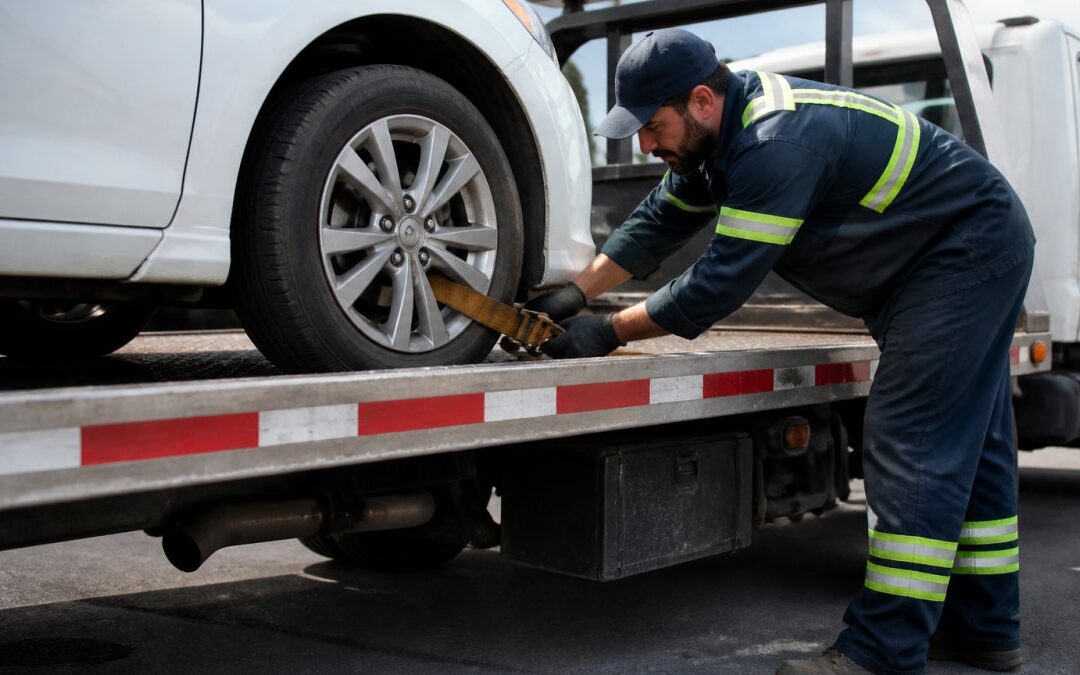
The tow method you choose determines whether your drivetrain survives. Flatbed towing lifts all four wheels off the ground, so nothing spins and your drivetrain rests completely. Wheel-lift towing (also called hook-and-chain) lifts the front or rear wheels while the other two stay on the ground and rotate, forcing your transmission and axles to work. For most vehicles, flatbed is safer because it eliminates drivetrain stress entirely; wheel-lift works only for specific vehicle types and short distances.
Understand Your Vehicle’s Drivetrain Type
Your drivetrain type determines which towing method works best. The three main types are front-wheel drive, rear-wheel drive, and all-wheel drive.
Front-Wheel Drive vs. Rear-Wheel Drive vs. All-Wheel Drive
Front-wheel drive (FWD) sends power to the front wheels, where the engine, transmission, and differential sit. Tow with the front wheels lifted so the unpowered rear wheels roll freely without damaging the drivetrain.
Rear-wheel drive (RWD) sends power to the rear wheels via a driveshaft connecting the transmission to the rear axle.
All-wheel drive (AWD) sends power to all four wheels through a transfer case that splits engine power between front and rear axles.
Check your owner’s manual for the exact towing method recommended for your vehicle. Manufacturers test their vehicles and specify the safest approach. Following their guidance protects your investment.
Towing an AWD Vehicle Safely
AWD vehicles need special care because all four wheels receive power. You have three safe options:
-
Use flatbed towing, All four wheels lift off the ground. Nothing spins. This is the safest choice for AWD vehicles.
-
Tow with all four wheels on the ground, Keep the vehicle in neutral and the parking brake off. The wheels roll freely. This works for short distances only (typically under 50 miles).
-
Disable the transfer case, Some AWD vehicles allow you to disengage the transfer case, converting to two-wheel drive. Check your manual to see if your model supports this. If it does, you can then tow using the two-wheel drive method.
Never tow an AWD vehicle with two wheels lifted and two on the ground, this forces the transfer case to fight itself, causing catastrophic internal damage.
Flatbed Towing vs. Wheel-Lift Towing: Which Method Protects Your Drivetrain
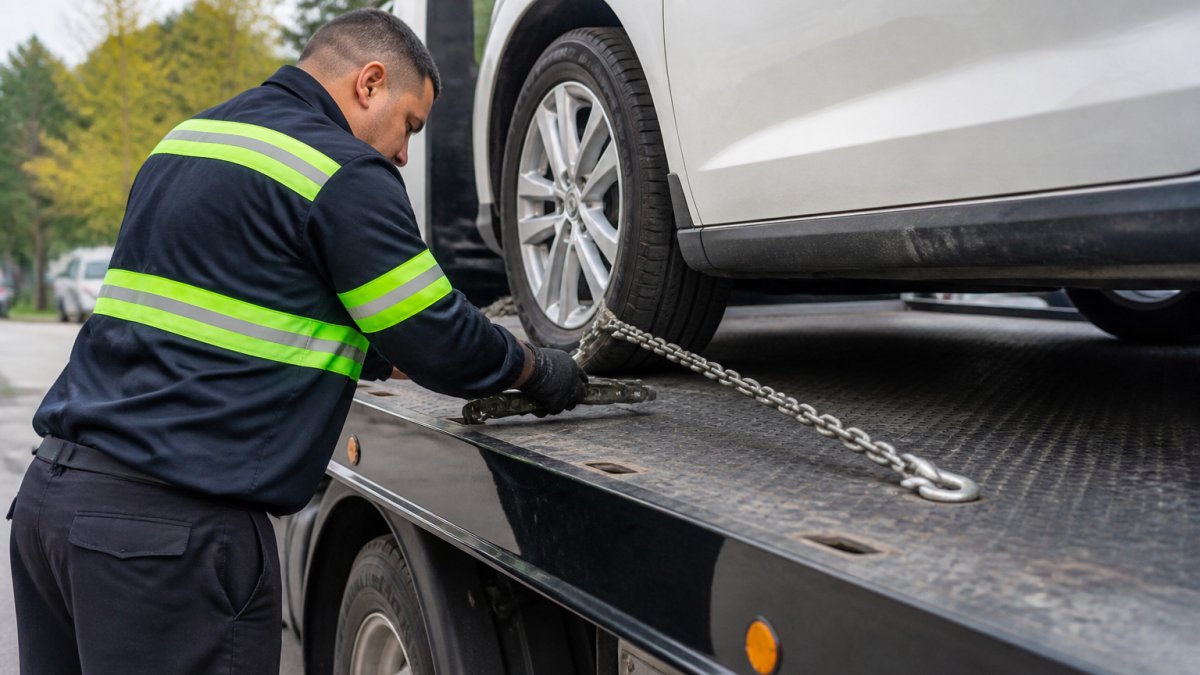
Flatbed towing loads your entire vehicle onto a flat platform. All four wheels leave the ground.
Wheel-lift towing (also called wrecker towing) uses a metal arm that slides under the front or rear bumper.
Flatbed wins for drivetrain safety. No wheels spin means no drivetrain stress.
Wheel-lift works only for:
- Front-wheel drive vehicles towed front-end up
- Rear-wheel drive vehicles towed rear-end up
- Short distances only
Wheel-lift costs less. That’s its only advantage. For preventing drivetrain damage during towing, flatbed is the clear choice.
A Decision Tree for Choosing Your Tow Method
Most guides stop at “use a flatbed.” That advice is safe but incomplete, sometimes a wheel-lift is the only truck that can reach you, and sometimes a vehicle can be flat-towed behind a motorhome for thousands of miles.
Step 1, Can all four wheels roll freely?
- If any wheel is locked, seized, or on a broken suspension component: flatbed only. A wheel-lift will drag the locked wheel and can bend the axle or tear the brake backing plate.
- If all four wheels roll: continue to Step 2.
Step 2, What is the drivetrain?
- All-wheel drive or four-wheel drive: flatbed, unless the owner’s manual specifically approves four-wheels-down towing and gives a distance and speed limit. Never lift two wheels on an AWD or 4WD vehicle.
- Rear-wheel drive: rear wheels up, front wheels down is the standard wheel-lift configuration, but only if the manual permits it. Front wheels up on a RWD vehicle will spin the driveshaft and transmission.
- Front-wheel drive: front wheels up, rear wheels down is the standard wheel-lift configuration. Rear wheels up on a FWD vehicle will spin the transaxle.
Step 3, What does the transmission type allow?
- Automatic: many automatics cannot be towed with the drive wheels on the ground at any distance. If the manual doesn’t explicitly approve it, treat it as flatbed-only.
- Manual: generally more tolerant of wheels-down towing, but the manual still governs distance and speed.
- CVT: treat like an automatic unless the manual says otherwise. CVTs are especially sensitive to being spun without fluid pressure.
Step 4, Is this an emergency recovery or a planned tow?
- Emergency (breakdown, crash, no-start): get the vehicle off the roadway without adding damage. If a flatbed isn’t available, a wheel-lift that lifts the correct end beats dragging the vehicle with all four wheels down.
- Planned (moving, storage, RV flat-tow): match the method to the manual, not to what’s cheapest.
Step 5, Hybrid or electric?
Hybrids and EVs can spin their traction motor or generator when the wheels turn, even with the transmission in neutral. Many manufacturers restrict or prohibit wheels-down towing for this reason.
If you remember one rule: flatbed is always safe, wheel-lift is conditionally safe, and wheels-down is almost never safe unless the manual says so. When in doubt, ask for a flatbed.
Fox Recovery uses state-of-the-art 19 ft. and 21 ft. flatbeds for this reason.
Towing a Car with an Automatic Transmission: Step-by-Step
Automatic transmissions need extra protection during towing. Follow these steps carefully.
Step 2: Decide on your tow method. If the manual allows wheel-lift, confirm which wheels should lift (front or rear).
Step 4: Release the parking brake. An engaged parking brake locks the wheels and creates friction and heat during the tow.
Step 6: Tow at moderate speed. High speeds create heat and stress.
Putting the Vehicle in Neutral and Parking Brake Precautions
Neutral is your first defense against transmission damage, when the transmission is in neutral, it’s not connected to the wheels, so they can spin without forcing the gears to move. Some vehicles have electronic transmissions that need power to shift into neutral, so a dead battery can prevent it.
If your vehicle won’t shift into neutral because the battery is dead, try this:
- Turn the ignition to the “on” position (don’t start the engine)
- Press the brake pedal firmly
- Try shifting to neutral again
If the vehicle still won’t shift, you have a problem.
What to Do If the Vehicle Cannot Be Shifted Into Neutral
This situation requires flatbed towing. Do not attempt wheel-lift towing.
When a vehicle cannot shift into neutral, the transmission stays in park or drive, and towing with wheels on the ground forces it to work, damage happens quickly.
Some vehicles have a neutral override button. Check your manual; if yours has one, press it while the ignition is in the “on” position to allow neutral engagement even with a dead battery.
Towing a vehicle in park or drive causes immediate transmission damage. Do not attempt this under any circumstances. The cost of flatbed towing is far less than transmission replacement.
Signs of Transmission Damage After Towing
Damage from an improper tow doesn’t always announce itself immediately. Some failures show up the moment the vehicle comes off the truck. Others surface over the next few hundred miles as heat-stressed fluid and bearings degrade. A short inspection after every tow catches problems while they’re still cheap to fix.
Post-Tow Inspection Checklist
Do this before you drive away from the drop-off point, and again after the first short drive.
Before driving:
- Walk around the vehicle. Look for fresh fluid spots under the transmission pan, transfer case, and rear differential. Transmission fluid is typically red or reddish-brown; gear oil is darker with a sulfur smell.
- Check the tires and wheels. A dragged or locked wheel leaves flat spots, scuff marks, or a hot rim. If one wheel hub is noticeably hotter than the others, that corner was dragging.
- Look at the undercarriage. Straps and chains can crush brake lines, wiring, and fuel lines if routed wrong. Check for pinched or chafed lines.
- Check the driveshaft and axles. Fresh grease sling around U-joints and CV boots, or a torn boot, usually means the axle was spun under load.
- Start the engine and watch the dash. Note any warning lights. A lit AWD or 4WD light after a two-wheel-lift tow is a red flag.
After the first short drive (under 5 miles, low speed):
- Shift through every gear in a safe, empty area. Note any delay, clunk, or slip.
- Listen at low speed. Whining that rises with vehicle speed points to the differential or transfer case; whining that rises with engine speed points to the transmission.
- Re-check for leaks while the fluid is hot and thin, small seeps show up better warm.
Symptoms That Mean Stop Driving
Some symptoms are “monitor.” Others are “park it now.” Treat these as stop-driving symptoms:
- Burning smell, transmission fluid has overheated. Damage has almost certainly occurred.
- Slipping gears, the transmission shifts unexpectedly, flares between gears, or won’t hold a gear under load.
- Delayed engagement, a noticeable pause when shifting from park to drive or reverse.
If any of these appear, do not continue driving. Have the vehicle inspected by a mechanic before the next trip.
Symptoms That Warrant Monitoring
Not every post-tow noise is damage. These are worth watching but don’t require an immediate stop:
- A single soft clunk the first time you shift into drive after the vehicle has been sitting.
- A brief hesitation on a cold start that clears once the fluid warms.
- A faint new vibration at highway speed, note the speed and conditions, and mention it at your next service.
If a monitored symptom gets worse over the next few drives, treat it as a stop-driving symptom.
Repair Cost Ranges
Costs vary widely by vehicle, transmission type, and labor rates, but a common pattern is:
- Seal or pan gasket replacement: roughly $500 to $1,000.
- Valve body service or solenoid replacement: roughly $800 to $2,000.
- Full transmission rebuild: roughly $3,000 to $5,000.
Early repairs are almost always cheaper than waiting. A seal that costs a few hundred dollars today can become a rebuild if the fluid runs low and the clutches burn.
If you smell burning transmission fluid or see metal debris on the dipstick, stop driving immediately. Continuing to drive a damaged transmission can turn a $1,000 repair into a $6,000 replacement.
When to Call a Mechanic vs. a Tow
- Call a mechanic (drive carefully): a single warning light with no drivability change, a faint new noise, or a small seep that isn’t growing.
- Call a tow: any stop-driving symptom above, a puddle of fluid under the vehicle, a wheel that won’t roll, or a transmission that won’t engage a gear.
If you’re unsure, err toward the tow. A diagnostic fee is far cheaper than a rebuild.
Follow the Vehicle Owner’s Manual and Manufacturer Instructions
Your owner’s manual is the authority on towing. Manufacturers test their vehicles extensively and know exactly how to tow safely. The manual specifies:
- Whether your vehicle can be towed at all
- Which wheels should lift (if wheel-lift is allowed)
- Maximum towing distance and speed
Some vehicles have restrictions you might not expect, some automatics cannot be towed more than 50 miles, and some AWD vehicles cannot be towed with wheels on the ground at any speed.
Follow these instructions exactly, they’re written by engineers who understand your vehicle’s drivetrain better than anyone else.
Preventing drivetrain damage towing comes down to three things: using the right tow method, keeping your transmission in neutral, and following your manufacturer’s instructions.
At Fox Recovery, we understand how critical proper towing is. Whether you need roadside assistance or specialized recovery, we’re here to protect your investment. Call Fox Recovery at (847) 587-6076 for immediate towing service and let our team handle it right.
Frequently Asked Questions
Can towing damage an automatic transmission?
Yes, towing can damage an automatic transmission if the vehicle is towed incorrectly. Dragging a car with its drive wheels on the ground while the transmission is in park or neutral can cause internal transmission damage, especially over longer distances. The transmission relies on fluid circulation for lubrication, and when wheels rotate without the engine running, the transmission can overheat and suffer mechanical damage. Always follow your vehicle owner’s manual for approved towing methods.
How should an AWD vehicle be towed to prevent drivetrain damage?
AWD vehicles require special care during towing because all four wheels are connected to the drivetrain. Most manufacturers recommend flatbed towing for AWD vehicles to keep all wheels off the ground. If flatbed towing is unavailable, check your owner’s manual for distance and speed limits on wheel-lift towing. Never tow an AWD vehicle with any drive wheels on the ground for extended distances, as this can cause severe differential and transfer case damage.
Is flatbed towing safer for a vehicle’s drivetrain?
Flatbed towing is the safest method for protecting your vehicle’s drivetrain because all four wheels are lifted completely off the ground. This eliminates wheel rotation and prevents transmission lubrication loss, differential strain, and axle damage. Wheel-lift towing, which leaves some wheels on the ground, can damage the drivetrain if the vehicle is towed incorrectly or over long distances. Flatbed towing is especially critical for AWD vehicles and high-value cars.
What should I do if my vehicle cannot be shifted into neutral during towing?
If your vehicle cannot be shifted into neutral, do not attempt to tow it with its wheels on the ground. Contact a professional towing service that can use flatbed equipment instead. Forcing a transmission into neutral or towing without achieving neutral can cause severe transmission damage. A certified tow operator will know how to handle this situation safely, whether through flatbed recovery or alternative methods based on your vehicle’s specific design.