
Table of Contents
- Understanding Emergency Roadside Response Time Expectations
- Roadside Assistance Wait Times by Service Type and Location
- Factors That Affect Towing Service ETA and Arrival Time
- What to Do While Waiting for Roadside Assistance
- Truck Breakdown Assistance: Specialized Response Considerations
- How to Interpret Your ETA and Handle Changes
- Information to Provide When Requesting Emergency Roadside Assistance
- Frequently Asked Questions
Last Updated: October 12, 2026
Understanding Emergency Roadside Response Time Expectations
When your vehicle breaks down, the first question is always how long until help arrives. Understanding what affects your emergency roadside response time can help you stay calm and safe while you wait.
Emergency roadside response time is the period between when you call for assistance and when a service vehicle arrives. It varies widely based on location, service type, and network demand. For most drivers, realistic expectations range from 30 minutes to 2 hours.
At Fox Recovery, our 24/7 team minimizes your wait by dispatching the nearest available unit and keeping you updated throughout the process.
Roadside Assistance Wait Times by Service Type and Location
Different service types have different response patterns, driven by equipment, training, and how far a qualified provider must travel. A battery jump-start in an urban area may arrive in 30 to 45 minutes, while a tire change on a rural highway could take 60 to 90 minutes. Towing stretches longer still, especially for heavy-duty vehicles requiring specialized equipment.
Urban and dense suburban areas typically see faster response times:
- Battery jump-start: 20-40 minutes
- Tire change: 30-50 minutes
- Fuel delivery: 25-45 minutes
- Lockout: 25-45 minutes
- Light-duty towing: 45-75 minutes
Rural and remote locations often experience longer waits:
- Battery jump-start: 45-90 minutes
- Tire change: 60-120 minutes
- Fuel delivery: 60-90 minutes
- Lockout: 45-90 minutes
- Heavy-duty towing: 90-180 minutes
Why Service Type Changes the Clock
Not every provider carries every tool. A jump-start or lockout needs only a service truck with a booster pack or lockout kit. Towing needs a flatbed or wheel-lift truck sized to your vehicle’s weight.
Fuel delivery is usually fastest because any service truck can carry a gas can, but it can be slowest if local rules restrict carrying fuel. Lockouts are fast for older vehicles and slower for newer ones with advanced anti-theft systems.
How Location and Dispatch Radius Interact
In a city, multiple service vehicles are stationed throughout the area, and a dispatcher can usually match you with a unit within a few miles. In suburban areas, coverage is thinner, and response times land in the middle of the urban and rural ranges.
A useful way to think about it: your wait is roughly the drive time from the nearest qualified unit to your location, plus any queue time if that unit is finishing another call. If you are 10 minutes from a provider and they are free, expect roughly 10 to 20 minutes.
When you call, ask two questions: how far away is the nearest qualified unit, and is that unit currently free? Those two answers tell you more about your real wait than any published average.
What This Means for Your Expectations
Treat the ranges above as planning figures, not promises. A 30-minute city estimate can become 60 minutes if a storm hits or several calls come in at once. Ask the dispatcher for a range, confirm the unit is qualified for your problem, and request a callback if the estimate changes by more than 15 to 20 minutes.
Factors That Affect Towing Service ETA and Arrival Time
Several concrete factors shape how long you’ll actually wait and help you interpret your estimated time of arrival (ETA).
Distance and Geographic Demand
Distance is the most obvious factor: a breakdown five miles from the nearest service hub arrives faster than one 30 miles away. But distance is also about access, a vehicle stuck in highway traffic moves differently than one parked safely on a shoulder, and dense urban zones dispatch faster than sparse areas where the nearest provider is 45 minutes away.
Geographic demand also matters. If three other vehicles called for help in your area within the last hour, your provider may be fully deployed, adding 20 to 40 minutes to your realistic arrival estimate.
Traffic, Weather, and Road Conditions
A tow truck faces the same traffic you do. Rush hour on a congested highway slows the service vehicle’s actual time of arrival (ATA), and snow, ice, or heavy rain slows the response vehicle too.
Weather also impacts what the provider can safely do on arrival. In severe conditions, an operator may need extra time to connect your vehicle, and road closures force detours that add 15 to 30 minutes.
Service Provider Availability and Dispatch Efficiency
Not all service networks are equally efficient. A well-coordinated dispatch system tracks vehicle locations in real-time and sends the closest available unit, while a less sophisticated system might send the next truck in rotation even if it’s farther away, a difference of 20 to 30 minutes.
During peak demand, late Friday afternoons, holiday weekends, severe weather, every service vehicle is deployed. Your ETA might be honest (45 minutes), but that’s 45 minutes from when a truck becomes available, not from when you called.
Peak demand hours are typically Friday 4 PM to Sunday 8 PM, holiday weekends, and immediately after severe weather. Plan accordingly if you’re traveling during these windows.
What to Do While Waiting for Roadside Assistance
Your safety while waiting matters more than how long you wait. The actions you take in the first few minutes set the tone for a safe resolution.
Safety Steps and Vehicle Positioning
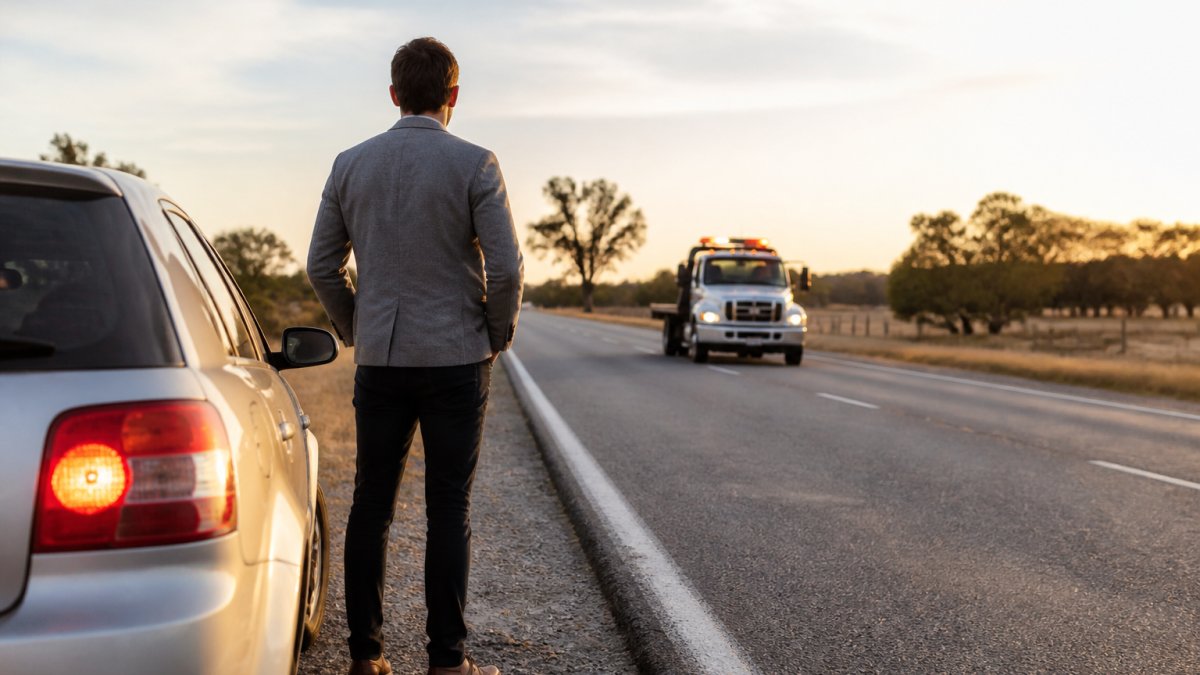
Turn on your hazard lights immediately to alert other drivers and help the provider locate you. On a highway, move to the shoulder as far from traffic as safely possible.
Open your hood slightly to signal a mechanical issue, and use a flashlight or phone light in the dark. Stay inside with the doors locked until the driver confirms their identity.
Keep your phone charged and available for dispatcher updates, and have your registration and insurance information ready to speed up the process.
Highway and Poor-Visibility Positioning
On a highway, the shoulder is not a safe place to stand, passing trucks create wind gusts and can drift onto it. If you can exit safely, do so from the side away from traffic and move behind a guardrail or well off the roadway. Otherwise, stay buckled inside.
In poor visibility, fog, heavy rain, snow, or darkness, turn on your interior dome light and keep hazards flashing. Do not stand behind your vehicle where an approaching driver might not see you. Place a reflective vest or triangle only if you can do so without entering the roadway.
When to Leave Your Vehicle
Stay inside your vehicle on a busy road or highway; stepping out puts you in danger from passing traffic.
On a quiet residential street or in a parking lot, you can step out and wait nearby, but stay visible. In severe weather, extreme heat, cold, or lightning, move to a nearby building or shelter.
Never attempt major repairs while waiting. A simple tire change might be okay if you are comfortable and safe, but do not drain fluids, work under the vehicle, or attempt electrical repairs, providers may charge extra or refuse to proceed until you are clear.
Do NOT stand between your vehicle and oncoming traffic, even briefly. Service providers have been hit by passing vehicles while working on disabled cars. Stay behind the vehicle or well away from the roadway.
Special Circumstances: Children, Medical Needs, and Extreme Conditions
If you are stranded with children, keep them inside with seatbelts on and doors locked. If anyone has a medical condition that could worsen with heat, cold, or stress, call 911 in addition to roadside assistance, medical responders can often reach you faster and coordinate with the provider.
For mobility limitations, tell the dispatcher when you call so they can send a trained driver or coordinate with local services.
Escalation: When to Call Back or Call 911
If you are in an unsafe location, a blind curve, a travel lane, or near active traffic with no safe shoulder, call 911 first; law enforcement can protect you and coordinate the tow. If your ETA passes by more than 20 minutes with no update, call the dispatcher for a revised estimate and unit status. If you feel threatened, call 911.
Safety first, then status. If you are in danger, call 911. If you are safe but waiting, call the dispatcher for an update. Never trade your safety for a faster arrival.
Truck Breakdown Assistance: Specialized Response Considerations
Heavy-duty trucks, buses, and tractor-trailers have different response patterns than passenger vehicles, and not every provider can handle them safely.
A standard tow truck cannot safely transport a fully loaded semi-trailer; the weight and length require a heavy-duty wrecker or rotator with specific training.
Truck breakdown assistance providers need your vehicle type, load status, and whether hazardous materials are involved to dispatch the correct equipment. Fox Recovery specializes in medium and heavy-duty vehicle recovery.
Arrival time also depends on whether your vehicle blocks traffic.
How to Interpret Your ETA and Handle Changes
When you call for roadside assistance, the dispatcher gives you an estimated time of arrival (ETA), an educated guess based on current conditions, not a guarantee.
The initial ETA assumes traffic and weather stay stable. If conditions worsen, a sudden traffic jam or storm, your actual time of arrival (ATA) will be later.
If you’re waiting more than 20 minutes past your revised ETA, call for an update, the provider may have been rerouted or you may be next in queue for a different unit.
Information to Provide When Requesting Emergency Roadside Assistance
Have this information ready when you call; it speeds up dispatch and ensures the right equipment is sent.
Essential details to provide:
- Your exact location (highway exit number, mile marker, street address)
- Vehicle year, make, model, and color
- Type of problem (battery, tire, towing, lockout, fuel)
- Whether the vehicle is safe to approach or blocking traffic
- Any hazards (fuel leak, smoke, unstable position)
- Your phone number and whether you’re inside or outside the vehicle
For heavy-duty vehicles, also mention:
- Whether the vehicle is loaded or empty
- Approximate weight if known
- Any hazardous materials being transported
- Whether you need recovery or just a tow to the nearest shop
The more specific you are, the faster dispatch can send the right unit.
Waiting for roadside assistance tests your patience, but understanding what affects your response time helps you stay calm and safe. Your emergency roadside response time depends on distance, demand, weather, and provider efficiency, factors largely outside your control.
Fox Recovery delivers prompt, courteous service 24/7 with fully certified and licensed operators. We dispatch the nearest available unit and keep you informed throughout the process. For immediate help, call (847) 587-6076.
Frequently Asked Questions
What is a realistic emergency roadside response time?
Response times vary significantly based on location and service type. In urban areas, roadside assistance typically arrives within 30 to 60 minutes. Rural locations may see 60 to 120 minutes or longer. Heavy-duty truck recovery often takes additional time due to equipment requirements and the complexity of the breakdown. Your actual arrival time depends on dispatcher availability, current service demand, distance from the nearest service vehicle, and road conditions. Always ask for a realistic ETA when you call.
What information should I provide when requesting roadside assistance?
Give the dispatcher your exact location (highway exit, mile marker, or address), vehicle type and year, the nature of the breakdown (flat tire, dead battery, engine trouble), whether you have hazard lights on, if you’re in a safe location, and any injuries or safety concerns. For truck breakdown assistance, also mention the vehicle weight, cargo type if relevant, and any special handling requirements. Clear, specific details help dispatchers send the right equipment and estimate accurate arrival times.
How do traffic and weather affect roadside assistance ETA?
Heavy traffic, especially during rush hours or accidents on major routes, can significantly delay your towing service ETA. Bad weather such as snow, ice, or heavy rain slows response vehicles and makes recovery more difficult, particularly for heavy-duty trucks. Road closures or construction also redirect service vehicles. When you call, mention current weather and traffic conditions so the dispatcher can factor these into your estimated arrival time. Peak demand periods may also extend wait times as more vehicles need assistance simultaneously.
When should I call back if my roadside assistance is delayed?
If your ETA has passed and the service vehicle hasn’t arrived, wait 10 to 15 minutes before calling back, traffic or navigation changes may cause minor delays. When you contact the dispatcher again, provide your original call reference number and ask for a revised ETA. Don’t hang up on your original call; use a different line to check status. If you’re in an unsafe location or conditions have worsened significantly, prioritize your safety and ask the dispatcher about moving to a safer spot or requesting police assistance.