
Last Updated: November 21, 2026
Quick Summary
To learn how to find reliable 24/7 recovery services in rural areas, verify local coverage before you need it by asking for the nearest dispatch base address, after-midnight coverage by town and county, travel radius, and road-access limits. Test the claim by calling the after-hours line and asking for an arrival window from the nearest base, then get a written estimate before authorizing the tow.
- Ask which towns and counties are covered between 10 p.m. and 6 a.m., since coverage often shrinks after hours.
- A dispatcher who cannot name the nearest town or give a base address is likely routing your call to a broker.
- Store coverage answers offline in a note app, screenshot, or paper list in the glovebox.
- Ask for a texted or emailed estimate with line items before you authorize the tow.
- Ask for proof of licensing and insurance; a professional operation answers plainly.
Table of Contents
- Why Rural Breakdowns Demand a Different Search Strategy
- Step 1: Verify Local Coverage Before You Need It
- Step 2: Confirm 24/7 Availability and Realistic Roadside Assistance Response Time
- Step 3: Match Recovery Equipment to Your Vehicle and Terrain
- Step 4: Understand Towing Service Cost and Call-Out Fees
- Step 5: Know What to Tell a Tow Truck Operator When You Call
- Red Flags That Signal an Unreliable Rural Provider
- Staying Safe While You Wait in an Isolated Location
- Frequently Asked Questions
Why Rural Breakdowns Demand a Different Search Strategy
A breakdown on a quiet county road is a different problem from one on a busy interstate. In a rural area, help is farther away, cell signal comes and goes, and the first number you find online may not actually cover your location. Learning how to find reliable 24/7 recovery services in rural areas means checking coverage, response time, and equipment before you are stranded, not after.
Many drivers and fleet managers learn this the hard way after picking a provider by search result alone. A few simple checks can prevent that. Below, we walk through practical vetting steps and the red flags that should send you looking elsewhere.
Step 1: Verify Local Coverage Before You Need It
Coverage is the first thing to confirm. A provider can advertise nationwide service and still have no truck near your county. Verify coverage before you need it, using a checklist rather than a single phone call.
The Pre-Breakdown Coverage Checklist
Run this on a calm afternoon, not on a rainy shoulder. Save the answers where you can reach them without signal.
- Nearest dispatch base address. Ask for the street address of the base that would actually dispatch to you, not a corporate office. A call center in another state cannot tell you where the closest truck sits.
- After-midnight coverage by town and county. Ask which towns and counties are covered between 10 p.m. and 6 a.m. Coverage often shrinks after hours even when the main line advertises 24/7.
- Travel radius and mileage charges. Confirm how far the provider travels and whether mileage beyond a set radius is billed. Get the radius number, not a vague “we go anywhere.”
- Road-access limits. Ask directly whether they reach dirt roads, forest service roads, trailheads, farm lanes, and unpaved driveways, or paved roads only. Many light-duty providers stop at pavement.
- Remote-route familiarity. Name the specific highway, county road, or pass you drive most. A dispatcher who recognizes the route and can describe the nearest town is a better sign than one who asks you to spell it.
- Equipment staged nearby. Ask what class of truck is parked closest to your area, light-duty wrecker, medium-duty, heavy wrecker, or flatbed. If the nearest heavy wrecker is two counties away, plan accordingly.
Test the Claim, Don’t Trust the Website
A service-area map on a website is marketing. Test it:
- Call the after-hours line and ask the dispatcher to confirm coverage for a specific intersection or mile marker on your route.
- Ask for the estimated arrival window from the nearest base, not a generic “45 minutes.”
- Ask what happens if the assigned truck cannot reach you: is there a backup provider, and who calls whom?
Watch out: a dispatcher who cannot name the nearest town or refuses to give a base address is likely routing your call to a broker, not a local operator.
Write the answers down and store them offline, a note app that works without signal, a screenshot, or a paper list in the glovebox. Rural coverage is about a local base and a reachable road, not a national phone number.
Run this checklist on a calm afternoon and store the answers where you can reach them without signal.
| Item to confirm | What to ask |
|---|---|
| Nearest dispatch base | Street address of the base that would dispatch to you |
| After-midnight coverage | Which towns and counties are covered between 10 p.m. and 6 a.m. |
| Travel radius | How far the provider travels and mileage beyond a set radius |
| Road-access limits | Dirt roads, forest service roads, trailheads, farm lanes, unpaved driveways |
| Remote-route familiarity | Whether the dispatcher recognizes your highway, county road, or pass |
| Equipment staged nearby | What class of truck is parked closest to your area |
Step 2: Confirm 24/7 Availability and Realistic Roadside Assistance Response Time
Real 24/7 service means a person answers at 2 a.m. and a truck actually rolls. Test it by calling the after-hours line and seeing who picks up.
Response time in rural areas depends on distance, weather, and traffic. A realistic roadside assistance response time is often longer than in a city, and a good dispatcher will tell you that upfront. Ask for an arrival estimate and a callback if anything changes. You can read more about emergency roadside response time to set fair expectations, and see what genuine 24/7 heavy recovery service availability looks like before you trust a claim.
Step 3: Match Recovery Equipment to Your Vehicle and Terrain
The wrong truck damages vehicles. A light-duty wrecker cannot safely pull a loaded semi, and a flatbed that is too short will not carry a long-wheelbase truck. Tell the dispatcher your vehicle type, weight, and where it sits.
Terrain matters just as much. Mud, ditches, soft shoulders, and trails call for winching and the right rigging, not just a hook and a chain. If you want to understand which gear your situation actually needs, this guide on heavy vehicle recovery equipment breaks it down.
Heavy-Duty Truck Recovery Capability Checklist
- Flatbed length suits your wheelbase and weight
- Winch capacity rated for your vehicle plus resistance
- Operator trained on heavy-duty truck recovery
- Straps and rigging rated for the load
- Air brake and drivetrain knowledge for big rigs
Step 4: Understand Towing Service Cost and Call-Out Fees
Ask about price before the truck arrives, and ask in a way that produces numbers rather than reassurances. This heavy-duty towing cost transparency guide explains how towing costs and call-out fees are structured. Towing and recovery pricing in rural areas is built from several line items, and a provider who explains them plainly is usually the safer bet.
The Line Items to Ask About
- Base or hook-up fee. The charge to dispatch a truck and connect to your vehicle, before any mileage.
- Per-mile rate. How mileage is calculated, from the dispatch base, from a city limit, or from the pickup point, and whether the return trip counts.
- After-hours and weekend surcharge. Confirm the window (for example, after 6 p.m. and before 6 a.m.) and whether holidays carry a different rate.
- Recovery complexity charges. Winching out of a ditch, mud, snow, or off-road terrain usually costs more than a flat-road hook-up. Ask what triggers the upcharge and roughly how much.
- Mileage beyond a radius. Many providers include a set radius and bill per mile beyond it. Get the radius number.
- Storage and cancellation fees. Ask what a daily storage rate is if the vehicle cannot be delivered same-day, and whether a cancellation fee applies once a truck is dispatched.
How to Get a Written Estimate
Ask the dispatcher to text or email an estimate with the line items above before you authorize the tow. A legitimate operator can give a range even when the final cost depends on what they find on scene. If the situation is genuinely unknown, a vehicle buried in mud, for example, ask for the hourly winching rate and an estimated number of hours.
Watch out: a flat rate quoted sight unseen over the phone is not a guarantee. Confirm in writing whether the quote is a cap, an estimate, or a starting point, and who pays if the job takes longer than expected.
Authorization Script
When you are ready to approve service, say it in plain terms: “Please confirm the hook-up fee, the per-mile rate, the after-hours charge, and any recovery or winching charge. Text me the estimate before the truck rolls. If the final cost will exceed the estimate, call me before doing additional work.” That single sentence prevents most billing disputes.
Keep the text thread and the dispatcher’s name. If a charge later looks wrong, you have a written record of what was authorized. We would rather quote honestly up front than surprise you at the end.
Step 5: Know What to Tell a Tow Truck Operator When You Call
Clear details get you help faster. Knowing what to tell a tow truck operator saves time and prevents the wrong equipment from being sent. Stay calm and give the facts in order.
- Your exact location, with GPS coordinates if you have them
- Vehicle type, weight, and what it is carrying
- What happened: breakdown, flat tire, ditch, mud, or accident
- Whether anyone is hurt or the road is blocked
- Your phone number and a safe place to wait
Send your GPS pin by text if signal allows. It beats describing a landmark that looks like every other fence line.
Red Flags That Signal an Unreliable Rural Provider
Some warning signs show up before you commit. Watch for a dispatcher who cannot name a local base, quotes a price with no details, or dodges questions about licensing. A provider who will not confirm certification should raise concern.
Ask for proof of licensing and insurance. A professional operation expects the question and answers it plainly. This guide to verifying towing certification shows exactly what to check. If the answers feel evasive, trust your gut and call the next number.
Staying Safe While You Wait in an Isolated Location
Safety comes first once you are stranded. Move as far off the road as you can, turn on your hazard lights, and stay visible. On a rural two-lane road, a passing truck can close the gap in seconds.
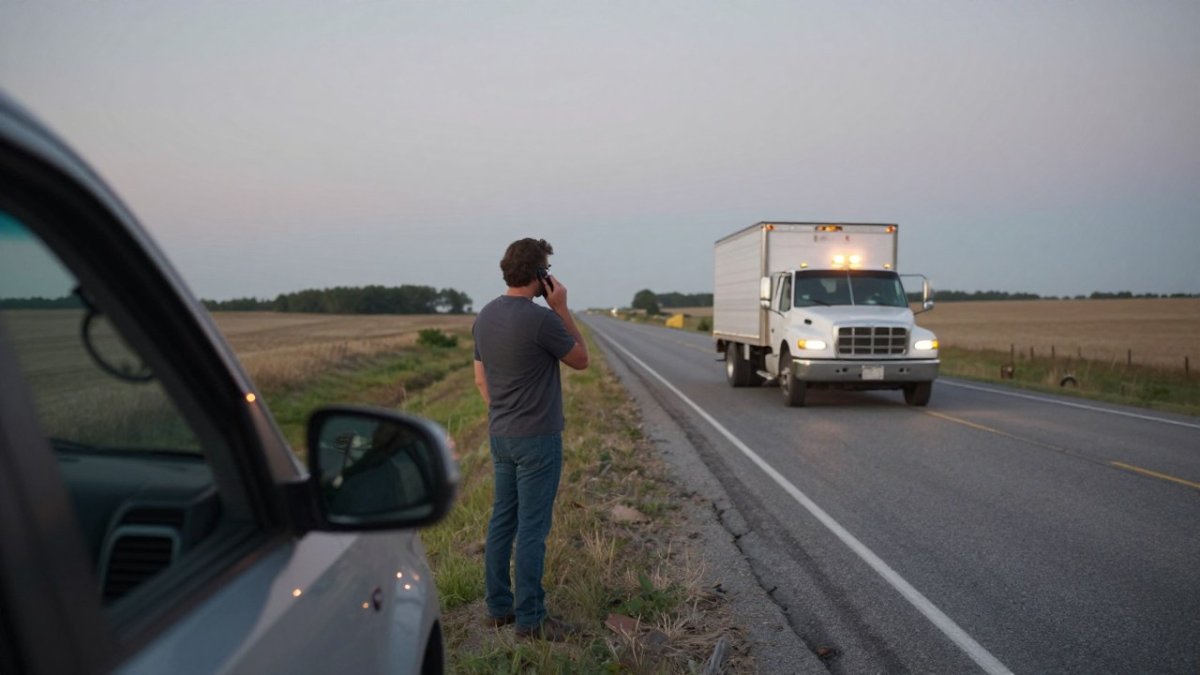
Stay in or near your vehicle if it is safe, and keep your seatbelt on if you remain inside. Share your location with someone you trust. Keep a flashlight, water, and a warm layer handy.
A rural breakdown tests your patience, but a little prep keeps it from becoming a crisis.
Frequently Asked Questions
How can I find roadside assistance in a rural area when I break down?
Start by calling a provider that explicitly lists your county or surrounding counties in its service area, not one that only advertises a metro base. Ask the dispatcher for an arrival estimate and confirm the truck type being sent. Give your GPS coordinates rather than a vague landmark. A provider with a local base and 24/7 dispatch can confirm coverage before you commit. Fox Recovery offers 24/7 service for vehicles in Fox Lake and surrounding counties.
How long can a rural recovery service take to arrive?
Response time in rural areas depends on distance from the nearest local base, road access, and weather. Ask the dispatcher for a realistic arrival estimate and request a callback if the truck is delayed. Reputable operators give a window and update you if it changes. If a provider promises an exact minute figure for a remote location without checking your coordinates, treat that as a warning sign.
How do I confirm a towing company can recover a heavy-duty truck?
Ask directly whether they have equipment rated for your vehicle’s weight and whether their operators are certified for medium- and heavy-duty recovery, including buses and tractor-trailers. Request proof of licensing. For ditch, mud, or off-road recovery, confirm they carry winching equipment suited to the terrain. Fox Recovery handles medium- and heavy-duty vehicles, including buses and tractor-trailers, with fully certified and licensed operators, which is the level of specificity to look for.
What should I do while waiting for roadside assistance in a remote location?
Pull as far off the road as possible, turn on hazard lights, and stay inside the vehicle with seatbelts on if traffic is moving fast nearby. Share your GPS coordinates with the dispatcher and a contact at home. Keep a phone charger and a reflective vest in the vehicle. If you are on a blind curve or in a ditch, tell the operator so they send the right recovery equipment.
