
Quick Summary
Commercial vehicle towing safety standards are the federal and state rules and practices that govern equipment, licensing, weight limits, load securement, and pre-tow inspections for heavy trucks and buses. They prevent connection failures, shifting loads, and roadside hazards. Compliance means matching equipment ratings to the combined weight and documenting every check.
- Federal Motor Carrier Safety Regulations govern interstate commercial vehicles, while states add their own equipment and permit rules.
- Verify GVWR and GCWR, since the towed unit’s weight counts toward CDL thresholds.
- Match tow bars, chains, and lifts to combined weight, not only the primary hitch.
- Use working load limits and crossed secondary chains, then re-check securement after the first few miles.
- Complete a written pre-tow checklist and photograph vehicle condition before leaving the scene.
Table of Contents
- Why Commercial Vehicle Towing Safety Standards Matter
- Federal and State Commercial Vehicle Towing Regulations
- Driver Licensing, CDL Thresholds, and Vehicle Size and Weight
- Commercial Vehicle Towing Equipment Requirements
- Commercial Vehicle Load Securement and Secondary Connections
- Tow Truck Driver Safety Checklist for Pre-Tow Inspections
- Scheduling Your Next Heavy-Duty Tow with Fox Recovery
- Frequently Asked Questions
7 Commercial Vehicle Towing Safety Standards You Must Follow
Last Updated: October 26, 2026
Why Commercial Vehicle Towing Safety Standards Matter
Commercial vehicle towing safety standards are the rules and practices that keep heavy trucks, buses, and tractor-trailers from becoming hazards on the road.
The stakes are higher with commercial equipment because the weights involved are larger and the margin for error is smaller. A passenger car tow is a routine event.
Most towing incidents trace back to a short list of causes: skipped inspections, mismatched equipment, and improper securement. For a companion guide on preventing towing damage to trucks, see how to avoid damage during a tow.
Federal and State Commercial Vehicle Towing Regulations
Commercial vehicle towing is governed by a layered system. Federal rules set the floor for interstate carriers, and state and local rules add requirements that vary by location. Knowing which layer applies to a given trip is the first step in compliance.
Federal Motor Carrier Safety Regulations and the Department of Transportation
The Federal Motor Carrier Safety Regulations (FMCSRs) govern commercial motor vehicles operating in interstate commerce. Administered through the Federal Motor Carrier Safety Administration regulations, these rules cover driver qualifications, vehicle maintenance, hours of service, and equipment standards.
The Department of Transportation oversees the federal framework, and its guidance is the reference point for most carrier compliance programs. Carriers should keep records of inspections, repairs, and driver qualification files, because these documents are what enforcement officers request during roadside checks.
State and Local Rules That Differ from Federal Requirements
Federal rules do not replace state law. States set their own requirements for towing equipment, flagging, lighting, and operator licensing, and some local jurisdictions add permit or parking restrictions. A tow that is fully compliant on a federal interstate may still violate a state width or equipment rule on a secondary road.
Before accepting a commercial tow, confirm the applicable state rules for both the origin and destination. Our guide on preventing truck drivetrain damage covers the equipment-related risks in more depth.
Driver Licensing, CDL Thresholds, and Vehicle Size and Weight
Licensing and weight thresholds determine who may operate a given combination and how much it can carry.
A combination vehicle that exceeds the federal CDL threshold requires an appropriately endorsed license.
Vehicle size and weight limits also affect equipment selection. A heavier load requires a rated coupling device, appropriate tie-down capacity, and a secondary connection sized for the combined weight.
Commercial Vehicle Towing Equipment Requirements
Equipment must match the weight, drivetrain, and configuration of the vehicle being towed. Mismatched equipment is one of the most common causes of towing failure, and it is also one of the easiest to prevent. The sections below break equipment requirements down by towing configuration, because a flatbed, a wheel-lift, and a heavy-duty wrecker each impose different demands on the same underlying components.
Core equipment and what to verify
Every commercial tow depends on the same chain of components. Verify each one against the manufacturer’s rating plate before dispatch:
- Tow bar or coupling device rated for the combined weight, with a ball-and-socket or pin connection in good condition. Check for cracks at the weld collar, deformation at the ball, and a locking pin that seats fully.
- Safety chains or cables attached as a secondary connection, sized and rated for the load. The Federal Motor Carrier Safety Regulations on equipment standards specify minimum performance requirements for many of these components.
- Wheel lift or flatbed carrier matched to the vehicle’s drivetrain and wheelbase. A wheel-lift on a vehicle with an engaged parking pawl or a locked steering column can damage the drivetrain; a flatbed avoids that risk but adds height and clearance constraints.
Configuration-specific requirements
Flatbed towing. The deck must be rated for the loaded vehicle, and the winch, straps, and wheel chocks must be sized to the load.
Wheel-lift towing. The lift rating must exceed the weight on the lifted axle, not the total vehicle weight.
Heavy-duty and wrecker operations. Under-lift and boom ratings govern what a heavy wrecker can safely recover.
Driveaway-towaway operations. When one commercial vehicle tows another with a driver in the towed unit, the connection, lighting, and braking requirements differ from a conventional tow.
Inspection and removal from service
Inspect each piece before use, and remove any equipment with cracks, deformation, or worn locking mechanisms from service. A common mistake is relying on the primary connection alone. A secondary connection exists to keep the towed unit attached and controlled if the primary fails, so its condition matters as much as the main hitch.
The table below summarises the core equipment checks before any commercial tow.
| Component | What to verify | Common issue |
|---|---|---|
| Tow bar or coupling device | Rated for combined weight; pin fully seated | Cracks at weld collar, deformed ball |
| Safety chains or cables | Sized and rated for the load; secure attachment | Damage or wrong length |
| Wheel lift | Rated on the lifted axle weight | Engaged parking pawl or locked steering column |
| Flatbed carrier | Deck rated for the loaded vehicle | Deck length shorter than vehicle wheelbase |
| Supplemental braking | Required above state weight threshold | Threshold varies by state |
Commercial Vehicle Load Securement and Secondary Connections
Load securement and secondary connections prevent shifting, separation, and rollover during transit. Even when a vehicle is being towed rather than hauling cargo, the securement principles still apply to any loose equipment, tools, or attached components on the carrier. This section turns those principles into a verifiable process, because the gap most operators fall into is not knowing the rules, it is having no record that the rules were followed.
Working load limits and the securement standard
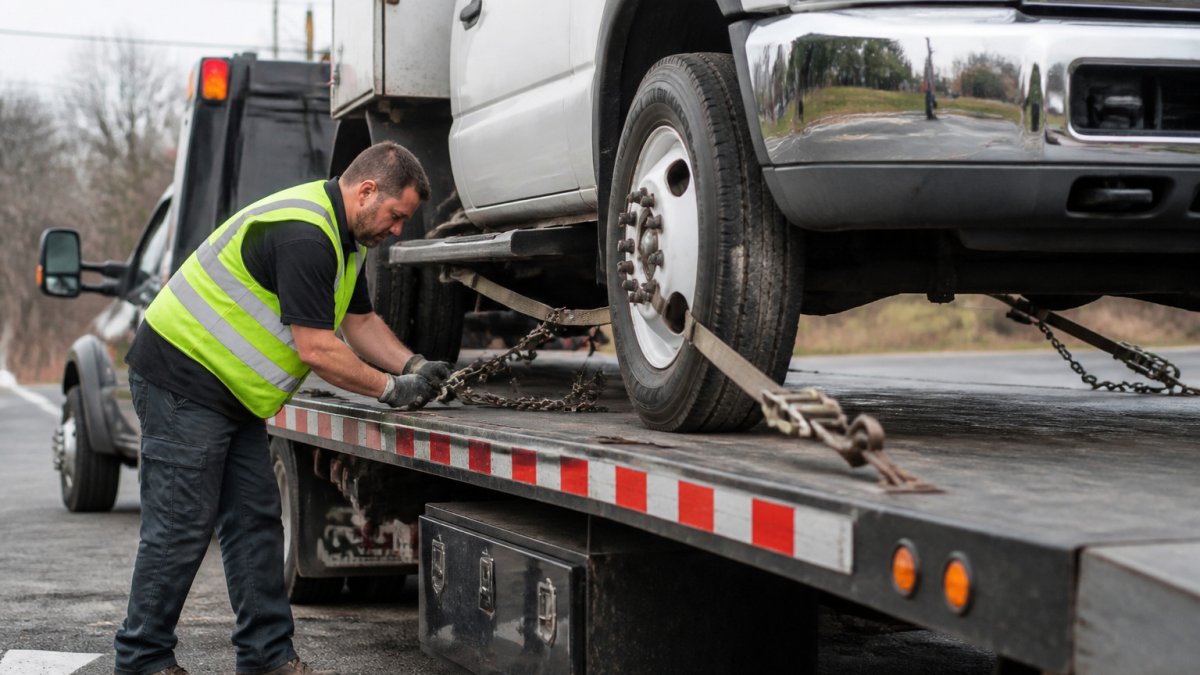
The federal securement standard, 49 CFR Part 393, Subpart I, sets the framework most states reference. The core mechanic is the working load limit (WLL): every strap, chain, binder, and attachment point has a rated WLL, and the aggregate WLL of the securement system must meet or exceed the performance criteria for the load. Two practical rules follow:
- Match the component to the load, not to the last job. A strap rated for a 5,000 lb. load is not adequate for a 12,000 lb. vehicle, even if it held last week.
- Count the attachment points. The number and arrangement of tie-downs must resist movement in all directions, forward, rearward, and lateral. A single strap across a vehicle resists one direction well and the others poorly.
Inspect ratchets, hooks, and webbing before every tow. Frayed straps, bent hooks, and stretched chain links are common reasons equipment fails during a roadside stop. Remove damaged components from service rather than relegating them to lighter duty.
Secondary connections
Secondary connections should be attached in a crossed configuration under the tongue or coupling point, with enough slack to allow turning without placing load on the chains during normal operation. Chains must not drag on the pavement, and the attachment points must be rated for the combined weight. Check the crossover: chains that are crossed correctly cradle the tongue if the coupler separates; chains that are parallel allow the tongue to drop.
A securement verification workflow
A written sequence is what separates a compliant operation from a lucky one. Before the vehicle leaves the scene:
- Confirm the load weight from the vehicle’s registration or a scale ticket, and record it.
- Select components whose aggregate WLL meets the criteria for that weight, and record the component ratings used.
- Attach and tension the primary securement, then verify each binder is locked and each hook is closed.
- Attach the secondary connection in the crossed configuration and confirm slack allows full turning range.
- Photograph the completed securement from at least two angles, including a close-up of each attachment point.
- Re-check after the first few miles. Straps settle and loads shift; a mid-route check catches what the initial inspection missed.
Keep the weight record, component ratings, and photos with the job file. If a question arises after delivery, the file is the evidence that the securement met the standard at the time of the tow.
Corrective actions
When an inspection finds a deficiency, a frayed strap, a bent hook, a chain with a stretched link, the corrective action is removal from service and replacement, not downgrading the component to a lighter job. Log the removal and the replacement so the equipment record stays current. A securement program that documents both the inspection and the correction is the one that holds up under scrutiny.
Tow Truck Driver Safety Checklist for Pre-Tow Inspections
A consistent pre-tow inspection catches most problems before the vehicle leaves the scene. Operators who follow a written checklist report fewer equipment failures than those who rely on memory, and the habit also creates documentation if a question arises later.
Use this sequence before every commercial tow:
- Confirm the vehicle’s GVWR and GCWR and verify your operator credential covers the combination
- Inspect the coupling device, tow bar, and locking pins for wear and proper engagement
- Check safety chains or cables for damage, correct length, and secure attachment points
- Test lighting, brake lights, and turn signals on the towed unit
Standardizing this routine across your team is one of the most effective safety steps you can take.
Scheduling Your Next Heavy-Duty Tow with Fox Recovery
Commercial towing safety depends on having qualified equipment and operators available when a breakdown happens. Fox Recovery provides 24/7 towing and recovery for domestic, import, medium, and heavy-duty trucks, using 19 ft. and 21 ft. flatbeds and fully certified, licensed operators. We also handle buses and tractor-trailers, which makes us a fit for fleet managers who need dependable support.
To schedule a heavy-duty tow, call (847) 587-6076.
Frequently Asked Questions
Is predatory towing illegal?
Predatory towing generally refers to a tow company removing a vehicle without the owner’s consent, or charging excessive fees for a nonconsensual tow, often on private property. Many states regulate private property towing through licensing, signage requirements, and fee caps, and some restrict towing without owner authorization. Because the rules vary by state and locality, check your state’s motor vehicle or consumer protection agency for the specific limits that apply. If a tow seems improper, request an itemized invoice, document the signage and the vehicle’s condition, and ask the tow company for the name of the authorizing party.
What equipment is required to tow a commercial vehicle safely?
A safe commercial vehicle tow requires equipment rated for the combined weight being moved. That includes a tow vehicle or flatbed with an adequate gross combination weight rating, a properly rated coupling device such as a tow bar or ball-and-socket coupling, safety chains or cables as a secondary connection, working lights and brakes, and securement devices such as wheel nets, straps, or chains. Confirm that every component carries a rating at or above the load it will handle, and inspect each item before the tow begins.
What should a driver check before towing a commercial vehicle?
Before towing, the operator should verify the gross vehicle weight rating and the tow vehicle’s towing capacity, confirm the coupling and safety chains are secure, check tire condition and inflation on both units, and test lights and brakes. The operator should also confirm the disabled vehicle’s parking brake is set or released as the tow method requires, and that the load is secured at all designated points. Documenting these checks on a pre-tow inspection form creates a record if an incident or inspection occurs later.
Do federal regulations apply to tow trucks and towing operations?
Federal Motor Carrier Safety Regulations apply to many commercial motor vehicle operations, including some towing activities, depending on vehicle weight, cargo, and whether the operation crosses state lines. Purely intrastate towing is often governed by state rules instead. Because applicability depends on the specific operation, review the Department of Transportation’s guidance and your state’s requirements, and confirm with a regulatory professional when you are unsure which rules govern your fleet or service.
