
Last Updated: November 2, 2026
Quick Summary
The five best parking enforcement signs for private lots are tow-away zone signs, no-parking notices, reserved and permit signs, accessible parking signs, and directional, stop, and fire-lane signs. Tow-away signs rank first because they give a property manager the authority to call for a tow, while the other four cover restricted zones, assigned spaces, ADA compliance, and traffic flow.
- Post a tow-away notice at every vehicle entrance before a driver enters the lot.
- Mount standard post-mounted signs with the bottom roughly 5 to 7 feet above the ground.
- Repeat no-parking and fire-lane signs every few car lengths, commonly 50 to 75 feet.
- Photograph every sign at installation and re-check it annually for fading and outdated numbers.
- Specify reflective aluminum and engineer-grade or high-intensity sheeting so signs read at night.
Table of Contents
- Quick Comparison: 5 Best Parking Enforcement Signs for Private Lots
- Parking Enforcement Sign Requirements Every Private Lot Must Meet
- 1. Tow-Away Zone Signs: The Backbone of Private Lot Enforcement
- 2. No-Parking and Parking-Restriction Notices
- 3. Reserved, Permit, and Assigned Parking Signs
- 4. Accessible Parking and Access-Aisle Signage (ADA)
- 5. Directional, Stop, and Fire-Lane Signs That Complete the Lot
- Parking Sign Placement: Height, Spacing, and Where Each Sign Belongs
- Frequently Asked Questions
Quick Comparison: 5 Best Parking Enforcement Signs for Private Lots
A private lot without enforceable signage is, in practice, a lot with no rules at all. The single most common reason a removal gets challenged is a sign that never met the legal bar.
| Rank | Sign Type | Primary Job | Where It Belongs | Enforceability Weight |
|---|---|---|---|---|
| 1 | Tow-away zone signs | Authorizes vehicle removal | Every entrance and restricted zone | Highest |
| 2 | No-parking notices | Blocks unauthorized parking | Fire lanes, loading zones, edges | High |
| 3 | Reserved and permit signs | Assigns specific spaces | Assigned stalls, permit areas | Medium-high |
| 4 | Accessible parking signs | Protects ADA spaces | Accessible stalls and aisles | Legally mandatory |
| 5 | Directional, stop, and fire-lane signs | Controls traffic flow | Drive aisles, exits, entrances | Supporting |
The order matters. Signs lower on this list protect people and property, but the first three are the ones that give a property manager the authority to call for a tow.
Parking Enforcement Sign Requirements Every Private Lot Must Meet
Parking enforcement sign requirements vary by state and municipality, and no single federal code governs private-lot signage. That is the first thing most property managers get wrong: they order a generic tow-away sign online and assume it travels.
Federal, State, and Local Rules That Decide Enforceability
Federal law sets the floor for accessible parking through the ADA Standards for Accessible Design, which governs stall dimensions, access aisles, and sign mounting height. Everything else comes from state statute and local ordinance. Many jurisdictions require a posted tow-away notice at each lot entrance before a vehicle can be removed, and several require a specific sign size, letter height, or wording.
What a Tow-Away Notice Must Say to Hold Up
A defensible tow-away notice typically names the restriction, states that violators will be towed at the owner’s expense, and identifies who to contact. It must be legible from the driver’s seat, mounted at the entrance, and current. Faded lettering or a disconnected phone number gives a driver grounds to dispute the removal. We recommend photographing every sign at installation and re-checking it annually.
1. Tow-Away Zone Signs: The Backbone of Private Lot Enforcement
Tow-away zone signs do the heaviest lifting in any private lot because they convert a parking rule into an enforceable consequence. Without one posted at the entrance, a removal is easy to challenge.
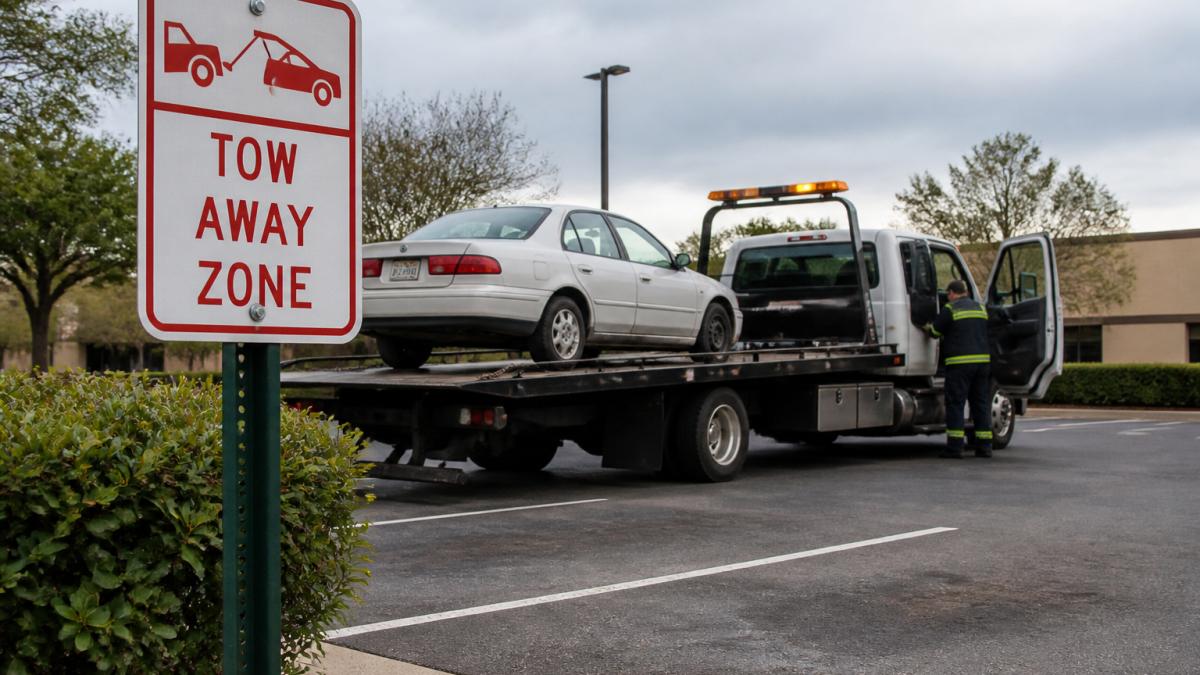
CUSTOMERS ONLY. ALL OTHER VEHICLES TOWED AT OWNER’S EXPENSE. CALL [TOW COMPANY] AT [PHONE].”
Custom metal tow-away signs are available from a range of sign suppliers, and pricing depends on the design, size, and wording you choose; check with individual suppliers for current prices. If you would rather not manage removal logistics yourself, our guide to private property towing for businesses walks through the full setup. Comparing providers is the next step, and our breakdown of how to compare heavy-duty towing rates covers what to ask before signing.
Best for: lots that need removal authority on day one.
Skip if: your jurisdiction requires a permit before any towing is allowed.
2. No-Parking and Parking-Restriction Notices
No-parking notices handle the zones where a vehicle should never sit: fire lanes, loading docks, curb edges, turnaround areas, and short-term customer spots. These signs are narrower than tow-away notices and usually work alongside them, the no-parking sign states the restriction, and the tow-away notice at the entrance supplies the consequence.
Exact Wording That Holds Up
The most defensible no-parking signs follow a three-part pattern: the restriction, the scope, and the consequence.
Examples of wording that practitioners commonly use:
“NO PARKING ANY TIME. VEHICLES WILL BE TOWED AT OWNER’S EXPENSE. CALL [TOW COMPANY] AT [PHONE].”
“CUSTOMER PARKING ONLY. 30-MINUTE LIMIT. ALL OTHER VEHICLES TOWED AT OWNER’S EXPENSE.”
“NO PARKING, FIRE LANE. VEHICLES BLOCKING THIS LANE WILL BE TOWED AT OWNER’S EXPENSE.”
“LOADING ZONE. ACTIVE LOADING AND UNLOADING ONLY. UNAUTHORIZED VEHICLES TOWED AT OWNER’S EXPENSE.”
“PRIVATE PROPERTY. PARKING FOR [BUSINESS] PATRONS ONLY. VIOLATORS TOWED AT OWNER’S EXPENSE.”
Wording requirements vary by state and municipality. Some jurisdictions require specific phrases, minimum letter heights, or a posted phone number before a tow is authorized. Confirm local requirements before ordering custom signs, copying a sign from a neighboring lot is a common and costly mistake.
Time-Limit and Conditional Restrictions
Time-limited and customer-only restrictions belong in this category, and they need the hours or conditions spelled out in plain language, not implied. A sign that says “Customer Parking” without stating a time limit or a consequence gives a driver no notice of what triggers enforcement. Pair every conditional restriction with a stated consequence and a contact number so the sign functions as notice, not decoration.
Placement and Repetition
Placement is where most lots fail. A no-parking sign at the far end of a fire lane does nothing for a driver pulling in at the near end. Post at the start of the restricted stretch and repeat every few car lengths, signs should be repeated along long restrictions at intervals that keep them visible to drivers, and at every entrance to a restricted zone.
Materials and Lifecycle
Reflective aluminum holds up to sun and rain; cheap painted steel fades within a season and undermines the whole enforcement program. For no-parking signs that face traffic, specify engineer-grade or high-intensity reflective sheeting so the message reads at night and in rain.
Best for: fire lanes, loading zones, curb edges, and short-term customer spots.
Skip if: the zone needs removal authority on its own, pair with a tow-away notice at the entrance instead.
3. Reserved, Permit, and Assigned Parking Signs
Reserved and permit signs assign specific spaces to specific users, and they only work when the assignment is visible before a driver parks.
The practical rule: mount reserved and permit signs at the head of the stall, facing the approaching driver, at a height that clears snow and bumper lines.
Watch out: permit areas without a stated consequence invite overflow parking from adjacent businesses, and once the habit forms it is hard to reverse.
4. Accessible Parking and Access-Aisle Signage (ADA)
Accessible parking signage is the one category where getting it wrong carries legal exposure, not just enforcement friction. The ADA Standards for Accessible Design require a sign at each accessible space, mounted high enough to be seen over a parked vehicle, with the International Symbol of Access and the van-accessible designation where it applies.
Accessible signs should be audited regularly for fading, graffiti, and damage. An accessible sign that has faded is a compliance problem, not a cosmetic one.
5. Directional, Stop, and Fire-Lane Signs That Complete the Lot
Directional, stop, and fire-lane signs do not authorize a tow on their own, but they prevent the confusion that creates violations in the first place.
Fire-lane signs deserve separate attention. They must be unmistakable, posted along the full length of the lane, and paired with painted curb markings where local code requires them.
Signage for traffic control and pedestrian safety in lots and garages is available from a variety of sign suppliers.
Parking Sign Placement: Height, Spacing, and Where Each Sign Belongs
Parking sign placement decides whether a sign gets read or ignored. The governing principle is the decision point: a sign must be visible from the driver’s seat before the driver commits to a space or a lane, not after. Placement guidance below is practical and commonly used, but confirm local height and spacing requirements, some jurisdictions specify minimums for tow-away and accessible signs.
Height: What Drivers Actually See
- Standard post-mounted signs: mount the bottom of the sign roughly 5 to 7 feet above the ground so it clears vehicles, snow, and bumper lines while staying in the driver’s sightline. Accessible parking signs are commonly mounted higher, often around 7 feet to the bottom of the sign, so they remain visible over a parked vehicle; confirm the exact requirement with the ADA Standards for Accessible Design and local code.
- Wall-mounted signs: mount at eye level for a seated driver, at a height suited to a seated driver, and avoid placing them where an open door or a parked vehicle will block the view.
- Fire-lane signs: mount high enough to be seen over parked cars and repeat along the lane; do not rely on a single sign at one end.
Spacing and Repetition
- Entrances: post tow-away notices at every vehicle entrance, facing inbound traffic, before the driver enters the lot.
- Long restrictions: repeat no-parking and fire-lane signs every few car lengths, practitioners commonly use 50 to 75 feet, and at every entrance to the restricted zone.
- Individual spaces: mount reserved and permit signs at the head of the stall, facing the approaching driver, and match the space number on the sign to the space on the pavement.
Sightlines and Obstructions
- Trim vegetation and relocate signs that get blocked by growth; a sign behind a shrub is a suggestion, not notice.
- Keep signs clear of dumpsters, utility boxes, and parked vehicles that can obscure them.
- Use reflective sheeting so signs read at night and in rain, and check that lettering is large enough to read from a moving vehicle.
Lighting and Night Visibility
Reflective sheeting is the baseline; where the lot is dark, add lighting or choose higher-intensity reflective material. A sign that cannot be read after dark weakens enforcement for every evening violation.
Audit and Maintenance
Audit signs annually for fading, damage, graffiti, and outdated contact numbers. Photograph every sign at installation and keep the photos with your enforcement records, faded lettering or a disconnected phone number gives a driver grounds to dispute a removal.
Walk the lot as a driver would, at the times enforcement actually happens. If you cannot read the sign from the driver’s seat before the decision point, neither can the person you are trying to notify.
Frequently Asked Questions
Do private parking lots need signs before a vehicle can be towed?
In most states, yes. Property owners generally must post clear parking enforcement signs at every entrance and near restricted spaces before a vehicle can be towed. The signs typically need to state the restriction, who enforces it, and a local contact number. Requirements vary by state and municipality, so confirm the exact wording with your local code enforcement office before ordering signs or authorizing a tow.
What should a private property tow-away sign say?
A tow-away zone sign should name the restriction (for example, “Unauthorized Vehicles Will Be Towed”), list who may park there, and include a phone number for vehicle recovery. Many jurisdictions also require the towing company’s name and the hours enforcement applies. Keep text short, use large letters, and mount the sign where drivers see it before entering the space, not after parking.
Where should parking enforcement signs be placed in a private lot?
Place signs at each entrance, at the head of every restricted row, and beside individual reserved or accessible spaces. Mount them high enough to clear vehicle roofs and stay readable. Angling signs slightly toward oncoming traffic and repeating them along long rows improves parking sign visibility and readability, especially at night or in bad weather.
How large should parking enforcement signs be?
Sign size should be chosen so lettering is readable from a moving vehicle; confirm size requirements with local code. Accessible parking signs have their own size and mounting rules under the ADA, so check those separately. Larger signs suit high-speed entrances and wide lots where drivers need more distance to read and react.
What makes a parking sign easy to read at night or in bad weather?
Reflective sheeting, high-contrast lettering, and durable metal backing make the biggest difference. White text on a red or blue background reads clearly in low light, and reflective signage bounces headlights back at the driver. Check signs at least once a year for fading, graffiti, and damage, and replace any sign whose message is no longer legible from a moving vehicle.
A private lot is only as enforceable as its weakest sign, and a challenged tow usually traces back to a notice that was faded, misplaced, or never posted at the entrance. Fox Recovery supports property managers with 24/7 private property towing, certified and licensed operators, and flatbed equipment that protects high-value vehicles during removal. Get started with Fox Recovery and turn your posted rules into enforcement that holds up. Call (847) 587-6076.
