
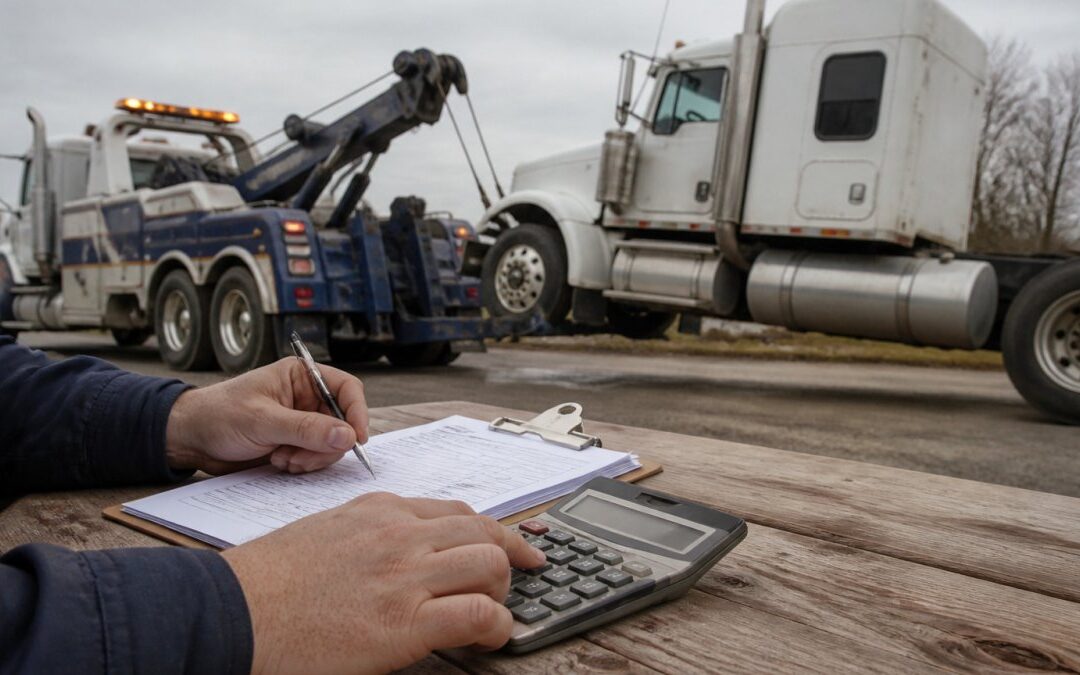
Last Updated: October 29, 2026
Quick Summary
Ewing Bros and Guardian Fleet should be compared on service footprint, equipment class, flatbed deck length, and billing terms, since public detail on both is limited. Heavy-duty towing rates are typically a base hookup fee plus mileage, with extra charges for after-hours work or special equipment. Ask each provider for a written estimate that itemizes these costs.
- Confirm the dispatch terminal and truck count nearest your location with each provider.
- Ask for the maximum boom and winch rating of the specific unit that would be dispatched.
- Request a written estimate listing base fee, per-mile charge, and any surcharges.
- Ask whether quotes are all-inclusive and what triggers waiting, storage, or winching fees.
- Read the newest 12 months of reviews for response time, billing accuracy, and damage.
Table of Contents
- Ewing Bros vs Guardian Fleet: How the Two Providers Stack Up
- What Each Provider Offers: Service Footprint, Fleet Size and Equipment
- Understanding Standard Heavy-Duty Towing Rates in the United States
- Heavy-Duty Towing Quote Comparison: Billing, Fees and Hidden Charges
- 24/7 Heavy-Duty Towing: Response Times and Availability
- Customer Experience: What Review Evidence Shows
- Choosing the Right Heavy-Duty Tow Provider for Your Situation
- Frequently Asked Questions
Ewing Bros vs Guardian Fleet: How the Two Providers Stack Up
Choosing between Ewing Bros and Guardian Fleet comes down to a few practical questions: how far their trucks can reach, how much equipment they can bring to a job, and how clearly they explain their charges. Fox Recovery publishes this comparison because fleet managers and vehicle owners often ask these questions before they ever need a tow. The answer depends on the job, not on a single headline feature. For a direct side-by-side of Barnetts Towing and Guardian Fleet to see how a third option fits, read Barnetts Towing vs Guardian Fleet: Which Fits Your Fleet.
We are not in a position to verify each company’s current capacity from the research available, so treat any specific fleet count or coverage claim as something to confirm directly with the provider. A reader who handles routine fleet moves will weigh these differences differently than someone who needs an emergency recovery on a highway shoulder.
Fox Recovery sits in the same market, with 24-hour availability and flatbed equipment sized at 19 ft. and 21 ft. Our recommendation is to compare all three on response time, equipment fit and billing terms, not only on which name is familiar.
What Each Provider Offers: Service Footprint, Fleet Size and Equipment
This section breaks the comparison into the four capability questions that decide a heavy-duty tow, and shows how to evaluate Ewing Bros and Guardian Fleet on each one, including where public information runs out and what you must confirm by phone.
1. Service footprint and dispatch radius. A provider’s footprint is not the same as its marketing map. What matters is where the trucks physically sit overnight, because that determines the real dispatch radius. When you call either Ewing Bros or Guardian Fleet, ask three specific questions: Which terminal would dispatch to my location? How many trucks are stationed there? What is the typical drive time from that terminal at 2 a.m. on a Sunday?
2. Equipment class and weight ratings. Heavy-duty towing is not one service, it is a ladder of equipment classes. A standard flatbed handles passenger vehicles and light trucks. A medium-duty wrecker covers box trucks and smaller commercial vehicles. A heavy-duty wrecker is rated for loaded tractor-trailers, and a rotator is what you need when a vehicle is overturned, off-road, or in a position a standard wrecker cannot reach.
3. Specialized transport capability. Flatbeds matter for high-value, damaged, or low-clearance vehicles because they carry the vehicle rather than dragging it. Deck length matters too: a 19 ft. deck fits most sedans and SUVs, while a 21 ft. deck accommodates longer wheelbases and full-size pickups without overhang. For multi-vehicle or oversized loads, ask whether the provider can send a second truck or a trailer rather than assuming one unit covers the job.
4. Commercial and municipal contracts. Fleet and municipal work is a different operating model from consumer roadside calls. If you are a fleet manager, ask directly whether the provider offers account billing, whether contract customers jump the queue on emergency calls, and what the SLA looks like in writing. Consumer callers should ask the reverse: whether contract volume affects how long they wait.
Build a one-page capability sheet before you call either provider. List your heaviest vehicle’s gross weight, its length, and your three most common pickup locations. Ask each company to confirm equipment rating, dispatch terminal, and typical response time against that sheet. The provider that answers all three specifically is the one to shortlist.
Where the public record runs thin. The comparison has to be completed by phone, because the public detail available on each provider’s terminals and equipment is limited. Treat any fleet count, coverage map, or weight rating you see online as a starting point to verify, not a settled fact.
For reference, Fox Recovery operates 19 ft. and 21 ft. flatbeds and tows medium- and heavy-duty vehicles, including buses and tractor-trailers, with licensed operators. Use that as the format for the answers you should expect from any provider: specific deck lengths, specific vehicle classes, specific licensing.
The four capability questions that decide a heavy-duty tow, and what to confirm with each provider:
| Capability | What to confirm | Why it matters |
|---|---|---|
| Service footprint | Dispatch terminal and truck count near you | Sets the real response radius |
| Equipment class | Max boom and winch rating of the dispatched unit | Must match the vehicle’s weight |
| Flatbed deck length | 19 ft. or 21 ft. deck | Fits sedans, SUVs and full-size pickups |
| Commercial contracts | Account billing and written SLA | Shapes fleet vs. consumer service |
Understanding Standard Heavy-Duty Towing Rates in the United States
Heavy-duty towing is priced differently from passenger-vehicle towing because the equipment, labor and risk are higher. Rates usually reflect the truck required, the distance traveled, the time on site and whether the job is a simple tow or a complex recovery. Many providers quote a base hookup charge plus mileage, with extra fees for after-hours work or special equipment.
Because published rate ranges are limited in the research available, we will not quote specific dollar figures for any provider. A practical approach is to ask each company for a written estimate that lists the base fee, per-mile charge, and any surcharges. Compare those line items directly rather than comparing totals alone.
Heavy-Duty Towing Quote Comparison: Billing, Fees and Hidden Charges
Most surprise charges come from fees that appear only at the end of a job. Our heavy-duty towing cost transparency guide explains how to spot hidden charges before you agree to a quote. Common examples include waiting time, storage fees, winching surcharges and after-hours premiums. Ask whether each quote is all-inclusive and what triggers an additional charge.
A reliable quote should answer four questions in writing: What is the base rate? How is distance measured? What is billed by the hour? What fees apply if the vehicle is not released on the first attempt? Providers that answer these clearly are usually easier to budget around.
24/7 Heavy-Duty Towing: Response Times and Availability
Around-the-clock availability matters most for fleet vehicles on interstates, where a breakdown can stop deliveries and create safety hazards. Ask each provider for its typical response time to your location, and whether that estimate holds at night and on weekends.
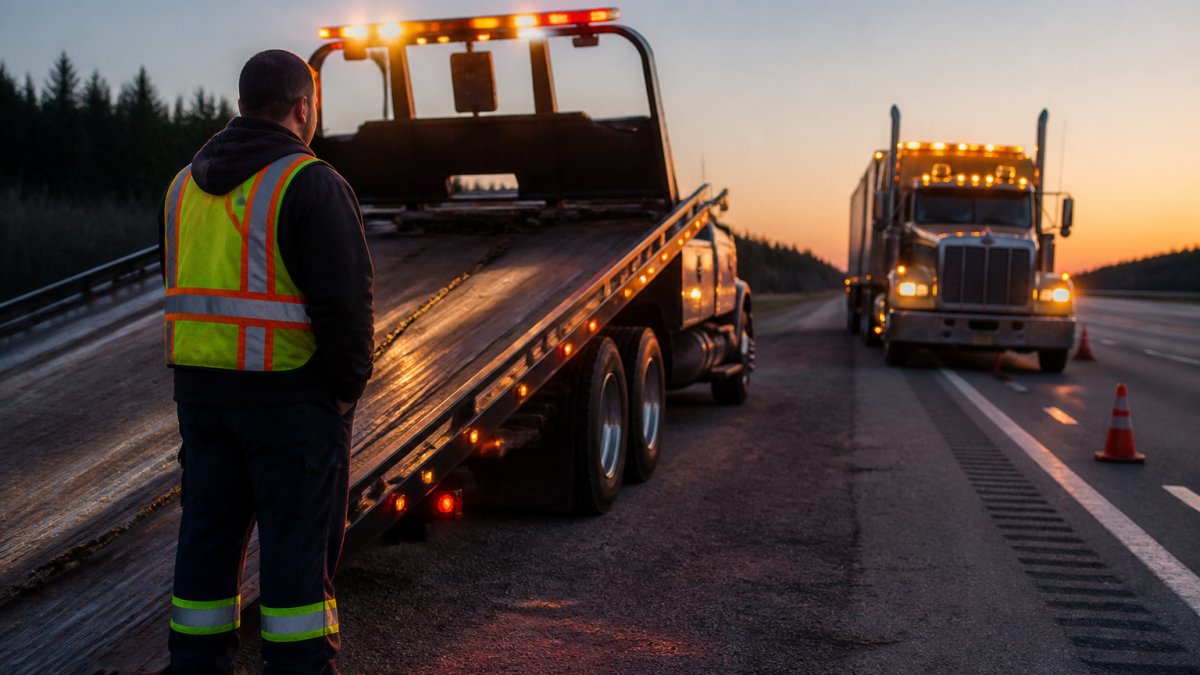
Fox Recovery operates 24 hours a day, 365 days a year.
Customer Experience: What Review Evidence Shows
Review evidence is where published marketing and day-to-day performance diverge, and it is the area where this comparison can add the most value, because almost no page ranking for this query actually analyzes reviews for both providers side by side. Instead of repeating testimonials, this section gives you a repeatable method for reading the review record on Ewing Bros, Guardian Fleet, or any other provider, and tells you which themes to weight.
Read for themes, not stars. A single five-star review and a single one-star review tell you almost nothing. What matters is the pattern across many reviews over a defined period. Sort reviews by newest first and read the last 12 months. Then tally how often each of these themes appears:
- Response time versus the quoted ETA. Did the truck arrive when promised, or was the estimate optimistic? This is the single most decision-relevant theme for emergency callers.
- Billing accuracy. Did the final invoice match the quoted price? Look specifically for mentions of surprise fees, after-hours premiums, winching charges, waiting time, or storage fees added after the fact.
- Vehicle handling and damage. Did the vehicle arrive in the condition it left in? Damage complaints are rare but serious when they appear, and they tend to cluster around specific equipment types.
- Driver professionalism and communication. Did the dispatcher keep the customer informed? Was the driver licensed and clear about the process?
- Resolution behavior. When something went wrong, did the company make it right? A provider that resolves complaints well is often a safer bet than one with a slightly higher average rating and no resolution pattern.
Weight the reviews by job type. A review from a driver whose sedan was towed two miles says little about how a provider handles a loaded tractor-trailer recovery. When you read reviews for Ewing Bros or Guardian Fleet, filter for the reviewers who describe commercial, fleet, or heavy-duty work. Those are the experiences closest to the job you are likely to need. Consumer reviews are still useful for judging dispatch and billing behavior, but they should not be the deciding evidence for heavy recovery.
Cross-check the source. Reviews on a company’s own website are curated; reviews on independent platforms are not. Look for the same themes appearing in both places. If a provider’s site shows only glowing testimonials but independent reviews consistently mention billing disputes, that divergence is itself the finding. Note the date on every review you rely on, a pattern from three years ago may reflect a company that has since changed ownership, equipment, or dispatch practices.
Be cautious with review evidence that cannot be dated or attributed. A testimonial with a first name only and no job description is weak evidence for a heavy-duty decision. Prefer reviews that state the vehicle type, the location, and the outcome.
What the public review record shows, and does not. Review listings for Ewing Bros exist, but a balanced, dated, theme-by-theme analysis covering both Ewing Bros and Guardian Fleet is not available in the public record at the depth this decision deserves. That is precisely why the method above matters: you will likely have to do the tally yourself. Spend 20 minutes on the two providers’ newest reviews, score them against the five themes, and you will have better evidence than any single testimonial page can offer.
For transparency about our own record: published testimonials for Fox Recovery include feedback from customers such as Herbert Kufke, Angeleque Hall, and Miguel Aceves describing their service experiences. These are individual accounts, and we present them as such, weigh them using the same method above, alongside reviews from independent sources, before making a decision.
Choosing the Right Heavy-Duty Tow Provider for Your Situation
The right provider depends on your situation. A fleet operator with regular, scheduled moves should prioritize documented equipment capacity and written billing terms. A dealership or collector moving high-value vehicles should prioritize certified operators and secure flatbed transport. An individual facing a roadside breakdown should prioritize how quickly a truck can reach them.
Build a short checklist before you need help: confirm coverage for your routes, verify equipment weight ratings, request a written quote, and check availability hours. Comparing Ewing Bros, Guardian Fleet and Fox Recovery on those points will show which provider fits your fleet or vehicles best.
Fox Recovery is available around the clock at (847) 587-6076 to discuss your vehicles and provide a quote for your specific job.
Frequently Asked Questions
What is Guardian Fleet?
Guardian Fleet is a towing and recovery provider. Because the research available for this comparison is limited, readers should confirm its current service area, equipment list and rate structure directly with the company before making a decision.
What services does Ewing Bros provide?
Confirm the specific equipment capacity, service locations and availability for your vehicle type before booking, since those details determine whether a provider can handle your tow.
What should I ask before booking a heavy-duty tow?
Confirm the truck size and equipment the operator will use, and ask how quickly they can dispatch to your location. Verify that operators are licensed and certified. For current pricing or a quote, contact Fox Recovery through its website.
Which towing provider offers 24/7 service?
Many heavy-duty towing companies advertise around-the-clock dispatch, but availability can differ by location and equipment type. Confirm directly with each provider that they dispatch 24 hours a day, 365 days a year, and ask for a realistic estimated arrival time for your specific location. Fox Recovery lists 24/7 availability for domestic, import, medium and heavy-duty vehicles on its website.
