
Table of Contents
- Essential Recovery Gear for Heavy Duty Operations
- Winch Recovery Kits and Components
- Heavy Duty Recovery Winch Capacity: Matching Equipment to Vehicle Weight
- Kinetic Energy Ropes vs. Static Tow Straps: When to Use Each
- Shackles, Hitch Points, and Soft vs. Hard Anchors
- How to Inspect Recovery Gear for Wear and Safety Compliance
- OSHA Standards for Vehicle Recovery Equipment and Load Ratings
- Common Mistakes That Lead to Recovery Failures
- Frequently Asked Questions
Last Updated: October 2, 2026
Essential Recovery Gear for Heavy Duty Operations
Heavy duty recovery equipment is essential for off-road operations. The difference between success and failure often comes down to having the right gear and understanding how to use it.
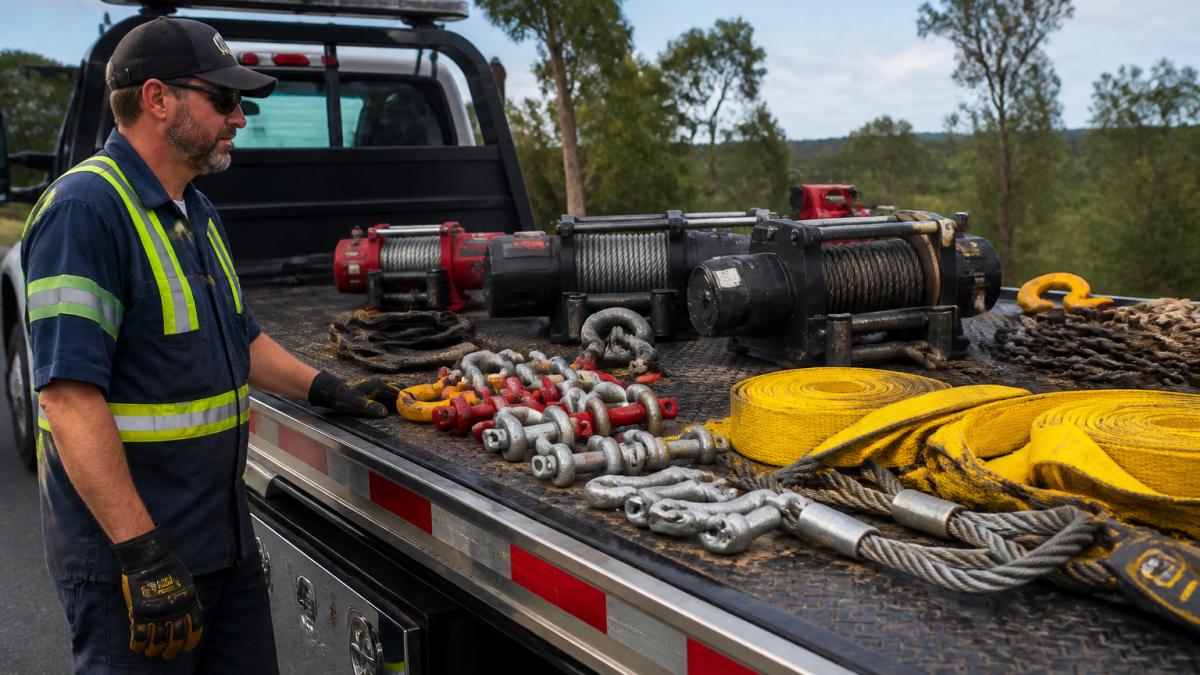
Your recovery kit must match your vehicle’s weight, terrain, and extraction scenario. Equipment failures typically result from undersizing or damage.
Core components include a properly sized winch, kinetic ropes or static straps, rated shackles, and a reliable recovery point. Each plays a specific role; using the wrong type compromises the entire operation.
Before buying recovery equipment, calculate your vehicle’s gross vehicle weight rating (GVWR) and add 50% as a safety margin. Your winch capacity should exceed this number by a comfortable margin.
Winch Recovery Kits and Components
A winch provides the mechanical advantage needed for extraction, allowing one vehicle to recover another from situations that would otherwise require professional equipment.
Electric winches suit mid-range work and are easier to maintain. Hydraulic winches deliver greater power for extreme scenarios but require specialized knowledge.
The working load limit (WLL), the safe continuous pulling capacity, is what matters most. It’s typically 20-25% of minimum breaking strength and is the number to use for all calculations.
A complete kit includes the winch, fairlead, snatch block, winch damper, and anchoring hardware. The damper is critical, it catches the line if it breaks, preventing it from whipping across the work area.
Never operate a winch without a damper installed and positioned correctly. Line failures happen. A damper is the only thing that prevents serious injury or death when they do.
Heavy Duty Recovery Winch Capacity: Matching Equipment to Vehicle Weight
Winch capacity must match vehicle type, terrain, and extraction angle. One-size-fits-all recommendations either undersized or oversized.
Vehicle-Specific Load Calculations
Start with gross vehicle weight rating (GVWR), not curb weight. A pickup truck might weigh 5,000 pounds empty but have a GVWR of 8,500 pounds when loaded. Medium-duty trucks range 15,000-25,000 pounds GVWR; heavy-duty trucks can exceed 35,000 pounds.
UTVs and side-by-sides typically have 2,000-5,000 pound GVWR and require 4,000-8,000 pound capacity winches, following the same load-calculation principles.
For overlanding rigs, add vehicle weight plus camper or cargo weight. An 8,000-pound truck with a 4,000-pound camper has an effective recovery weight of 12,000 pounds.
Terrain-Specific Load Multipliers
Terrain affects required pulling force:
- Soft recovery (sand, mud, snow): Multiply GVWR by 1.25-1.5. A 15,000-pound truck requires 18,750-22,500 pounds of force.
- Hard recovery (ditches, ruts, rocky terrain): Multiply GVWR by 1.5-2.0. A 15,000-pound truck requires 22,500-30,000 pounds.
- Extreme recovery (rollovers, deep water): Multiply GVWR by 2.0-3.0. A 15,000-pound truck requires 30,000-45,000 pounds.
Extraction Angle Load Multiplication
Pull angle multiplies load on equipment:
- Straight pull (0°): Multiplier = 1.0
- 30°: Multiplier = 1.15
- 45°: Multiplier = 1.4
- 60°: Multiplier = 2.0
- 90° (sideways): Multiplier = 2.0+
A 15,000-pound vehicle at 45° requires 21,000 pounds of pulling force.
Most recovery scenarios involve angles. A vehicle stuck in a ravine often requires a 45-degree or steeper pull. Your equipment must account for this multiplication.
Recommended Winch Capacity by Vehicle Type and Terrain
| Vehicle Type | GVWR | Soft Terrain | Hard Terrain | Extreme Scenario | Recommended Winch |
|---|---|---|---|---|---|
| UTV/Side-by-side | 3,000-5,000 lbs | 3,750-7,500 lbs | 4,500-10,000 lbs | 6,000-15,000 lbs | 8,000-12,000 lbs |
| Light truck (1/2-ton) | 8,000-12,000 lbs | 10,000-18,000 lbs | 12,000-24,000 lbs | 16,000-36,000 lbs | 12,000-18,000 lbs |
| Medium truck (3/4-ton) | 15,000-20,000 lbs | 18,750-30,000 lbs | 22,500-40,000 lbs | 30,000-60,000 lbs | 25,000-35,000 lbs |
| Heavy truck (1-ton+) | 25,000-35,000 lbs | 31,250-52,500 lbs | 37,500-70,000 lbs | 50,000-105,000 lbs | 40,000-60,000 lbs |
| Overlanding rig | 12,000-18,000 lbs | 15,000-27,000 lbs | 18,000-36,000 lbs | 24,000-54,000 lbs | 20,000-30,000 lbs |
The Safety Margin Rule
Add a 50% safety margin to worst-case load calculations. If hard terrain requires 40,000 pounds, your winch should have 60,000 pounds WLL. This margin accounts for unexpected angles, equipment degradation, multiple pulls, and unknown variables.
Undersizing is the most common mistake in the field. A 25,000-pound winch on a 20,000-pound truck seems adequate until you encounter a 45-degree pull angle in hard terrain, which multiplies the load to 40,000 pounds. The winch fails, the recovery fails, and you’re now in a worse situation than when you started.
Professional Recovery Operations Standard
Professional operators use winches with 50-100% more capacity than worst-case loads. This is insurance against unpredictable variables; the extra cost is negligible compared to failure costs.
Calculate your worst-case load (vehicle GVWR × terrain multiplier × angle multiplier), then add 50%. That’s your minimum winch capacity. If that number seems high, you’re probably calculating correctly, recovery is a high-stakes operation.
Kinetic Energy Ropes vs. Static Tow Straps: When to Use Each
This distinction separates amateur recovery operations from professional ones. The wrong choice creates dangerous loads and failed extractions.
Kinetic ropes stretch under load to absorb energy and create controlled pulls. They’re ideal for self-recovery in soft terrain like sand or mud, reducing shock load on vehicle frames.
Static straps have minimal stretch and are designed for steady pulling when a vehicle is mobile. Use them for highway towing to maintain constant tension without dynamic shock.
Never use kinetic ropes for highway towing (creates jerking) or static straps for off-road recovery (creates shock loads that tear frames or flip vehicles).
Kinetic ropes for dynamic recovery scenarios (stuck vehicles, soft terrain). Static straps for controlled towing on established surfaces. Never mix them up.
Shackles, Hitch Points, and Soft vs. Hard Anchors
Connection points matter as much as equipment. A 10,000-pound shackle on a 5,000-pound recovery point creates a weak link that fails first.
Soft shackles (synthetic rope) absorb energy and reduce shock loading, making them gentler on frames. Hard shackles (steel D-rings or bow shackles) are more durable in high-heat and UV environments, standard for professional operations.
Factory tow hooks are designed for pavement towing, not off-road extraction. Serious recovery work requires hitch-mounted or frame-welded anchor points rated for applied loads. Pulling at angles through factory points tears frames.
Never exceed the working load limit of any component in your recovery chain. An 8,000-pound shackle on a 15,000-pound pull will fail.
How to Inspect Recovery Gear for Wear and Safety Compliance
Recovery gear experiences extreme loads and environmental exposure. Regular inspection is essential, but most operators inspect visually without understanding failure mechanics.
Understanding Failure Modes Before Inspection
Equipment fails predictably: kinetic ropes degrade 10-15% annually from UV exposure; shackles lose 20-30% capacity from corrosion pitting; winch lines lose up to 50% capacity at kinked sections; fairleads fail from metal fatigue.
Knowing these failure modes tells you what to look for and why it matters.
Visual Inspection with Load-Capacity Implications
Inspect kinetic ropes for discoloration, brittleness, or cracking indicating UV damage. Two years of direct sunlight reduces breaking strength by 20-30%. Reduce working load limit by 25% or replace if damaged. Fraying indicates lost structural integrity.
For shackles, pitting indicates active corrosion; derate by 20-30% or replace. Check that pins move freely; stuck pins indicate compromised fit. If load rating stamping is unreadable, do not use the shackle.
Inspect winch lines for kinking, crushing, or unraveling. Kinked sections lose capacity permanently; cut and re-splice or replace. Crushing occurs when line is loaded before settling; unraveling happens when pulled across sharp edges.
Inspect fairlead edges for sharpness. Sharp burrs will cut winch lines under load. Smooth edges with a file or replace if significantly damaged.
Load-Testing to Verify Actual Capacity
Visual inspection doesn’t verify rated capacity. Load-test winches annually using a load cell against a fixed anchor. A 12,000-pound winch pulling only 8,400 pounds has lost 30% capacity and needs service or replacement.
Test synthetic ropes by securing one end and pulling with a come-along until significant resistance.
Documentation and Degradation Tracking
Do not assume equipment is safe because it looks intact. Corrosion, UV damage, and metal fatigue are invisible until they cause failure. Load-test critical equipment annually and replace anything showing degradation signs.
OSHA Standards for Vehicle Recovery Equipment and Load Ratings
OSHA’s general duty clause requires safe working conditions and equipment that won’t fail under foreseeable loads, though specific off-road recovery standards don’t exist.
Never rely on marketing claims about breaking strength. Always verify the working load limit from the manufacturer’s documentation. Breaking strength is not the same as safe working capacity.
Common Mistakes That Lead to Recovery Failures
Most recovery failures aren’t caused by bad luck. They’re caused by predictable mistakes that operators repeat.
Frequently Asked Questions
What should be in a professional heavy duty recovery kit?
A complete heavy duty recovery kit includes a winch with appropriate capacity for your vehicle weight, kinetic recovery rope or static tow strap rated for your load, soft shackles or D-ring hard shackles, snatch blocks, a tree trunk protector, a winch damper, and tire repair and inflation tools. Each component must have a working load limit clearly marked and documented. The kit should also include recovery points rated for your vehicle’s specifications.
What is the difference between kinetic ropes and static tow straps?
Kinetic recovery ropes stretch under load, absorbing shock energy and reducing peak forces on vehicles and anchors. Static tow straps have minimal stretch and are better for straightforward pulling where the anchor point is solid and won’t move. Kinetic ropes work well for extracting stuck vehicles from sand or mud; static straps suit controlled towing on roads. Choose based on terrain and the type of recovery situation you’re facing.
How do I choose the right winch capacity for heavy vehicle recovery?
Select a winch with a minimum breaking strength of at least 1.5 times your vehicle’s gross weight rating (GWR). For a 10,000-pound vehicle, a 15,000-pound winch provides safety margin. Account for friction losses in the fairlead and snatch block, which reduce effective pulling power by 10-20%. Heavy duty trucks and fleet vehicles require winches rated 20,000 pounds or higher. Always verify the winch’s working load limit matches your recovery scenario.
What are the safety standards for heavy duty recovery equipment?
OSHA standards for vehicle recovery equipment require all components to be rated, tested, and marked with load capacities. Recovery shackles must meet ASME B29.1 standards. Synthetic ropes should comply with industry testing certifications. All equipment must be inspected regularly for wear, fraying, or damage before use. Operators should follow manufacturer guidelines and never exceed equipment load ratings. Proper certification and licensing of recovery operators is essential for safe, compliant operations.